As User Experience (UX) practices continue their unprecedented global expansion, organizations are increasingly grappling with a critical operational bottleneck: scalability. While the demand for human insight grows exponentially alongside iterative product development, traditional research methods often struggle to keep pace with agile engineering cycles. To bridge this widening gap, forward-thinking UX leaders are increasingly turning to a transformative operational model—the Rapid Research program.
By standardizing and templatizing user research operations, Rapid Research provides cross-functional teams with actionable, end-user insights at an accelerated pace, aligning seamlessly with rapid product sprints. This comprehensive guide outlines the main facts, developmental chronology, supporting metrics, operational frameworks, and long-term implications of building a Rapid Research program from the ground up.
1. Main Facts: Deconstructing the Rapid Research Model
At its core, Rapid Research is not merely about rushing user interviews or cutting corners; rather, it is a systematic approach to standardizing workflows to deliver consistent, repeatable cadences of insights. Where traditional exploratory studies can take weeks or months, a robust Rapid Research framework delivers actionable guardrails, templates, and requirements on a predictable weekly or bi-weekly cycle.

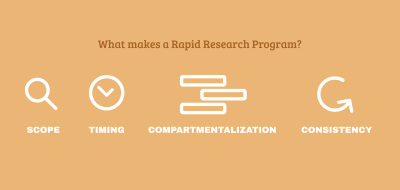
The engine of any effective Rapid Research program relies on four foundational pillars:
- Scope: Defining boundary conditions for methods, sample sizes, and participant availability.
- Timing: Compressing end-to-end project lifecycles to consistently outpace legacy research models.
- Compartmentalization: Decoupling linear workflows—such as separating project intake from study kick-offs or recruitment from discussion guide creation—to eliminate operational dependencies.
- Consistency: Establishing predictable delivery cadences that stakeholders can reliably integrate into their product development sprints.
Crucially, Rapid Research acts as a vital balancing mechanism within an organization’s insight ecosystem. By offloading evaluative, mid-sized testing projects to a streamlined rapid track, senior researchers are freed from constant firefighting, allowing them to redirect their expertise toward complex, generative discovery work that fuels long-term product strategy.
2. Chronology: A Step-by-Step Implementation Roadmap
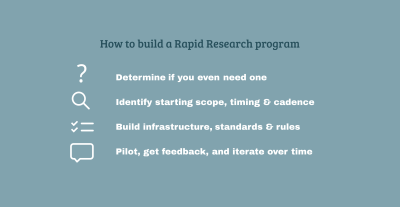
Building a Rapid Research program requires deliberate planning, cross-functional alignment, and iterative refinement. Industry pioneers recommend executing a four-phase chronological roadmap to transition from concept to enterprise-wide implementation.
Phase 1: Needs Assessment and Feasibility Evaluation
Before committing resources, organizations must evaluate whether a Rapid Research program is genuinely required. Teams should audit historical research requests to categorize incoming workloads, identify pain points, and determine if product teams are being left out of the discovery process due to sluggish turnaround times.
- Limitations Check: Stakeholders must acknowledge what Rapid Research cannot do. It is poorly suited for deep generative inquiries, longitudinal diary studies, or highly complex behavioral analyses.
Phase 2: Defining Scope, Timing, and Cadence
Once the need is established, leaders must design the program’s parameters backwards from the organization’s capability gaps:
- Participant Profiles: Identify end-user groups that are broad enough to recruit easily yet specific enough to yield valuable feedback. Testing panel incidence rates early prevents recruitment bottlenecks.
- Methodologies: Focus primarily on evaluative methods—such as rapid usability testing—that align with standard two-week development sprints.
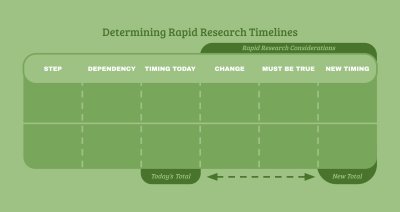
- Timeline Modeling: Document current research steps, dependencies, and timelines. Construct efficiency models to calculate prospective "rapid" timelines, ensuring the new cadence offers a clear, differentiating speed advantage over legacy processes.
Phase 3: Building Infrastructure, Standards, and Rules
With the parameters set, foundational infrastructure must be established before launching pilot projects.
- Buy-In and Governance: Secure executive sponsorship, budget, and legal/compliance alignment early. Establish service-level agreements (SLAs) to manage stakeholder expectations.
- Templating: Create standardized test scripts, feedback forms, analysis matrices, and reporting formats to eliminate redundant setup time.
- Staffing Models: Determine how the program will be resourced. Organizations can leverage dedicated junior researchers, rotate cross-functional team members, or partner with external research vendors to maintain high throughput.
- Coaching and Playbooks: Deploy comprehensive documentation and training sessions to onboard product managers and designers into the rapid workflow.
Phase 4: Piloting, Feedback, and Iteration
No program launches flawlessly. Organizations should treat their first wave of rapid studies as controlled pilots. By embedding continuous feedback loops at every milestone, teams can identify operational friction, refine moderation guides, and progressively compress timelines over a ramp-up period that typically spans anywhere from three months to one year.
3. Supporting Data and Industry Case Studies
The operational viability of Rapid Research is supported by decades of enterprise UX maturation. A notable case study from a major U.S. telecommunications firm illustrates the trajectory: as its UX research team scaled from 4 to over 25 practitioners, the sheer volume of product development requests threatened to overwhelm staff.
Trapped in a reactive cycle of late-stage evaluative testing, senior researchers experienced severe burnout, while generative research ground to a halt. By instituting a dedicated Rapid Research track—initially staffed through trusted external vendor partnerships—the organization successfully restored balance to its research portfolio.
Key Performance Indicators to Track:
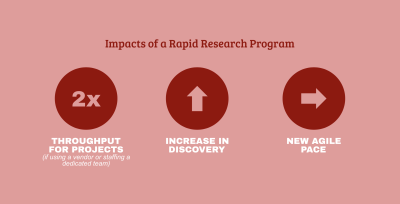
- Throughput: Organizations frequently witness a 100% increase (a doubling) in project throughput when utilizing dedicated rapid teams or vendor-backed models.
- Upstream Usability: Catching usability flaws earlier in the design phase yields exponential savings, with industry data suggesting that fixing issues upstream can reduce remediation costs by up to 100x compared to post-launch redesigns.
- Resource Allocation: A successful program shifts the organizational research ratio, allowing expert researchers to dedicate more bandwidth to foundational, generative discovery.
4. Official Responses and Industry Perspectives
Industry leaders and professional UX organizations have widely endorsed the strategic shift toward operationalized scalability. According to insights from the Nielsen Norman Group, the broader UX practice will continue its massive expansion, making operational sub-disciplines like research operations (ResOps) and rapid methodologies non-negotiable for enterprise survival.
Commentary from leading usability platforms highlights the delicate balance required in participant sourcing. As noted by UserZoom, casting a wide net with generous incentives does not guarantee quality data; hence, Rapid Research programs must prioritize pre-vetted, recurring participant panels to maintain data integrity without sacrificing speed. Similarly, entrepreneurship frameworks emphasize the risk-mitigation value of piloting, noting that early real-time feedback allows product teams to shape solutions safely before commercial deployment.
5. Strategic Implications and Long-Term Outlook
Implementing a Rapid Research program carries profound implications for organizational culture, product velocity, and financial ROI.
The Pros:
- Agile Alignment: Enables end-to-end user testing to occur securely within compressed, two-week development sprints.
- Cost Efficiency: Identifies and resolves friction points before code is written, preserving engineering resources.
- Talent Development: Provides an ideal training ground and mentorship pipeline for junior researchers entering the field.
The Cons:
- Risk of Dilution: Over-relying on rapid, evaluative methods can starve the organization of deep, long-term contextual insights if not carefully balanced against generative studies.
- Operational Overhead: Requires rigorous adherence to standardized templates and consistent scheduling, which can chafe against hyper-creative or unstructured team cultures.
Conclusion:
Ultimately, a Rapid Research program transforms user research from a bottleneck into a strategic accelerator. By approaching program design with high intentionality—balancing scope, timing, compartmentalization, and consistency—organizations can future-proof their UX practices, empower cross-functional teams, and deliver exceptional digital experiences at an unprecedented operational scale.