
In an era where product development cycles move at breakneck speeds, the User Experience (UX) research discipline is undergoing a significant transformation. As organizational reliance on data-driven decision-making expands, traditional research methodologies—often lengthy and resource-intensive—are struggling to keep pace with the iterative demands of agile development. To bridge this gap, forward-thinking organizations are turning to "Rapid Research": a standardized, templated, and highly efficient program designed to deliver actionable user insights within the constraints of a typical product sprint.
The Evolution of Research Scalability
The maturity of the UX practice has necessitated a shift in how insights are gathered. While increasing researcher-to-designer ratios or leveraging big data are viable strategies, Rapid Research stands out as one of the most effective methods for maintaining a consistent cadence of user feedback. By standardizing the research lifecycle, teams can provide stakeholders with high-quality, actionable data at an unprecedented speed, without sacrificing the integrity of the findings.
This approach is not merely about "doing things faster"; it is about optimizing the research ecosystem. By offloading evaluative, repetitive tasks to a streamlined Rapid Research pipeline, senior researchers are freed to focus on complex, long-form generative discovery that drives long-term innovation.
The Anatomy of Rapid Research: Key Pillars
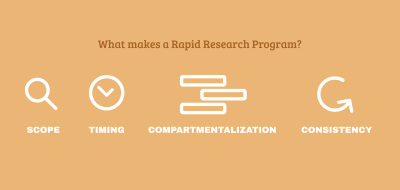
A successful Rapid Research program is built on four foundational pillars: Scope, Timing, Compartmentalization, and Consistency.

Defining Scope and Methodology
Not every research question is a candidate for a rapid approach. Longitudinal diary studies or complex, long-form ethnographic interviews are generally ill-suited for the quick-turnaround nature of a sprint-based program. Success requires a disciplined audit: teams must identify which methods—such as usability testing or quick preference testing—can be templatized effectively.
Sample size and session duration are critical variables. Attempting to conduct 60-minute sessions with 15 participants is often counterproductive to the "rapid" objective. Instead, teams should narrow their focus, utilizing fewer sessions and shorter durations to ensure data synthesis can occur within the necessary window.
Timing and Operational Efficiency
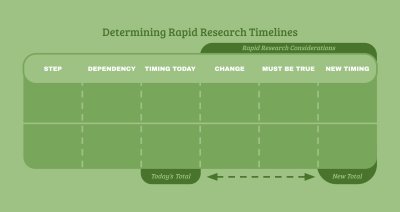
The "rapid" in Rapid Research is defined by the end-to-end timeline. If a program takes the same amount of time as a traditional study, it fails to provide the differentiating value required to support agile teams. Success here often involves "compartmentalization"—breaking the research process into independent, modular workflows. By decoupling project intake from recruitment, or ensuring discussion guides are independent of specific participant demographics, teams can eliminate bottlenecks that traditionally delay progress.
Consistency as a Metric for Maturity
Consistency is the ultimate hallmark of a mature program. Stakeholders must be able to predict exactly when insights will be delivered. If a study takes one week in the first instance and three weeks in the next, the program loses its reliability. A predictable cadence allows for continuous process improvement, as the team can identify recurring friction points and refine the workflow in real-time.
Chronology of Implementation: A Four-Phase Roadmap
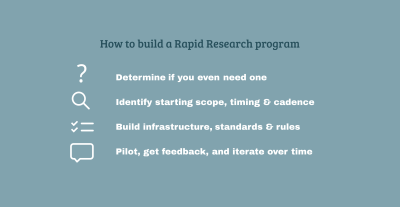
Building a robust Rapid Research program is an undertaking that requires foresight, buy-in, and careful orchestration. Based on industry best practices, the following chronology outlines the journey from inception to implementation.
Phase 1: Needs Assessment and Discovery
Before writing a single template, the first step is to determine if a program is even required. Teams should analyze the last 12 months of research requests. Are the requests mostly evaluative? Are product teams struggling to validate designs because research is "too slow"? By documenting these pain points, you can build a business case that aligns with the organization’s current maturity level.
Phase 2: Building the Framework
Once the need is validated, the focus shifts to infrastructure. This involves identifying participant profiles that can be recruited easily and consistently. It is essential to test the "incidence" of your participant pools; if your target user is too niche, your recruitment time will balloon, effectively killing the program’s speed.
Phase 3: Staffing and Resource Allocation
Rapid Research requires dedicated human capital. Whether you hire junior researchers, utilize existing staff, or partner with external research vendors, you must have a clear staffing model. During this phase, it is vital to secure budget and leadership support. A common pitfall is attempting to run this program on "spare time"; without dedicated bandwidth, the quality of insights will eventually degrade.
Phase 4: The Pilot Program
Never launch a full-scale program immediately. Start with a "pilot" phase using internal stakeholders or close-knit product teams. This allows you to gather feedback, identify bottlenecks in your templates, and adjust your SLAs (Service Level Agreements) before rolling the program out to the entire organization.
Supporting Data and Industry Implications
The impact of a well-implemented Rapid Research program is measurable. Data suggests that integrating research into the front-end of the development process can reduce overhead costs by up to 100x by catching usability issues before they reach production.
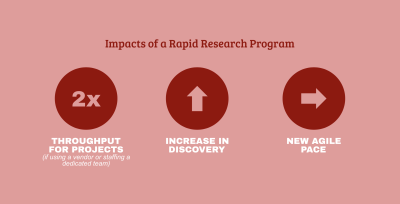
Furthermore, by doubling the throughput of projects, organizations can move from a "gatekeeper" model of research to a "partner" model. In the case study of a major US telecommunications firm, the implementation of a Rapid Research program allowed the team to grow from four practitioners to over 25. This growth was fueled by the program’s ability to satisfy the high demand for iterative validation, while simultaneously creating a talent pipeline for junior researchers to develop their skills.
The "Pros and Cons" of Velocity
It is essential to maintain a realistic view of what Rapid Research cannot do.
Pros:
- Increased Throughput: Facilitates a higher volume of studies per quarter.
- Agile Alignment: Matches the rhythm of 2-week development sprints.
- Cost Efficiency: Maximizes the output of existing research resources.
Cons:
- Limited Depth: Not intended for deep-dive, exploratory, or generative research.
- Risk of "Checkbox" Research: If not monitored, teams may rely on rapid insights for decisions that actually require more nuanced investigation.
- Operational Intensity: Requires a significant initial investment in template creation and process management.
Official Guidance: When to Use the Program
Leadership must provide clear guidance to product partners. Rapid Research should be the "go-to" for:
- Evaluative Usability Testing: Validating specific UI interactions or flows.
- Preference Testing: Choosing between two design variations.
- Concept Validation: Rapidly gauging initial reactions to a new feature idea.
Conversely, it should not be used for strategic discovery, complex behavioral studies, or high-risk architectural decisions where deep, qualitative understanding is paramount.
Implications for Organizational Growth
The shift toward Rapid Research signals a broader trend: the democratization of human insights. As businesses continue to prioritize customer-centricity, the ability to "test and learn" at speed becomes a competitive advantage.
The most successful programs are those that evolve. They are not static documents but living systems that are reviewed quarterly. By tracking the impact of these insights—such as the number of design iterations informed by research or the reduction in post-launch usability bugs—research leaders can demonstrate tangible ROI. This, in turn, secures the long-term funding and cultural buy-in necessary to sustain the program.
In conclusion, while the setup of a Rapid Research program can take anywhere from three months to a year, the long-term payoff is a research practice that is not only scalable but essential to the organization’s innovation engine. By starting with intention, maintaining a focus on consistent quality, and iterating based on stakeholder feedback, your team can transform research from a bottleneck into a catalyst for growth.