SAN FRANCISCO — For over a decade, venture capital and B2B SaaS playbook fundamentals remained as rigid as scripture. Startups aspired to follow the legendary "triple, triple, double, double, double" revenue path. Gross margins were expected to comfortably clear 80%. Headcount efficiency was tracked meticulously, and gross retention was treated as a secondary metric behind net revenue retention (NRR).
That world has officially evaporated.
In a landmark release, investment heavyweight ICONIQ has published The Pacesetter Index, replacing its legacy Enterprise Five Scorecard. Analyzing quarterly financial and operating data from top public software companies alongside ICONIQ’s private venture and growth portfolio from 2024 through Q2 2026, the index establishes a brand-new benchmark. Rather than looking at the industry average—a metric often dragged down by stagnant legacy players—the Pacesetter Index focuses exclusively on what venture capitalists actually want to fund: the absolute elite.
To qualify as a "Pacesetter," a company must clear a strict dual filter: it must achieve top-quartile revenue growth over the past three years while simultaneously operating as an AI-native or AI-driven enterprise. The resulting dataset provides a raw, unvarnished look at how artificial intelligence has rewritten the laws of physics for software economics.
Main Facts: The New Reality of Venture-Backed Software
The Pacesetter Index shatters long-held assumptions about how venture-backed tech companies scale, burn cash, and retain customers. The data reveals that the top tier of AI-native startups is growing at velocities previously thought mathematically impossible at scale, while simultaneously accepting structural compromises—such as lower early gross margins and higher gross churn—that would have disqualified them from funding in previous cycles.
Key foundational takeaways from the index include:
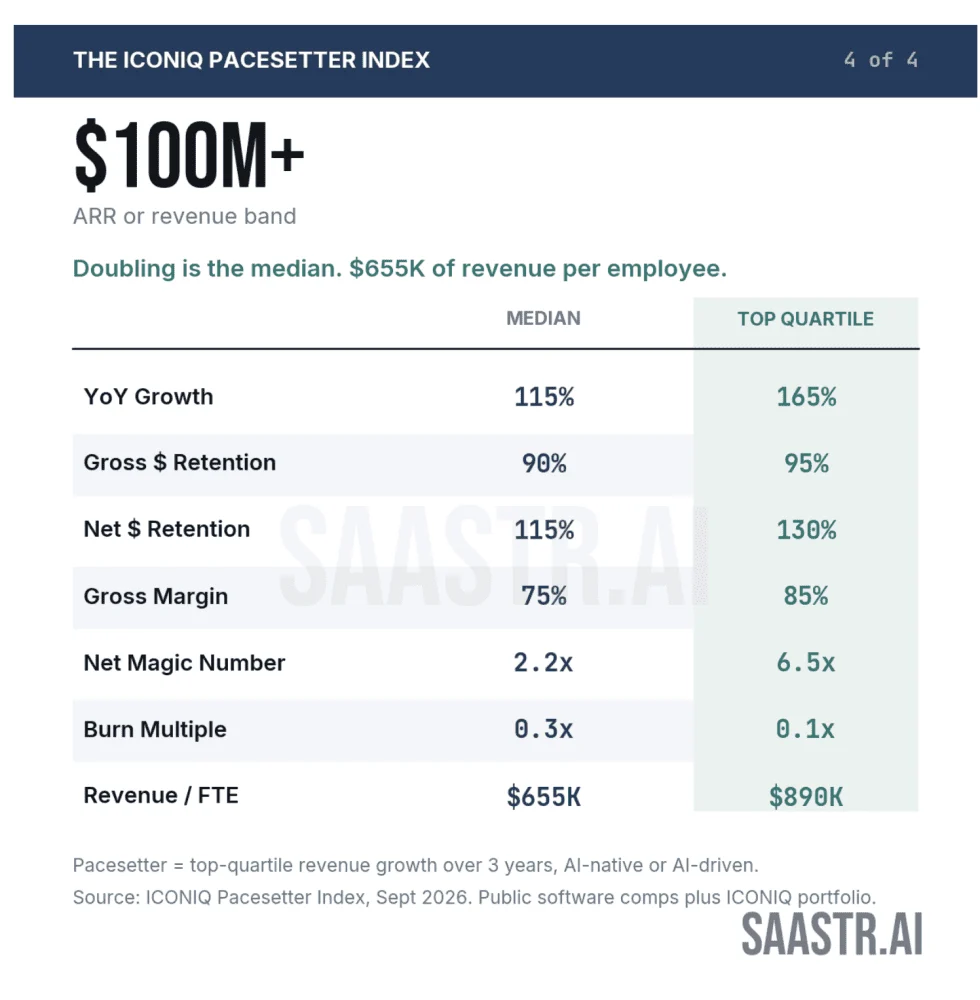
- Hyper-Growth at Scale: The median growth rate for a Pacesetter company generating over $100 million in Annual Recurring Revenue (ARR) is a staggering 115%.
- The Death of 80% Gross Margins: Early-stage AI companies routinely start with gross margins around 55%, heavily weighed down by intensive compute and infrastructure costs.
- Extreme Capital Efficiency (Eventually): While burn multiples peak during the $10M–$25M scaling phase, mature Pacesetters at the $100M+ mark operate with an astonishing revenue-per-employee median of $655,000.
- The Gross Retention Leak: Gross dollar retention drops to 90% at scale, highlighting a hyper-competitive market where lightning-fast procurement cycles cut both ways.
Chronology: The Evolution from Scorecard to Pacesetter Index
To understand why this index marks a watershed moment, one must trace the recent timeline of venture capital benchmarks:
- Pre-2023 (The Era of Traditional SaaS): B2B software scaling was defined by predictable growth decay curves. Companies could reliably forecast a descent from 300% to 150%, then 90%, and 60% growth. Gross margins consistently sat near 80%, and headcount bloated linearly with revenue.
- 2023–2024 (The Generative AI Gold Rush): The market experienced an explosive influx of AI wrappers and foundational applications. Early-stage valuations skyrocketed based on velocity alone, but metrics were messy, leaving investors struggling to separate sustainable business models from speculative hype.
- Late 2024–2025 (The Infrastructure Squeeze): As companies scaled past the $10M and $25M ARR marks, the true cost of inference, heavy cloud computing, and GPU cluster management materialized. Venture capitalists began panicking over compressed gross margins and unsustainable burn multiples.
- September 2026 (The Pacesetter Index Launch): ICONIQ officially retires the Enterprise Five Scorecard, consolidating multi-year data from 2024 through mid-2026. By filtering specifically for AI-native companies exhibiting top-quartile revenue growth, the firm codifies a completely new operational framework for the modern software era.
Supporting Data: The Top 8 Findings Breakdown
An analysis of the eight core pillars of the Pacesetter Index illustrates just how radically financial profiles have shifted across different ARR bands.
1. 115% Growth Is the Median at $100M+
Historically, a company crossing $100M in ARR while doubling its revenue was a once-in-a-decade unicorn outlier. In the Pacesetter cohort, it is merely the median, with the top quartile hitting 165%. More importantly, AI-native companies are defying historical growth decay curves. By continuously landing usage-driven expansion revenue fast enough, they are actually bending the decay curve upward for extended stretches as they mature.
2. 900% Median Growth Under $10M ARR
At the earliest stages, the numbers border on hyper-inflationary. The median growth rate for Pacesetters under $10M ARR is 900%, with the top quartile reaching a mind-boggling 2,600%. While small-number math plays a role (scaling from $400K to $4M on a handful of enterprise logos), it underscores a brutal reality for founders: a $2M ARR company growing at 200%—once considered an exciting, easily fundable asset in 2023—is now comfortably below the median.
3. Gross Margins Start at 55%, Not 80%
The golden rule of enterprise software used to be that anything under 75% to 80% gross margin signaled a glorified services shop. For AI-native products, that rule is dead. The median gross margin under $10M ARR sits at 55%, inching up to 60% in the $10M–$25M band. However, this is a transitional valley. As inference costs are optimized, contracts are repriced, and workloads shift, margins recover aggressively, climbing back to standard software health (75%–80%) by the time companies scale past $25M.
4. Gross Retention Falls to 90% at $100M+
One of the most sobering insights in the index is the inclusion of gross dollar retention (GDR). At the $100M+ mark, median GDR drops to 90%, meaning one-tenth of the revenue base churns out every single year—even among the industry’s best-performing companies. The same frictionless dynamics that allow AI startups to close deals and deploy proofs-of-concept (POCs) in weeks also empower nimble competitors to poach those exact accounts just as quickly.

5. Net Revenue Retention Peaks in the Mid-Market
The Net Revenue Retention (NRR) trajectory traces an unconventional path: 105% (under $10M ARR), peaking at 125%–130% in the mid-market bands ($10M–$100M), before dipping back to 115% at scale. The low early NRR (105%) dismantles the myth that consumption pricing automatically translates to instant expansion; early pilots frequently stall before expansion motions are properly engineered.
6. Burn Multiples Peak at 1.8x Between $10M–$25M
Capital efficiency is not linear. Pacesetters experience their most painful financial stretch in the $10M–$25M ARR bracket, where the median burn multiple balloons to 1.8x. Founders here are trapped in a capital-intensive squeeze, funding go-to-market (GTM) expansions and massive compute bills simultaneously before efficiency catches up. Once past $25M, the burn multiple collapses to 0.9x, and drops to an elite 0.3x at $100M+.
7. $655K in Revenue Per Employee at $100M+
This is perhaps the ultimate financial fingerprint of the AI era. While traditional SaaS companies historically praised themselves for reaching $200K to $250K in revenue per full-time employee (FTE), the median Pacesetter at $100M+ generates $655,000 per employee, with the top quartile hitting $890,000. For a $200M ARR company, this efficiency gap translates to running a lean operation of roughly 305 employees instead of an 800-person bloated workforce.
8. A 3.4x Magic Number at $5M ARR Signals Danger
While early-stage net magic numbers hit a dazzling median of 3.4x (and a staggering 7.7x for the top quartile), ICONIQ issues a stark warning. Exceptional early magic numbers often do not reflect operational genius; instead, they frequently mask dangerous underinvestment in a full sales and GTM team—a strategic shortcut that many AI founders ultimately live to regret as market competition intensifies.
Official Responses and Industry Context
Venture capital leaders and operators have seized upon the Pacesetter Index as a much-needed reality check for an industry grappling with the disruptive economic realities of artificial intelligence.
"We are looking at a fundamental restructuring of what a software business looks like on a balance sheet," notes commentary surrounding the index release. While legacy venture metrics were built on predictable, low-cost code replication, the AI era introduces heavy, variable infrastructure costs that change unit economics from day one.
Industry analysts emphasize that venture firms are no longer blindly writing checks for top-line growth alone. The focus has shifted toward a nuanced evaluation of how that growth is achieved: demanding clear pathways to 75%+ gross margins, monitoring gross retention leaks closely, and evaluating whether early capital efficiency is the result of true leverage or simply a failure to build out necessary enterprise sales infrastructure.
Implications: What the Pacesetter Index Means for Founders and Investors
The publication of ICONIQ’s Pacesetter Index acts as both a tactical roadmap and a cautionary tale for the tech ecosystem moving forward.
For founders, the bar has been raised to stratospheric heights. Raising a competitive Seed or Series A round in the AI landscape means outperforming yesterday’s historical medians by orders of magnitude. Founders can no longer hide behind low gross margins indefinitely; they must present boards with concrete models mapping out how infrastructure optimization will drive gross margins back toward traditional software health. Furthermore, ignoring the gross retention leak—or relying entirely on net expansion while the foundational customer base erodes—will trigger immediate skepticism during institutional due diligence.
For investors, the index provides a sophisticated lens through which to evaluate modern software assets. It proves that negative free cash flow is not necessarily a fatal flaw if it is being aggressively converted into high-velocity ARR via AI-driven operating leverage. However, it also demands rigorous interrogation of mid-stage burn multiples and early-stage magic numbers.
Ultimately, the Pacesetter Index confirms that the AI revolution has birthed a new breed of software company—one characterized by blinding speed, extreme employee leverage, and entirely unprecedented operational trade-offs. The rules have changed, and those who fail to adapt their financial models to the new benchmarks risk being left behind in the old SaaS graveyard.