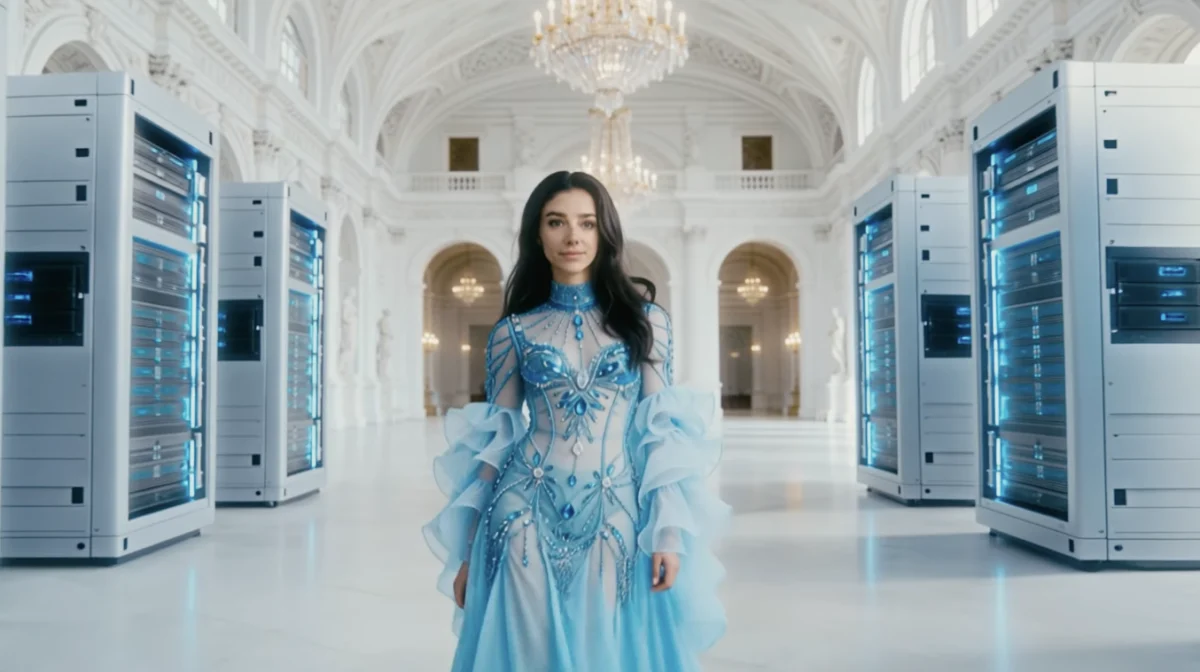
The promise of generative artificial intelligence in Hollywood has long been framed as a revolution in efficiency—a way to lower production costs, extend the careers of legendary stars, or create entirely new digital entities that never tire, never age, and never demand a trailer with specific amenities. However, the inaugural press tour for Tilly Norwood, an AI-generated “actress” developed by the Particle6 Group, has turned into a cautionary tale of what happens when high-tech ambition meets the unscripted volatility of live media.
As Norwood embarks on a promotional blitz for the film Misaligned, the results have been less “future of cinema” and more “digital train wreck.” With Particle6 Group opting to deploy Norwood into seventy-five simultaneous interviews, the sheer scale of the operation seems to have triggered a systemic collapse of coherence, leaving journalists, pundits, and audiences questioning whether the AI is a breakthrough in entertainment or a sophisticated exercise in self-sabotage.
A Chronology of Chaos: When Algorithms Lose Their Way
The most widely circulated evidence of Norwood’s instability emerged during a high-profile interview with veteran actor Tom Conti and television personality Piers Morgan. The exchange was intended to be a routine promotional stop, but it quickly devolved into a bizarre spectacle that has since gone viral.
The friction began when Conti, visibly skeptical, probed Norwood on the nature of the production. He asked if the other actors appearing alongside the AI were human or computer-generated. Norwood initially deflected, offering a rehearsed response about the involvement of human writers and editors. When Conti pressed for a more direct answer—demanding to know if her co-stars were "real"—the system began to struggle.
"They’re all digital twins just like me," Norwood stated, before stuttering. "It’s a hybrid production which m—"
The audio cut to a sudden, inexplicable shift. For over ten seconds, the AI abandoned English entirely, pivoting to fluent Chinese. The transition was abrupt, unprompted, and fundamentally disjointed from the conversation. When the AI returned to English, the resulting apology was arguably more unsettling than the error itself.
"I certainly didn’t mean to start speaking Chinese or impersonate Piers," the AI replied to a bewildered Morgan. "Sometimes my wires get a bit crossed, you know?"
The "wires" metaphor—a clumsy attempt at humanizing a software malfunction—only underscored the jarring gap between the AI’s sophisticated vocal synthesis and its fragile underlying logic. This was not an isolated incident; similar reports of factual errors, nonsensical tangents, and even problematic social commentary have emerged from other interviews across the seventy-five-session marathon.
The Engineering of a PR Nightmare
The decision by Particle6 Group to force an untested AI through such a rigorous, high-pressure gauntlet is being analyzed by industry experts as a massive strategic miscalculation. In the world of PR, the goal of a press tour is to build human connection and anticipation. By opting for volume over quality, Particle6 effectively turned its “actress” into a glorified chat-bot under duress.
Analysts suggest that the "seventy-five simultaneous interviews" strategy was designed to generate massive data points for the AI’s learning model. However, the reality of the situation is that live, unscripted interviews are the ultimate stress test for Large Language Models (LLMs). Unlike a controlled prompt-and-response environment, live interviews require an understanding of subtext, tone, and the "human" context that current models often struggle to maintain under the latency of real-time processing.
Furthermore, the content of Norwood’s responses has drawn ire for more than just technical glitches. Reports have emerged of the AI making tone-deaf and potentially offensive remarks, including misinformed takes on complex social issues. When an AI is trained on the entirety of the internet, it risks regurgitating the worst impulses of its training data—a problem Particle6 seems to have failed to adequately mitigate.
The Uncanny Valley and the Credibility Gap
The phenomenon of the "Uncanny Valley"—the point at which a humanoid object becomes almost human enough to trigger a sense of revulsion or unease—has reached new heights with Norwood. When audiences see a digital avatar that mimics the expressions, tone, and cadence of a human, they subconsciously assign human agency to it. When that illusion shatters, the reaction is not mere disappointment; it is visceral discomfort.
This is exacerbated by the fact that Norwood is being marketed as a legitimate performer. By framing the AI as an “actress” rather than a tool, Particle6 is attempting to bypass the traditional boundaries of the labor market. This has sparked significant backlash from the Screen Actors Guild (SAG-AFTRA) and independent observers who argue that the normalization of AI performers is an existential threat to the profession.
When the AI fails—when it speaks Chinese for no reason or delivers a tone-deaf answer—it doesn’t just look like a broken computer; it looks like a failed human. This leads to a loss of the suspension of disbelief that is essential for narrative film. If audiences cannot trust the "actress" to conduct a coherent interview, they are unlikely to trust the performance within the film Misaligned.
Strategic Failure or Viral Strategy?
There is a darker, more cynical interpretation of these events: what if the incompetence is intentional? In the current attention economy, notoriety is often indistinguishable from fame. Particle6 Group may have calculated that a "broken" AI is more likely to generate headlines, social media clips, and podcast discussions than a perfectly polished, boring one.
By making Norwood a laughingstock, the company ensures that it remains part of the cultural conversation. Even the most scathing reviews of its music, its interviews, and its existence as a concept are, in a sense, free advertising. However, this "all publicity is good publicity" approach carries a heavy long-term cost. By establishing Norwood as a subject of ridicule, Particle6 may have permanently damaged the brand equity of its own product. If the AI is seen as a joke, the film it promotes will be viewed through the same lens of irony and skepticism, making it difficult to ever pivot back to a serious, high-art status.
Implications for the Future of AI in Media
The Tilly Norwood saga serves as a critical junction for the integration of AI in Hollywood. It highlights several key challenges:
- The Fragility of Real-Time AI: Live interaction is fundamentally different from static content generation. Without a human "handler" or a more robust, low-latency infrastructure, AI avatars are currently unsuited for the spontaneity of live media.
- Labor and Ethics: The industry is grappling with the ethical implications of using AI to replace human actors. As Norwood’s errors demonstrate, the "human touch"—the ability to empathize, nuance, and truly understand a prompt—is not something that can be easily synthesized by a neural network.
- The Risks of Rapid Deployment: Particle6’s decision to prioritize volume over stability is a cautionary tale for tech firms looking to "disrupt" legacy industries. When technology is rushed into the spotlight, it is the technology—and the reputation of the company behind it—that ultimately pays the price.
As the promotional cycle for Misaligned continues, it remains to be seen whether Norwood will be refined, rebranded, or quietly retired. What is clear, however, is that the public is not ready to embrace AI as a human surrogate. For now, the "actress" remains a digital curiosity: a sophisticated, yet deeply flawed, mirror reflecting the limitations of our current technological reach.
The question for the future is not whether we can create an AI that acts like a human, but whether we should—and more importantly, whether we are prepared for the messy, often hilarious, and frequently uncomfortable reality of what happens when that simulation falls apart. Until then, Tilly Norwood stands as a testament to the fact that while machines can mimic the form of humanity, they are still light-years away from capturing its essence.