Main Facts: The Reality Check for Enterprise Marketing
As the marketing industry marks three years of widespread experimentation with generative artificial intelligence, a stark realization is setting in across boardrooms. While enterprise organizations have successfully unlocked isolated pockets of efficiency, an overwhelming number of marketing departments find themselves trapped in a cycle of accumulating tool subscriptions while team frustration mounts.
The core issue stems from a persistent chasm between AI’s grand promises and its practical, measurable value. Countless "AI best practices" circulate within digital marketing circles, yet few can be traced back to definitive business outcomes. Meanwhile, the broader digital ecosystem is shifting dramatically: traditional organic traffic and click-through rates are in a steep, well-documented freefall, driven by algorithmic changes and the rise of AI-generated summaries in search engines.
Despite these headwinds, industry leaders argue that AI remains an invaluable force multiplier for talented teams. When deployed with strategic intent, artificial intelligence can streamline arduous research phases, tighten collaborative workflows, and empower creators to ship higher-quality content at scale. However, the path forward requires dismantling deeply ingrained misconceptions regarding what generative AI can realistically achieve for content programs.
By cutting through the extreme polarities of uncritical hype and outright skepticism, marketing directors can finally establish a clear, disciplined framework for the year ahead.
Chronology: The Three-Year Evolution of AI in Content Marketing
To understand where corporate marketing stands today, it is essential to trace the rapid evolution of generative AI tools over the past three years:
- Year 1 (The Wild West of Experimentation): Following the mass availability of powerful large language models, marketing teams rushed to adopt generative tools. The initial phase was characterized by decentralized experimentation, where individual creators used AI to generate everything from social media snippets to complete blog posts with minimal oversight.
- Year 2 (The Tool Accumulation Trap): As software vendors flooded the market with specialized AI applications, organizations began layering multiple subscriptions onto their existing tech stacks. Instead of achieving seamless productivity, teams encountered workflow fragmentation, brand voice dilution, and mounting administrative overhead.
- Year 3 (The Reckoning and Search Disruption): The current phase is defined by strategic consolidation and a search landscape upended by zero-click AI overviews. Organizations are realizing that raw content volume no longer translates to pipeline growth. The focus has decisively shifted from unbridled creation speed to editorial rigor, brand differentiation, and AI-search visibility.
Supporting Data: The Metrics Driving the Strategy Shift
The urgency to revise corporate AI strategies is supported by compelling empirical research from across the digital marketing ecosystem:
- The Click-Through Deficit: According to comprehensive 2025 research from Ahrefs, the introduction of AI Overviews in search engines has directly reduced outbound clicks to top-ranking organic pages by a staggering 34.5%.
- The Volume Paradox: While modern content teams can publish at unprecedented speeds, internal metrics consistently show that unedited, high-volume AI output fails to convert at the same rate as human-crafted, perspective-driven narratives.
- The Adoption Learning Curve: Industry benchmarks indicate that realizing tangible productivity gains from enterprise AI tools requires a structured investment of two to four weeks dedicated specifically to team training, prompt engineering, and collaborative workflow integration.
Official Perspectives: Navigating the Balance of AI and Expertise
Industry analysts and content operations experts emphasize that technology alone cannot rescue a flawed marketing foundation. According to enterprise content strategists, the most successful organizations view AI not as a replacement for human intellect, but as an operational assistant that handles mechanical tasks while leaving strategic direction and creative voice firmly in human hands.
Compliance and quality assurance have also taken center stage. As regulatory scrutiny increases across specialized verticals—such as finance, healthcare, and legal services—brands are discovering that generic AI text introduces dangerous compliance risks. Industry leaders stress that human oversight, fact-checking, and accredited editorial review are no longer optional best practices; they are foundational requirements for enterprise survival.
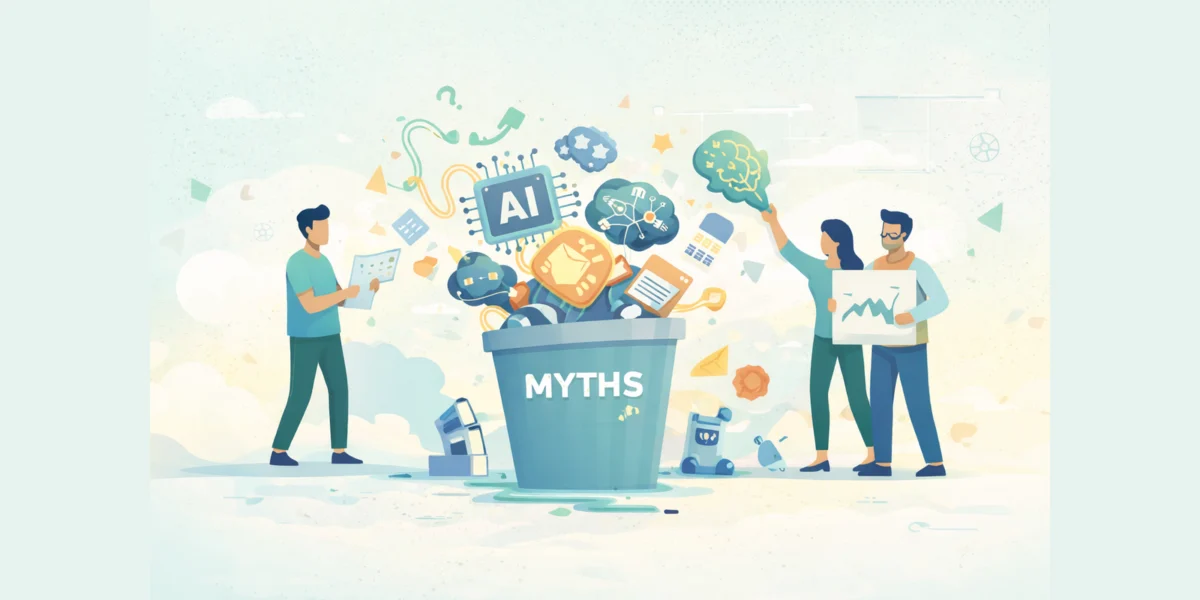
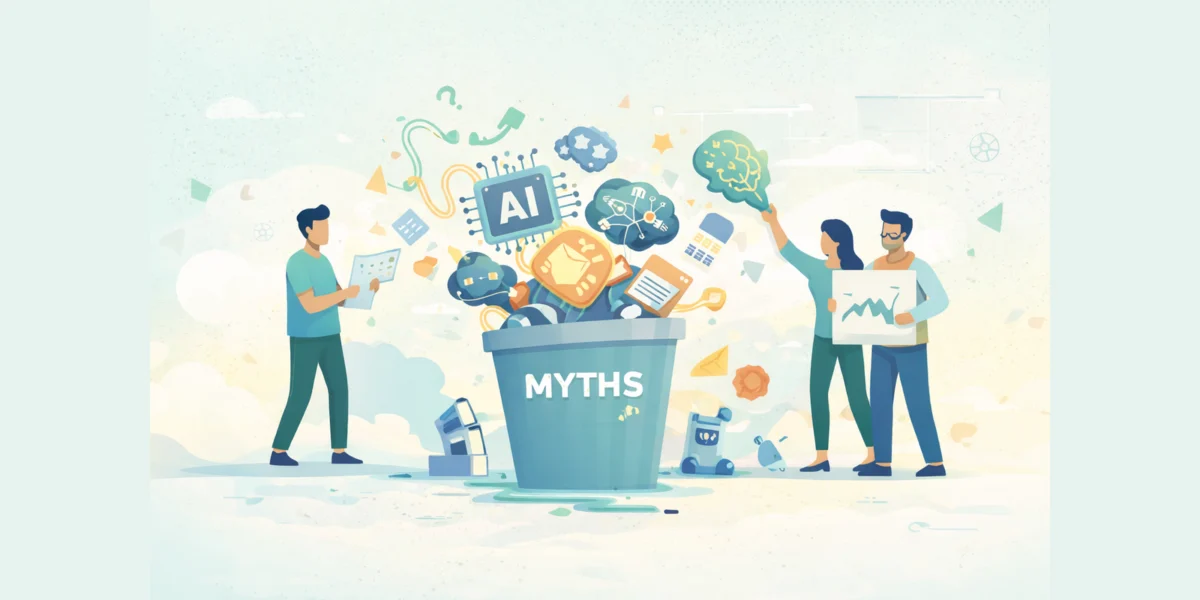
Implications: Five Myths to Leave Behind
To navigate the evolving digital landscape successfully, organizations must systematically dismantle five pervasive myths that continue to hinder marketing performance.
Myth 1: More AI Tools Automatically Mean More Efficiency
On paper, the logic appears unassailable: add more AI capabilities, accomplish more work. In practice, however, many marketing departments experience the exact opposite effect. Rather than replacing manual steps, teams frequently layer disparate tools on top of one another, creating workflow silos and cognitive fatigue.
True efficiency does not stem from collecting standalone applications; it emerges from connected workflows. When AI capabilities are embedded natively within the environments where daily work already takes place—such as creative briefs, content management systems, and editorial calendars—the productivity gains become apparent.
- What works: Before procuring any new software, map your organization’s end-to-end content process. Identify genuine bottlenecks that AI can realistically alleviate, consolidate redundant subscriptions, and invest in comprehensive training programs to ensure your team maximizes the platforms they already utilize.
Myth 2: AI Content Performs Just as Well on Its Own
We are living in an era of unprecedented content abundance. Publishing volume is at an all-time high, but the primary challenge has shifted from production capability to audience trust.
Performance now hinges on distinct expertise, lived experience, and unique perspective. Search engines and discerning readers alike actively search for signals of human authorship. Left unguided, generative AI naturally defaults to the safest, most generalized version of an idea—producing grammatically correct copy that lacks the narrative power required to drive conversions.
- What works: Treat AI as a collaborative partner for preliminary tasks such as background research, outline generation, and first-draft creation. Then, apply rigorous human editing to inject factual accuracy, proprietary brand voice, storytelling depth, and strategic differentiation.
Myth 3: AI Will Solve Bad Strategy
Artificial intelligence is a powerful accelerator of execution, but it possesses zero capacity to fix fuzzy market positioning or misaligned business objectives. In marketing, speed invariably amplifies direction—including the wrong direction.
Organizations frequently utilize AI to scale production rapidly, only to discover that core performance metrics remain stagnant. Traffic may experience a temporary lift, but if the underlying content fails to address genuine buyer pain points or provide a clear path to conversion, visibility simply evaporates before reaching the sales pipeline.
- What works: Establish crystal-clear messaging, target audience definitions, and conversion pathways before attempting to scale content production. Only then should you deploy AI to execute a strategy that is already pointed toward measurable business goals.
Myth 4: Everyone Needs to Adopt AI for Everything Immediately
Fear of missing out (FOMO) frequently drives reactionary technology investments. Too often, organizations adopt complex AI suites simply because competitors are doing so, rather than solving a clearly identified operational friction point.
Successful AI adoption is deliberate and methodical. High-performing teams begin by isolating a single, high-impact use case, defining precise success metrics, and executing a controlled pilot program before considering broader enterprise rollout.
- What works: Run localized pilots to test specific workflows. Document performance improvements and shortcomings meticulously, and expand your AI integration incrementally based on proven empirical results rather than industry hype.
Myth 5: AI Search Is Basically the Same as SEO
Traditional search engine optimization relied heavily on site architecture, keyword density, and backlink profiles. However, AI-powered search engines operate under fundamentally different mechanics, utilizing language models to synthesize and rewrite information across multiple distinct sources.
Because AI Overviews and conversational assistants directly summarize answers, ranking well on a traditional search engine results page no longer guarantees visibility or organic traffic. Success in AI search requires structured data, clear entity definitions, and rich, context-driven content formats that AI models can easily parse and cite.
- What works: Maintain foundational SEO best practices while layering optimizations designed specifically for AI visibility—including robust schema markup, definitive entity definitions, and direct, question-driven formatting.
Frequently Asked Questions (FAQs)
How do I know if my team is ready for AI adoption?
Assess your current content operations maturity before introducing new technologies. If your department operates with documented workflows, established brand guidelines, and consistent publishing cadences, you are well-positioned to pilot AI tools. If your baseline operations remain chaotic, strengthen those fundamental processes first.
What’s the minimum investment needed to see results from AI?
Many organizations can begin utilizing AI features included within their existing content platforms at no additional financial cost. The true investment lies in time: budget two to four weeks of dedicated training for prompt engineering and editorial oversight to realize genuine productivity improvements.
How should I balance traditional SEO with AI Search optimization?
Treat traditional SEO and AI search optimization as complementary forces. Continue cultivating topical authority, technical site performance, and quality backlinks, while simultaneously layering on AI-specific enhancements such as structured data markup, entity definitions, and direct-answer content structures.