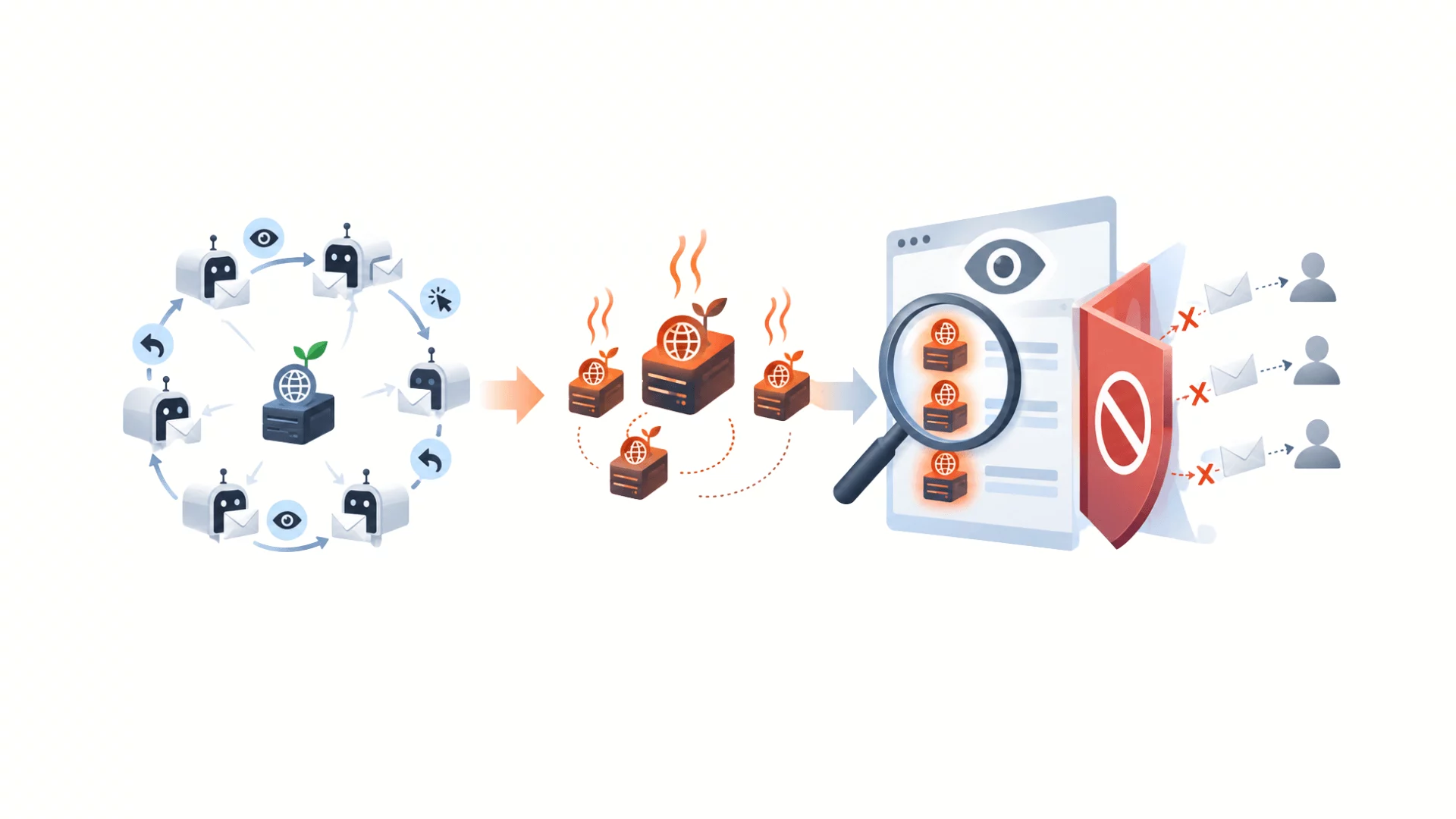
GLOBAL — In an aggressive move to restore trust to the digital inbox, email data and deliverability giant Validity has officially launched Heatwave, a specialized domain blocklist engineered specifically to hunt down, expose, and neutralize deceptive cold email operations. Announced on September 3, 2025, Heatwave targets one of the most pervasive abuses plaguing modern email infrastructure: synthetic domain warming.
Powered by the vast telemetry of the Validity Intelligence Network and hosted publicly at lookup.validity.tools, Heatwave represents a paradigm shift in how the email security community handles bad actors. Unlike traditional IP-based blocklists that hide behind closed partner doors, Validity has laid its cards on the table, offering a transparent, publicly queryable database designed to disrupt the mass-automation industrial complex that bombards corporate and personal inboxes daily.
1. Main Facts: Deconstructing Heatwave
At its core, Heatwave is not a traditional blocklist that targets spam-sending Internet Protocol (IP) addresses. Instead, it targets the sending domains themselves, tracking the lifecycle of an email campaign from its deceptive infancy to its active execution.
What is Synthetic Domain Warming?
The primary trigger for a Heatwave listing is "synthetic reputation warming"—often referred to in the industry as domain warming fraud. When cold email operators want to launch massive outbound campaigns, mailbox providers (like Gmail, Microsoft, and Yahoo) will quickly flag and block brand-new domains that suddenly start sending thousands of emails.
To bypass these security filters, bad actors deploy automated networks of controlled mailboxes. These bots systematically exchange artificial messages, open emails, click links, and reply to each other. This manufactured engagement artificially pumps up the domain’s reputation score, making a completely new, untrustworthy domain look like an established, legitimate sender before any real human outreach ever begins.
How the Listing Mechanism Works
Heatwave operates on an automated scoring threshold built upon three pillars:
- Domain Age: Identifying newly minted domains created specifically for short-term outreach.
- Infrastructure: Spotting suspicious DNS configurations, shared registrars, and patterns common among cold-email agencies.
- Message Characteristics: Detecting the linguistic and structural signatures of automated warming scripts.
Once a domain crosses the threshold, it is automatically flagged. The system tracks a domain through two distinct phases:
- The Warming Phase: The domain is flagged for synthetic reputation manipulation.
- The Active Outreach Phase: When the warmed domain is detected sending live cold-email campaigns to real recipients, its record is updated to "active outreach."
Crucially, if the operator halts outreach, that active flag can be reverted, but the underlying historical record of synthetic warming remains permanent. Validity emphasizes a vital caveat: a domain sending cold emails without any detected warming history falls outside Heatwave’s scoring scope, regardless of what the "Cold Email Domain Blocklist" label in the footer might imply.
Unique Capabilities: Related-Domain Discovery and Pre-Listing
Heatwave introduces two advanced investigative features that set it apart from legacy blocklists:
- Related-Domain Discovery: When security analysts or victims search a primary domain, Heatwave surfaces lookalike domains tied to the same warming infrastructure. Often, these are secondary domains registered automatically when a brand connects to a third-party sales or marketing tool—sometimes buried layers deep in a complex subcontractor chain. Validity advises organizations to audit their sales and marketing stacks when a related domain is flagged, rather than instantly assuming a false positive.
- Pre-Listing: When Validity identifies an entire family of domains operated by the same entity for warming purposes, un-launched domains within that same family can be pre-listed before they ever send a single message. These pre-listings are marked as advisory, carry registration dates on the public interface, and drop off automatically if they are severed from the warming cluster.
2. Chronology: The Timeline of a Crackdown
The rollout of Heatwave is the culmination of years of growing frustration among mailbox providers, enterprise security teams, and legacy anti-abuse organizations over the commoditization of automated cold emailing.
- Pre-2025: The Rise of B2B Spam-Tech: The proliferation of AI-driven sales engagement platforms gives rise to massive, outsourced lead-generation agencies. These entities routine-register thousands of domains, deploying automated warming tools to prepare them for blast-campaigns, clogging enterprise networks.
- Early 2025: Industry discussions intensify among groups like M3AAWG (Messaging, Malware and Mobile Anti-Abuse Working Group) regarding the need for standardized detection of synthetic warming networks. Organizations like SURBL lead early anti-abuse responses against deceptive cold email infrastructure.
- September 3, 2025: Validity formally announces the launch of Heatwave, publishing the database at
lookup.validity.toolsand integrating the signal into its existing DNS reputation zones. Major industry figures praise the initiative in the press release. - September 10, 2025: Just one week post-launch, metrics reveal the sheer scale of the operation: the public counter logs 1,052,595 domains listed, with 6,981 new domains added in the preceding 24 hours alone. The system processes an astounding 14.7 million trap signals, refreshing its database every five minutes.
3. Supporting Data & Metrics
While a million-plus listings sounds staggering, industry veterans note that Heatwave is part of a broader ecosystem rather than an all-encompassing oracle.
Compared to established domain blocklists like SURBL—which has tracked deceptive cold email infrastructure for many years—Heatwave’s current tally of roughly 1.05 million domains is relatively modest. Validity makes no claims of absolute completeness. A "not currently listed" search result is not a clean bill of health or a certification of safety, and lookups require exact-match precision.
However, the power of Heatwave lies in collective intelligence and cross-referencing. Industry experts note that major bad actors typically operate sprawling webs of hundreds of interconnected domains.
4. Official Responses & Industry Perspectives
The email security ecosystem has rallied behind Heatwave, viewing it as a vital collaborative weapon against bad actors who treat domain reputation as disposable.
Raymond Dijkxhoorn, co-founder of pioneering anti-abuse blocklist SURBL and a vocal advocate for inbox hygiene, highlighted the interconnected nature of modern spam rings:
"We see the same actors across hundreds of domains. Heatwave is one more independent view of that infrastructure, and each one makes it harder for operators to move. For the same actors, we typically find 15 to 20 times as many domains as Validity does, so overlap matters more than count."
The launch release also featured strong endorsements from a cross-section of industry leaders, including Tom Bartel (Validity and M3AAWG Board Chair), Alex Brotman (Comcast), Carel Bitter (Spamhaus), and Mariska Calabrese (beehiiv).
Validity has deliberately adopted a restrained posture regarding how security administrators should use the tool. Rather than mandating automated hard blocks across the board, Validity’s official guidance advises enterprises to:
- Filter at their own discretion.
- Incorporate the signal into vendor and partner onboarding checks.
- Treat the listing not as an infallible verdict, but as "Validity’s measured opinion" backed by transparent telemetry.
5. Implications: What Heatwave Means for Marketers, Vendors, and Defenders
The deployment of Heatwave carries profound implications for multiple segments of the digital marketing and cybersecurity landscapes.
For Legitimate Marketers and Sales Teams
The era of "spray and pray" B2B cold outreach is facing an existential reckoning. Sales engagement platforms that rely on automated domain spinning and synthetic warming will find their infrastructure incinerated almost as fast as they can provision it.
Furthermore, because of Related-Domain Discovery, legitimate enterprises must now exercise rigorous governance over their internal departments and external marketing agencies. If an outsourced lead-generation vendor spins up a sketchy lookalike domain on behalf of a company, that company’s primary brand risk can be compromised. Organizations are now forced to audit what sales and marketing tools are running in their corporate name to avoid collateral damage.
For the Delisting and Transparency Debate
Unlike black-box reputation systems of the past, Heatwave offers unprecedented visibility. Anyone can query a domain on the public web interface, which features three rolling tables:
- Pre-listed domains.
- New warming listings complete with algorithmic scores (a relative band from 1 to 100 recomputed hourly, though it does not drive the listing decision).
- Domains updated to active outreach.
Crucially, warming listings do not expire automatically. Simply turning off the automated warming script will not clear a domain from the database. Delisting requires active intervention through a formal review process. Senders must submit a delisting request via lookup.validity.tools/delist, which undergoes manual analyst review to determine if the original listing was a result of misattribution, corporate impersonation, domain compromise, or naming confusion. Reviews typically take two to five business days.
For the Future of Inbox Defense
With industry heavyweights such as Comcast, Proofpoint, Spamhaus, and SURBL already evaluating or actively utilizing the Heatwave signal, bad actors can no longer easily outrun their digital footprints. By dragging synthetic domain warming out of the shadows and into a public, queryable light, Validity and its partners have raised the cost of bad behavior—turning what was once a profitable, hidden loophole into a high-risk, easily tracked liability.