AMSTERDAM — Email deliverability remains one of the most volatile and complex operational challenges for digital marketers, customer engagement platforms, and enterprise senders alike. Shedding new light on the mechanics of inbox placement, email infrastructure consultancy Postmastery has released the milestone tenth edition of its authoritative Email Delivery Benchmark report. Covering the period from April to June 2026, the comprehensive study offers a rare, data-driven window into the inner workings of major mailbox providers (MBPs) across the globe.
Drawing from a massive empirical dataset of 15.5 billion email transactions dispatched via large-scale Email Service Providers (ESPs), the report meticulously evaluates delivery, bounce, and deferral rates across 15 distinct mailbox providers. While the findings provide an invaluable operational yardstick for enterprise senders, they also underscore the persistent friction points that modern email marketers face when attempting to reach end-users across diverse regulatory and technological ecosystems.
Main Facts: The State of Global Deliverability in Q2 2026
The latest Postmastery benchmark paints a vivid picture of stark contrasts in mailbox provider performance. While major global tech giants process unprecedented volumes of traffic with relative smoothness, legacy providers, regional platforms, and rigorous security gateways continue to introduce substantial friction into the delivery pipeline.
At the macro level, the dataset reinforces that achieving "delivery" is no longer a binary state of sent-versus-failed. Instead, it is governed by a delicate dance of acceptance rates, permanent rejections (bounces), and temporary holds (deferrals)—the latter of which often dictate whether a campaign lands in the primary inbox in real-time or languishes in processing queues for hours.
Key takeaways from the Q2 2026 dataset include:
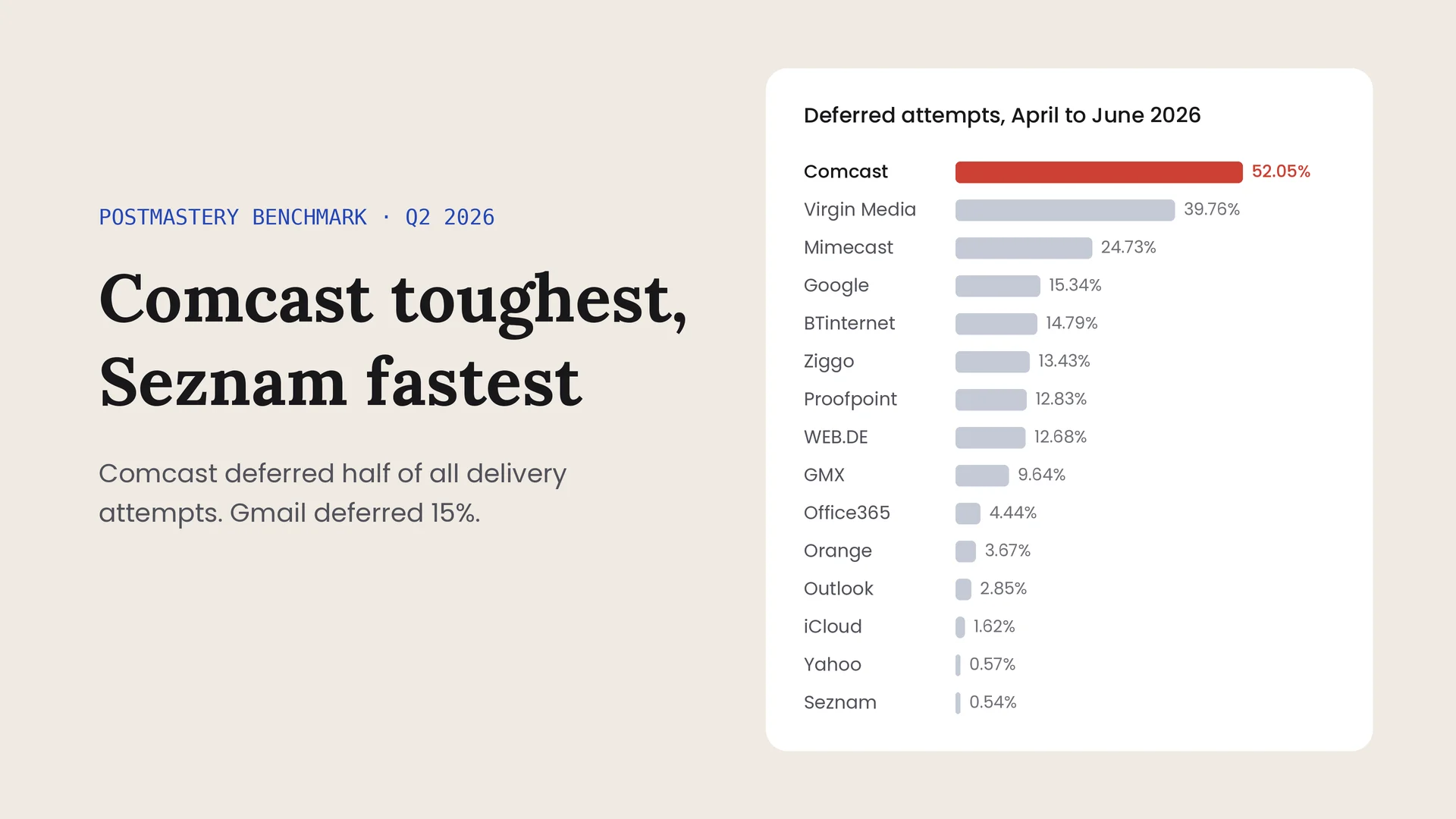
- The Comcast Bottleneck: US telecommunications and cable provider Comcast emerged as the single hardest mailbox provider to deliver to during the quarter, accepting just 88.12% of attempted mail, bouncing 11.88%, and imposing a staggering 52.05% deferral rate.
- The Speed Kings: Czech Republic-based Seznam claimed the top spot for efficiency, successfully delivering 99.95% of mail with a median arrival time of a blistering six seconds. Yahoo closely followed, delivering 99.81% of traffic while deferring a mere 0.57% of attempts.
- Google’s Volume and Caution: Google remains the heaviest juggernaut in the dataset, accounting for 28.5% of all analyzed message volume. While Gmail delivered a respectable 97.66% of its traffic, it deferred 15.34% of attempts, making it the most likely of the "Big Three" providers to instruct senders to "try again later."
- Methodological Nuances: A critical examination of the report highlights the importance of distinguishing between mathematical averages and medians—particularly when evaluating delivery speeds, where statistical outliers can profoundly distort perceived performance.
Chronology: The Evolution of Postmastery’s Benchmark Series
To fully appreciate the significance of the tenth edition of the Email Delivery Benchmark, it is necessary to examine the trajectory of the report series itself. Over the years, email infrastructure has shifted from a relatively straightforward IP-and-domain-reputation model to a highly sophisticated, AI-driven security and filtering matrix.
The Early Editions: Establishing a Baseline
When Postmastery first initiated its benchmarking project years ago, the primary focus of email deliverability was rudimentary spam filtering, feedback loops, and basic authentication protocols like SPF and DKIM. Senders struggled primarily with unauthenticated bulk mail and glaring misconfigurations. However, as bad actors grew more sophisticated, mailbox providers responded by tightening throttle limits, implementing gray-listing, and prioritizing user engagement metrics over pure infrastructure reputation.
Mid-Term Scaling and Big Data
As the benchmark progressed through its middle editions, the volume of data underpinning the reports expanded exponentially. By incorporating billions of transactions from tier-one ESPs, Postmastery transitioned the benchmark from a niche observational study into an industry-standard benchmark. Senders began utilizing the quarterly reports to diagnose whether delivery issues were systemic across the entire market or isolated to specific inbound gateways like Microsoft, Yahoo, or regional European operators.
The Milestone Tenth Edition (April–June 2026)
Reaching the tenth edition marks a maturity point for the benchmark series. The Q2 2026 report arrives at a time of sweeping architectural changes across the global messaging ecosystem. Senders are currently navigating stricter enforcement of DMARC policies by major webmail giants, the rollout of new security standards, and evolving compliance landscapes regarding user privacy and tracking pixels. By capturing 15.5 billion transactions during this specific window, the milestone report serves as a definitive snapshot of how mailbox providers balanced spam mitigation with legitimate message throughput in mid-2026.
Supporting Data: Deep Dive into the Numbers
Statistics can be deceptive in email infrastructure, and the Postmastery Q2 2026 report provides a masterclass in why raw averages must be handled with care. A granular look at the metrics reveals fascinating operational dynamics across the 15 mailbox providers analyzed.
The Hardest and Easiest Inboxes
At the bottom of the delivery ladder, Comcast proved to be exceptionally challenging for senders. Beyond its 88.12% acceptance rate and 11.88% bounce rate, Comcast’s 52.05% deferral rate meant that more than half of all delivery attempts were temporarily rejected, requiring multiple retries from sending servers. On average, a message destined for a Comcast address took one hour and 46 minutes to finally settle.
Mimecast, a prominent enterprise email security and gateway provider, sat just above Comcast at the bottom tier. Mimecast accepted 93.74% of incoming traffic but imposed a 24.73% deferral rate, reflecting its aggressive posture in scanning and throttling corporate inbound mail.
Conversely, Seznam demonstrated peerless efficiency in the Czech market, boasting a 99.95% delivery rate and a median arrival speed of six seconds. Yahoo demonstrated robust global infrastructure, delivering 99.81% of traffic and holding a near-zero deferral rate of 0.57%.
The Big Three: Volume vs. Friction
Google’s Gmail commands nearly a third of the dataset (28.5%), making its performance metrics critical for virtually every enterprise sender. Gmail delivered 97.66% of its intake but exercised significant caution through a 15.34% deferral rate. Outlook maintained a modest 2.85% deferral rate, while Yahoo kept its deferral rate at 0.57%. Among the dominant triad of consumer webmail providers, Gmail clearly stands out as the platform most inclined to exercise temporary throttling under the guise of "try again later" (SMTP 4xx errors).
Averages vs. Medians: The Virgin Media and Orange Anomalies
One of the most profound analytical contributions of the Q2 2026 report is its second data table, which splits delivery times by sender quartiles to expose the limitations of arithmetic averages.
For instance, Virgin Media recorded the slowest average delivery time in the entire report, clocking in at an hour and 47 minutes. However, a deeper examination reveals that its median sender experienced an arrival time of just three minutes and 17 seconds. The staggering discrepancy was caused by a small handful of outlier senders whose messages were delayed for nearly ten hours, violently skewing the mathematical average upward.
Postmastery asserts that the median is a far more meaningful metric for everyday senders. When evaluated by median delivery times, Orange emerged as the slowest provider at 25 minutes and 52 seconds, followed closely by Comcast at 16 minutes and 46 seconds.
Note on Reporting Methodology: While Postmastery’s executive briefing email notes that all figures are presented as medians, the formal technical notes within the report clarify that the headline performance table relies on averages, while only the specific delivery-time quartile breakdown utilizes median calculations. Senders referencing these statistics must keep this methodological distinction in mind.
Official Responses and Technical Developments
Beyond delivery percentages and latency metrics, the Q2 2026 report captures several critical developments in email authentication, server response behavior, and privacy regulation.
SMTP Responses and Infrastructure Stability
According to Postmastery’s telemetry, the quarter was remarkably uneventful regarding unusual or novel SMTP error responses. Mailbox providers largely adhered to standard protocol behaviors, meaning that fluctuations in delivery rates were driven by algorithmic reputation adjustments, authentication enforcement, and rate-limiting rather than widespread network outages or protocol anomalies.
Industry News and Regulatory Shifts
The back pages of the report summarize several pivotal technical and regulatory updates that are reshaping the messaging landscape:
- Microsoft SNDS Updates: Changes to Microsoft’s Smart Network Data Services (SNDS) continue to alter how senders monitor their IP reputation and complaint rates within the Outlook ecosystem.
- The Rise of DKIM2: Progress continues on the development and conceptualization of next-generation email authentication frameworks, designed to address legacy vulnerabilities in DomainKeys Identified Mail.
- DMARCbis Publication: The formal updating and refinement of the DMARC specification (DMARCbis) provides clearer guidance for mailbox providers and senders on enforcing domain-level message authentication, reporting, and alignment.
- CNIL Tracking Pixel Regulations: In Europe, France’s data protection authority, the CNIL, has advanced stringent consent rules regarding the use of tracking pixels in marketing emails. These regulations require explicit user consent before loading external resources used to track opens, introducing new compliance hurdles for cross-border email marketers.
Implications: What the Benchmark Means for Modern Senders
While the Postmastery dataset offers invaluable insights, it comes with an important caveat: the figures describe mail originating from the specific cohort of senders within Postmastery’s enterprise ESP dataset. It is not an exhaustive census of the entire global email market. Nonetheless, for any organization sending high volumes of mail through a tier-one ESP, the report serves as an indispensable operational yardstick.
1. The Danger of Unmaintained Lists
High bounce and deferral rates—such as those observed at Comcast—frequently reflect the hygiene of the sender’s mailing lists rather than arbitrary hostility from the provider. Old, inactive addresses (such as legacy @comcast.net accounts) naturally trigger hard bounces. Senders must enforce rigorous list-cleaning protocols and re-engagement campaigns to protect their domain reputation.
2. Preparing for Aggressive Throttling
The high deferral rates seen at Google (15.34%), Mimecast (24.73%), and Comcast (52.05%) demonstrate that inbound gateways are increasingly relying on temporary rejections to manage connection loads and assess sender behavior in real-time. Senders must configure their sending infrastructure to respect these 4xx retry signals gracefully. Aggressive or poorly managed retry loops can easily escalate temporary deferrals into permanent blocks.
3. Navigating the Regulatory and Authentication Maze
As frameworks like DMARCbis mature and privacy regulators like the CNIL clamp down on tracking technologies, technical compliance is no longer optional. Senders must ensure absolute alignment between their envelope domains, Header From addresses, and cryptographic signatures (SPF, DKIM, DMARC) while simultaneously auditing their email templates for unauthorized or non-compliant tracking pixels.
Ultimately, the tenth edition of the Email Delivery Benchmark reinforces a timeless truth in digital messaging: deliverability is not a destination, but a continuous process of technical compliance, reputation management, and operational vigilance.
Disclaimer: Postmastery is a Strategic Partner Member of emailexpert, supporting our mission to connect email and digital messaging professionals worldwide.