GENEVA — For years, the digital privacy landscape has been defined by a stark dichotomy. On one side stand the data-hungry tech giants—Google, Meta, and Microsoft—offering frictionless, feature-rich ecosystems powered by continuous user surveillance and targeted advertising. On the other side stand privacy-first alternatives like Proton, Tutanota, and Signal, offering ironclad encryption and strict no-logs policies, often at the expense of the seamless, intuitive user experience that mainstream consumers have come to expect.
Now, that traditional boundary is beginning to blur.
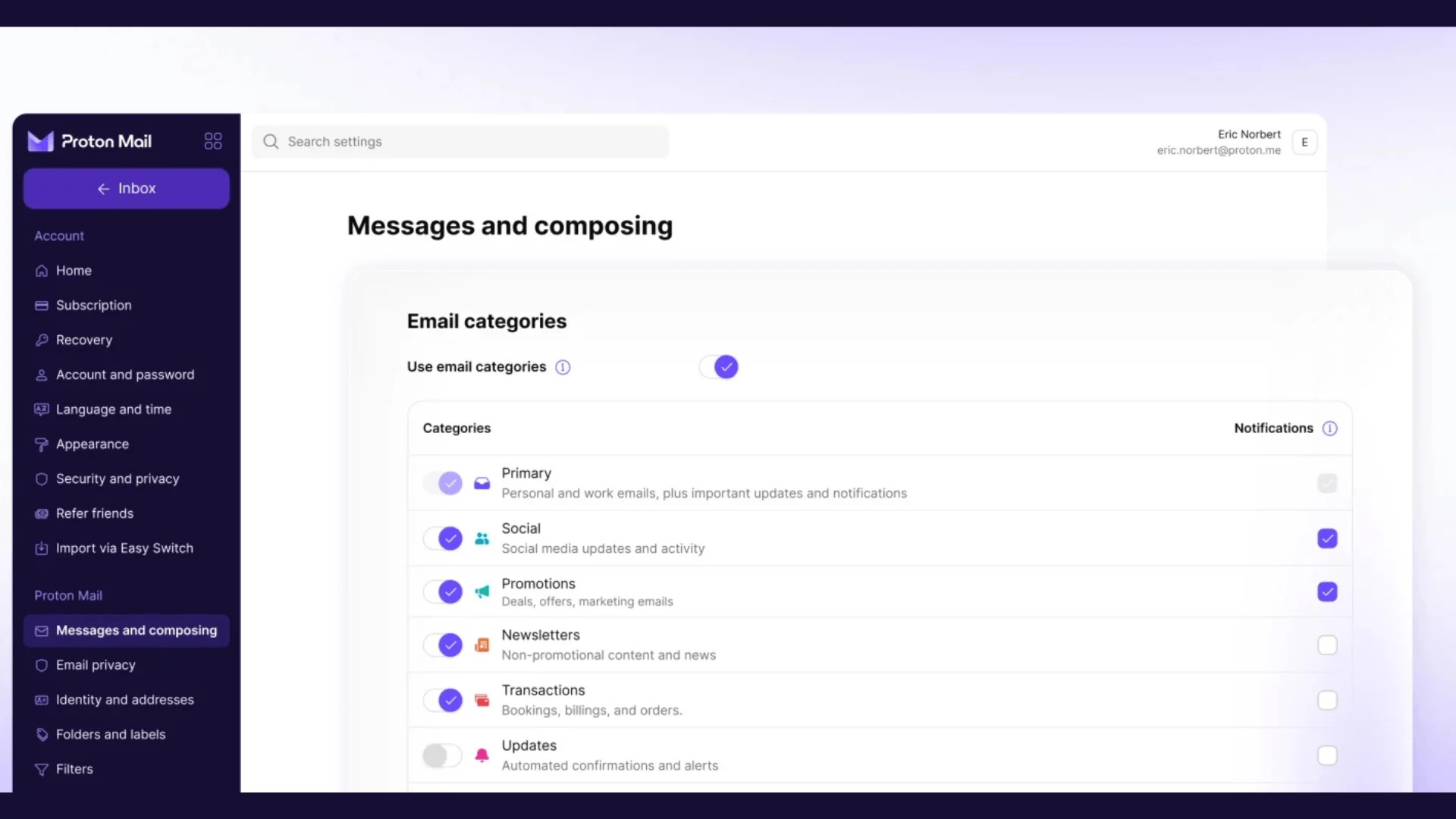
Proton, the Switzerland-based provider renowned for its end-to-end encrypted mail service, has spent a significant portion of its corporate life actively persuading users to abandon mainstream titans like Google’s Gmail. Yet, in a fascinating strategic pivot, the privacy champion has just adopted one of Gmail’s most defining and beloved features: automated inbox categorization.
While critics might view the move as an ideological concession, industry observers see it as a masterclass in pragmatic product design. By introducing Gmail-style inbox tabs—Primary, Social, Promotions, and Updates—Proton is attempting to prove that uncompromising privacy and modern digital convenience are not mutually exclusive.
Main Facts: The Feature, The Mechanism, and The Philosophy
At its core, the new update brings the familiar tabbed inbox layout to Proton Mail users. However, implementing a feature historically pioneered by Google required Proton’s engineering team to reinvent the underlying architecture to align with the company’s strict zero-access encryption model.
How Proton’s Categorization Works
Unlike Google, which scans the body text, links, attachments, and metadata of incoming emails to train machine learning models and serve hyper-targeted advertisements, Proton’s categorization system operates under a completely different paradigm:
- Metadata-Only Processing: Proton’s system analyzes structural metadata—such as sender addresses, routing paths, and basic header information—rather than reading the sensitive contents of the messages themselves.
- Client-Side/Local Processing: To maintain absolute privacy, much of the sorting logic respects the zero-access architecture, ensuring that Proton’s servers never index the plaintext body of user communications.
- Strictly Optional: In stark contrast to Gmail, where the tabbed layout is heavily integrated and difficult to completely disable, Proton’s categorization is entirely opt-in. Users who prefer a traditional, strictly chronological inbox can simply ignore the feature.
This technical distinction is vital. Proton is not adopting Google’s underlying data monetization model; instead, it has engineered a privacy-preserving replica of Gmail’s workflow convenience.
Chronology of a Strategic Shift: From Confrontation to Cautious Assimilation
To understand the weight of this release, one must trace the timeline of Proton’s aggressive anti-Google campaign and its steady creep toward functional interoperability with the mainstream web.
2023–Early 2024: The Migration Offensive
Proton ramped up its commercial and rhetorical war against Google, releasing toolkits designed to make migration as painless as possible. The company launched robust import-export tools and published aggressive marketing campaigns targeting enterprise users.
June 2024: "Your Business Data Isn’t Safe in Gmail"
In June, Proton published a blistering corporate pitch titled "Your business data isn’t safe in Gmail." The manifesto targeted small businesses and enterprises, highlighting Google’s history of utilizing workspace data for advertising profiling and machine learning training. The campaign sought to exploit growing enterprise anxiety over data sovereignty and regulatory compliance under frameworks like GDPR and HIPAA.
The Bridge: Gmail Integration in Proton Mail
Recognizing that cold-turkey migration is an enormous psychological barrier for casual users, Proton quietly rolled out features allowing users to manage external Gmail accounts directly inside the Proton Mail interface. This allowed users to test the waters of the Proton ecosystem without completely severing their ties to Google.
Late 2024: The Arrival of Categories
The logical culmination of this incremental approach arrived with the rollout of Gmail-style category tabs (Primary, Social, Promotions, and Updates). By lowering the friction of day-to-day inbox management, Proton removed one of the final remaining functional justifications users cited for keeping a foot in the Google ecosystem.
Supporting Data: The Battle for the Enterprise and Consumer Inbox
The stakes of this feature rollout are immense, underpinned by data reflecting the staggering dominance of Google Workspace and Gmail in both consumer and corporate sectors.
Market Share Realities
- The Giant’s Footprint: Gmail boasts over 1.8 billion active users worldwide, making it the undisputed heavyweight champion of consumer email. Google Workspace commands a massive chunk of the corporate market, particularly among SMBs, educational institutions, and startups.
- The Privacy Niche: While Proton has experienced explosive growth—boasting over 100 million accounts across its suite (Mail, Calendar, Drive, and VPN)—it remains a David fighting Goliath. The vast majority of mainstream internet users still reside within the Google, Microsoft, and Apple gardens.
- The Friction Factor: According to consumer behavior studies in the tech sector, UI/UX familiarity is the single greatest deterrent to software migration. Users may intellectually desire privacy, but they will revert to convenience if an alternative interface requires too much cognitive re-adaptation. By mirroring Gmail’s visual hierarchy, Proton directly attacks this friction point.
Official Responses and Industry Reactions
The reception to Proton’s feature update has been a mixture of cautious praise from privacy advocates and analytical intrigue from tech industry commentators.
Proton’s Official Stance
In official blog posts accompanying the release, Proton leadership framed the update not as a capitulation to Silicon Valley design standards, but as a maturation of the privacy movement.
"Privacy should not feel like a punishment," a Proton product spokesperson noted. "For years, alternative services have operated under the assumption that users must sacrifice modern workflows, clean interfaces, and automated organization in the name of security. We reject that false choice. We are proving that you can have the convenience of Gmail without the surveillance of Google."
Industry Analyst Commentary
Cybersecurity analysts and software UX designers have widely praised the technical execution of the feature.
- Dr. Elena Vance, Digital Rights Analyst: "Proton is performing a delicate high-wire act. If they remain too austere, they stay a niche product for tech-savvy purists. If they copy Google too closely, they risk diluting their brand identity. By adopting the UI convenience while fiercely protecting the underlying data architecture, they’ve found a sweet spot."
- Marcus Thorne, Enterprise Tech Consultant: "Enterprise adoption of encrypted mail has historically stalled because employees hate changing how they sort daily mail. Automated categories like ‘Promotions’ and ‘Updates’ aren’t just cosmetic; they are productivity necessities in the modern corporate world. Proton had to build this to be taken seriously as a viable corporate alternative to Google Workspace."
Implications: What This Means for the Future of Tech
Proton’s strategic borrowing of Gmail’s best idea carries profound implications for the broader technology landscape, signaling a maturation phase for the privacy tech sector.
1. The Commoditization of UI/UX Paradigms
For over a decade, tech monopolies used proprietary interface designs as a form of lock-in. Once users became habituated to specific workflows (like Gmail’s tabbed inbox or swipe gestures), moving to an alternative felt disorienting. Proton’s move demonstrates that open-market alternatives are increasingly willing to adopt proven UX patterns to democratize digital migration.
2. Redefining the Privacy Value Proposition
The narrative that "privacy is hard" is beginning to die. For the privacy movement to scale beyond activists, engineers, and threat-modelers, privacy-first software must achieve parity with mainstream applications in terms of usability. By closing the functional gap, Proton is shifting the competitive battleground back to where it belongs: data ethics, trust, and business models.
3. Pressure on the Titans
Google and Microsoft now face a nuanced challenge. When privacy alternatives look, feel, and organize just like Gmail, the psychological comfort of staying within the Google ecosystem diminishes. If users realize they can get automated inbox sorting without their data being harvested to train AI models or serve targeted ads, the migration pipeline from Mountain View to Geneva could widen significantly.
Conclusion
Proton’s decision to integrate Gmail-style categories into its encrypted mail client is far more than a minor software update. It is a strategic evolution that signals a new era for privacy-first technology.
By recognizing that user habits are deeply ingrained, Proton has chosen pragmatism over ideological rigidity. They are not abandoning their foundational privacy arguments; rather, they are equipping users with the familiar tools they need to make the leap safely. In doing so, Proton is sending a clear, defiant message to Silicon Valley: anything you can organize cleanly, we can protect privately.