The digital marketing landscape has undergone a seismic shift over the past twelve months. For years, practitioners have utilized Google Analytics (GA) as a rearview mirror—a tool to catalog what happened, why it happened, and who was responsible. However, the latest suite of feature releases from the Google Analytics team signals a definitive transition. GA is no longer merely a system of record; it is evolving into a platform for strategic foresight, enabling high-value decision-making that directly impacts corporate bottom lines and executive-level strategy.
For marketing and analytics professionals, this represents an opportunity to transcend the role of the "Reporting Squirrel"—the analyst who spends their days compiling charts and tables—and ascend to the role of an "Analysis Ninja." This transition is not just about technical proficiency; it is about leveraging data to command influence in meetings with Extremely Senior Leaders (ESLs), ultimately driving organizational growth and personal career advancement.
The Strategic Imperative: Four Pillars of Modern Analytics
To harness the full potential of these new capabilities, practitioners must act quickly. Many of these features are forward-only, meaning they begin processing data from the moment of activation. There is no historical backfilling; the clock starts the moment you enable them.
1. AEO: Navigating the AI Assistant Channel
The rise of Answer Engines (AEs) like ChatGPT, Claude, and Perplexity has fundamentally altered the search ecosystem. Predictions regarding a 20% to 30% decline in traditional SEO traffic have largely materialized. Google Analytics has responded by introducing a dedicated "AI Assistant" channel.
- Location: Reports > Acquisition > Traffic Acquisition.
- The Nuance: In the Default Channel Group, look for the medium
ai-assistant.
While this traffic currently represents a modest 1% to 5% of total sessions for most businesses, its value is disproportionately high. Adobe and Shopify data from mid-2026 suggest that AE-driven traffic boasts conversion rates up to 42% higher than traditional organic search and significantly higher Average Order Values (AOV). This is a margin story, not a volume story. Analysts must shift their focus from mere session counts to engagement rates and conversion quality to demonstrate the true impact of this emerging channel.
2. The Resurgence of Conversion Attribution Analysis
The era of blind last-click attribution is effectively over. Google Analytics has reintroduced a robust "Conversion Attribution Analysis" tool that allows marketers to view the full consumer journey.
By utilizing the "Assisted Conversions" report, analysts can identify channels that act as catalysts for demand rather than just the final click. For example, a channel like TikTok might show low last-click conversions but appear on 33% of multi-touch paths, proving its role as an essential upper-funnel driver. Recognizing this allows organizations to stop slashing budgets for "underperforming" channels that are actually critical for the consideration phase of the customer journey.
3. CMO Convos: Cross-Channel Budgeting
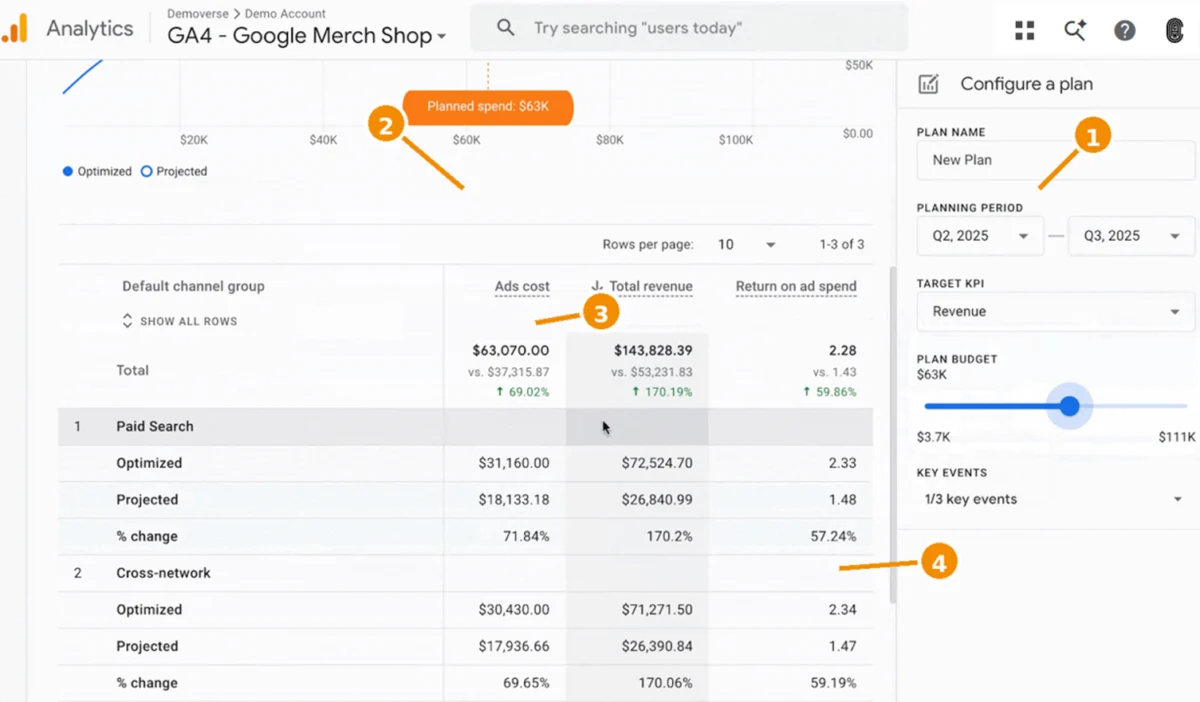
The divide between a data-driven insight and a boardroom decision is often where careers are made. The new "Cross-Channel Budgeting" tool within GA allows analysts to build "Project Plans" (pacing) and "Scenario Plans" (allocation).
These models are trained on internal historical data and account for seasonality, allowing marketers to answer the "what-if" questions that keep CMOs awake at night. By simulating the impact of shifting $250,000 from Paid Social to Paid Search, for instance, analysts can present evidence-based projections rather than relying on intuition. This transforms the analyst from an observer into a strategic partner in budget allocation.
4. Conversational Analysis: The "Ask Advisor" Revolution
Perhaps the most significant UX change is the introduction of the "Ask Advisor" feature—a conversational interface that allows users to query their data in plain English. This eliminates the need to navigate through complex report trees to find specific metrics.
By integrating the GA Model Context Protocol (MCP) server, organizations can connect their GA data directly to external LLMs like Claude or ChatGPT. This allows for cross-referencing web traffic with external data, such as promotional calendars or offline sales figures, in a single query.
Supporting Data: Why the Shift Matters
The shift toward AI-assisted analytics is backed by clear market trends. As of late 2026, the fragmentation of traffic sources—spanning desktop, mobile, and in-app browsers—has made the traditional "Direct" traffic bucket a dumping ground for misattributed data.
- Conversion Efficiency: Industry reports indicate that users arriving via Answer Engines spend 48% more time on product pages compared to traditional search traffic.
- Revenue Impact: Companies that have integrated AI-driven attribution report a 14% to 20% increase in AOV, as the quality of the visitor is higher, having already been "pre-qualified" by the AI’s synthesis of information.
- Budget Optimization: Early adopters of the Cross-Channel Budgeting tool report that they have identified significant "substitutable" spend, allowing them to maintain revenue levels while reducing total ad spend by up to 15%.
Chronology of Adoption: A Roadmap for Teams
For those looking to institutionalize these changes, the following timeline is recommended:
- Immediate (Month 1): Enable the AI Assistant Channel and start tagging reports as "Understating LLM Traffic" to manage stakeholder expectations.
- Short-Term (Month 2): Audit existing attribution models. Shift the focus from Last Click to Assisted Conversions to recalibrate channel performance expectations.
- Medium-Term (Month 3): Begin using the Cross-Channel Budgeting tool to run "What-If" scenarios. Use these to brief agency partners and internal stakeholders on next quarter’s budget.
- Long-Term (Month 4+): Deploy the GA MCP server to connect internal business data with web analytics, creating a unified dashboard for leadership.
Official Perspective and Cautions
Google’s design philosophy with these updates centers on "democratizing data." By lowering the barrier to entry for complex analysis, Google is attempting to ensure that GA remains the "source of truth" in an increasingly fragmented digital ecosystem.
However, caution is required. As with any AI-driven tool, the "Ask Advisor" can hallucinate when pushed to answer causal questions. Furthermore, attribution is not synonymous with incrementality. Analysts must remember that a model is only as good as its inputs; "Garbage In, Garbage Out" (GIGO) remains the cardinal rule of analytics. When presenting these models to leadership, they should be framed as "projections" or "best estimates," not infallible forecasts.
Strategic Implications: Driving What Happens Next
The ultimate implication of these advancements is the shift from descriptive analytics to prescriptive analytics.
Source Group Consolidation and LTV Percentile Targeting further underscore this evolution. By consolidating messy traffic streams (e.g., merging "facebook," "fb," and "meta" into one stream) and identifying the top 5% of customers who drive 40% of profit, teams can move away from mass-market advertising toward high-value audience cultivation.
For the modern professional, the path is clear. You must stop waiting for the data to tell you what happened and start using the data to propose what should happen. By leveraging AI-assisted tools to identify undervalued channels, optimize cross-channel budgets, and segment high-LTV customers, you move from being a cost center to a profit engine.
The goal is no longer to be the person who brings the report to the meeting; the goal is to be the person who brings the strategy that the meeting is built around. The era of the Analysis Ninja has arrived. Carpe diem.