NEW YORK — As the dust settles on the multi-billion-dollar frenzy of the late-year shopping season, digital marketers are left sifting through mountains of metrics to understand what worked, what failed, and why. Providing a macro-level lens into this chaos, marketing automation titan Mailchimp has released an exhaustive new analysis examining more than 44 billion emails and 83 million text messages sent by its global user base during the 2025 holiday shopping season.
Entitled Breaking Through Peak Season Noise—and produced in collaboration with analytics firm Datalily—the report was officially announced on September 21, 2025. By analyzing aggregate activity from both free and paid active Mailchimp accounts, the study offers a rare, sweeping view of consumer behavior across the critical final two months of the year.
However, beyond the dizzying top-line figures lie nuanced lessons about consumer fatigue, the paradoxical power of resting inboxes, the surprising dominance of SMS conversion rates, and the complex, often misunderstood role of generative artificial intelligence in modern commerce.
Main Facts: The Scope of the 2025 Holiday Data
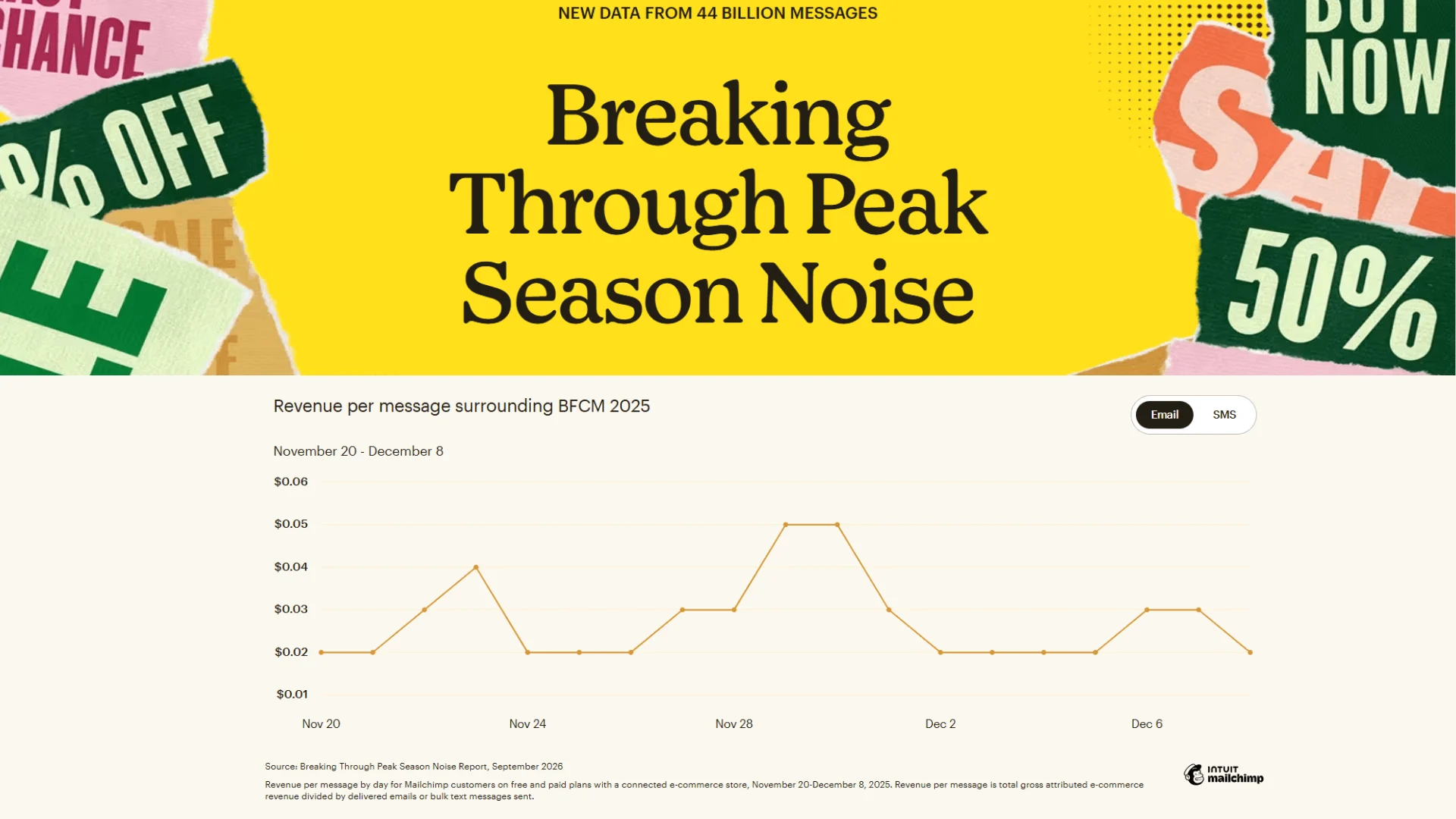
To understand the weight of Mailchimp’s findings, one must first grasp the sheer scale of the dataset. The report synthesizes communications sent between October 31 and December 31, 2025, with a distinct micro-analysis carved out for the high-stakes Black Friday-to-Cyber-Monday (BFCM) window spanning November 28 to December 1.
For e-commerce brands utilizing connected stores, the data translates into tangible economic impact: these merchants recorded 7.5 million distinct orders and more than $1.1 billion in attributed revenue during the study period.
Key structural takeaways from the report include:
- The Volume Paradox: While billions of emails flooded digital channels, brands actually dialled back their messaging intensity during weekends, sending roughly 60% fewer messages on Saturdays and Sundays.
- The Weekend Premium: Despite the drop in volume, weekend order rates were double those recorded on weekdays, suggesting that consumers spend weekends browsing and buying when their inboxes are relatively quiet.
- The Power of Personalization: During the BFCM rush, emails featuring basic segmentation and tailored personalization achieved an average order value (AOV) of $166, compared to just $150 for non-personalized campaigns—an 11% premium.
- The Omnichannel Dynamic: SMS messaging proved hyper-efficient, generating order rates up to six times higher than email at peak points, though email’s sheer volume (more than 500 times larger than SMS) ensured it remained the primary revenue driver overall.
- The AI Correlation: Approximately 450 million emails—representing roughly 1% of the total volume—utilized Mailchimp’s built-in generative AI features. These campaigns exhibited a 50% higher order rate and a 33% higher conversion rate.
Chronology: A Timeline of Peak Season Engagement
The holiday shopping season does not arrive overnight; it rolls in waves of increasing consumer anticipation and digital saturation. By mapping the chronological rhythm of the 2025 season, Mailchimp’s data illuminates precisely how buyer psychology shifted from late October through the New Year.
Phase 1: The Early-Season Buildup (October 31 – November 27)
The season officially opened on Halloween, marking the commencement of early-bird holiday promotions. During this initial phase, brands primarily focused on priming their audiences, offering early-access discounts, and building anticipation. Engagement was steady, but consumer restraint was evident; shoppers were budgeting and bookmarking items rather than executing immediate purchases. Volume remained manageable, giving marketers a window to test subject lines and audience segments before the November rush.
Phase 2: The BFCM Crucible (November 28 – December 1)
The four-day block from Black Friday through Cyber Monday represented the epicenter of the retail year. Inboxes transformed into hyper-competitive battlegrounds. The data shows that brands unleashed maximum email volume on Friday, November 28. However, consumer behavior immediately demonstrated signs of fatigue.
Notably, the Sunday separating Black Friday from Cyber Monday carried 59% fewer emails than Black Friday itself. This strategic pause by brands inadvertently created a sanctuary of quiet inboxes—a sanctuary that consumers enthusiastically raided, leading to spikes in conversion rates among brands that dared to whisper while others shouted.
Phase 3: The December Marathon and Shipping Deadlines (December 2 – December 24)
As BFCM faded, the holiday season entered its second major wave: last-minute gifting and shipping-deadline countdowns. Here, the cadence shifted from broad promotional blasts to targeted urgency messaging. Abandoned-cart reminders and real-time inventory alerts drove significant mid-December revenue.
Phase 4: The Post-Christmas Wind-Down (December 25 – December 31)
The final week of the year saw a pivot toward post-holiday clearance sales, gift card redemptions, and year-in-review messaging. While transaction volumes tapered compared to the November peak, engagement remained stable among consumers looking to spend holiday cash windfalls.
Supporting Data: Breaking Down the Numbers
A closer examination of the metrics reveals fascinating mechanical insights into what drives modern e-commerce success.
The Economics of Rest: Why Quiet Inboxes Win
One of the most actionable insights from the report concerns timing. Marketers instinctively lean toward higher frequency during peak periods, assuming that visibility equates to sales. Mailchimp’s data directly challenges this assumption.
Brands sent roughly 60% fewer messages over weekends, yet weekend order rates were twice those of weekdays. Furthermore, the Sunday between Black Friday and Cyber Monday saw 59% fewer emails dispatched than Black Friday, yet conversion metrics remained robust. The underlying consumer psychology is clear: when inboxes are less congested, readers are more likely to actually open, read, and act on promotional content.
Segmentation and Abandoned Carts
Generic "blast to all" campaigns continue to lose ground against targeted strategies. During the BFCM window, emails utilizing segmentation and personalization secured an $166 AOV compared to $150 for unsegmented blasts.
Similarly, abandoned-cart content blocks proved indispensable for capturing lost revenue. Messages incorporating automated cart-recovery elements were linked to a 36% higher open rate and a 28% higher click rate. (Industry analysts note, however, that open rate metrics must be interpreted with caution in the post-Apple Mail Privacy Protection era, though relative comparisons across campaigns remain valid.)
The Email vs. SMS Balancing Act
The report underscores the complementary nature of omnichannel marketing. SMS emerged as an efficiency powerhouse, generating order rates up to six times higher than email during peak moments. However, because email volume was more than 500 times larger than SMS volume, email maintained its crown as the absolute heavyweight champion of total revenue generation. Brands relying solely on one channel missed out on the synergistic effect of hitting consumers across multiple touchpoints.
Official Responses and Methodological Nuances
As with any major platform data release, industry experts and Mailchimp representatives have engaged in healthy discourse regarding the interpretation of the findings—particularly surrounding the headlines on generative AI.
The Generative AI Debate
Mailchimp’s report highlighted that the 450 million emails utilizing its generative AI tools recorded a 50% higher order rate and a 33% higher conversion rate, leading the report to state that the technology "improved performance."
However, a rigorous look at the methodology reveals important caveats. Mailchimp’s study describes a straightforward comparison of campaigns with and without the feature over the same period, with no randomized controlled trials or baseline adjustments.
Marketing analysts have been quick to contextualize these numbers. Early adopters of new platform features—such as generative AI copywriting tools—tend to overlap heavily with advanced marketers who already practice rigorous list hygiene, sophisticated segmentation, and continuous A/B testing. Therefore, the statistics demonstrate a correlation on Mailchimp’s platform, rather than a definitive, automated cause-and-effect guarantee for every sender.
Scope and Limitations
Mailchimp has been transparent about the boundaries of its dataset. The revenue, order, and conversion metrics apply strictly to customers with connected e-commerce stores (accounting for 7.5 million orders and over $1.1 billion in attributed revenue). Additionally, SMS figures are restricted to geographic markets where Mailchimp SMS was actively available during the holiday season. Consequently, while the dataset is massive, it represents Mailchimp’s specific customer ecosystem and should not be viewed as a blanket proxy for the entire global email marketing landscape.
Implications: What Marketers Must Learn for the Future
As digital marketers look ahead to the next holiday shopping cycle, Breaking Through Peak Season Noise offers several vital strategic directives.
- Prioritize Relevance Over Volume: The data proves that flooding the customer inbox yields diminishing returns. Brands must pivot toward disciplined cadence, leveraging weekend lulls and quieter days to capture the attention of overwhelmed consumers.
- Double Down on Personalization and Automation: The 11% lift in AOV driven by segmentation and the dramatic engagement boosts from abandoned-cart triggers confirm that automated, data-driven workflows are no longer optional—they are foundational to profitability.
- Embrace Omnichannel Harmony: While SMS boasts superior conversion speed, email remains the bedrock of volume and total revenue. Successful strategies will integrate both, using SMS for urgent, high-impact alerts and email for rich storytelling and product discovery.
- Approach AI as a Co-Pilot, Not a Magic Wand: While generative AI tools show strong performance associations within Mailchimp’s ecosystem, marketers must remember that technology amplifies the skill of the user. AI works best when paired with sound strategy, clean lists, and thoughtful audience segmentation.
Ultimately, Mailchimp’s 2025 holiday report delivers a reassuring message to digital marketers: success in a crowded marketplace is not about shouting the loudest or sending the most messages. It is about reaching the right customer, with the right message, at the exact moment their inbox is calm enough to listen.