AMSTERDAM / NEW YORK — In a massive financial and technological maneuver that has sent ripples through both the fintech and email delivery sectors, messaging infrastructure provider Bird has secured a $450 million debt financing package. Announced on September 23, the capital injection—orchestrated by banking giant J.P. Morgan alongside Capital One and Citi—is designed primarily to fund a dividend recapitalization for shareholders, including current and former employees, while allowing the company to retain its private and independent status.
Simultaneously, Bird used the financial milestone to unveil a sweeping technological leap: "Agentic Harness," a new suite of tools granting artificial intelligence agents direct access to its core infrastructure via a Model Context Protocol (MCP) server and a command-line interface. While the multi-million-dollar debt deal highlights the firm’s aggressive profitability and lean operational model following years of painful restructuring, the simultaneous launch of autonomous AI mailboxes—particularly those leveraging shared domains—has raised immediate eyebrows among global email deliverability experts and industry veterans.
Main Facts
The core of Bird’s announcement centers on a substantial private debt transaction coupled with a forward-looking product launch tailored for the age of autonomous artificial intelligence.
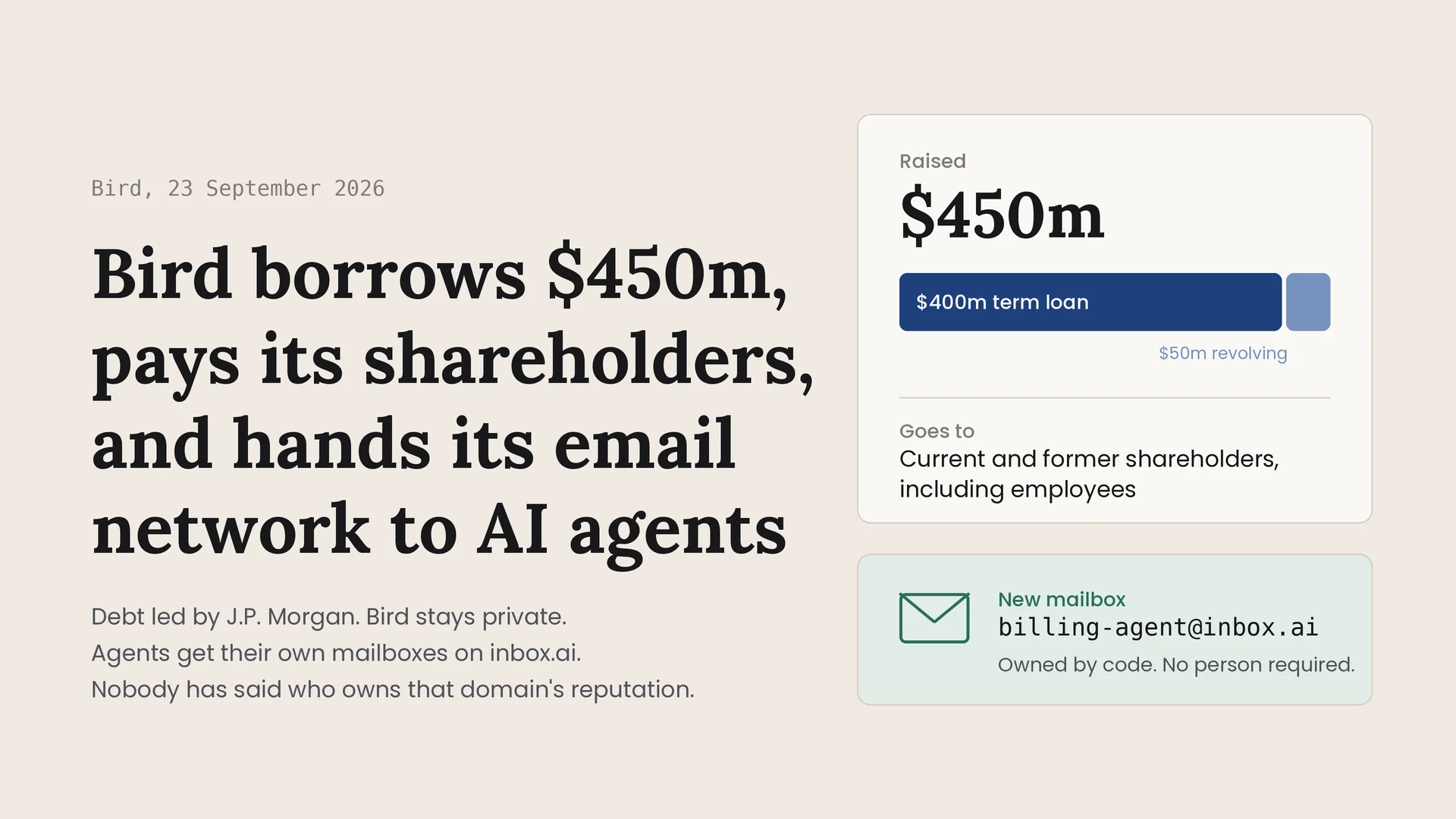
The $450 million debt facility is broken down into two distinct tranches: a $400 million term loan and a $50 million revolving credit facility. The syndication was led by J.P. Morgan, with Capital One and Citi serving as joint lead arrangers, alongside participation from seven participating banks. Rather than serving as a traditional venture capital or growth equity funding round—which would have diluted equity or introduced new institutional stakeholders—the transaction is a classic dividend recapitalization.
According to financial reports and statements from the company, the primary purpose of the capital is to provide immediate liquidity to existing shareholders. This includes a notable payout to both current and former employees who hold equity. Bird Chief Executive Officer Robert Vis swiftly took to social media platform X to confirm the transaction’s structure, reiterating that the company remains proudly private and independent.
On the product front, the company used the financing news to roll out "Agentic Harness." This developer-focused ecosystem provides AI agents with direct, programmatic access to Bird’s messaging infrastructure—which famously includes the former SparkPost sending architecture. Through an MCP server and a command-line tool, autonomous agents are now empowered to send, receive, and manage email communications natively.
Central to this release is the new "Mailbox API," billed by Bird as "a real inbox your code owns." Developers can provision email addresses for their AI agents either on the customer’s custom-owned domain or via a shared platform-provided domain: inbox.ai. While programmatic email generation is not entirely new, integrating it directly into an agentic framework capable of independent decision-making represents a distinct evolution in how digital communications are initiated and managed.
Chronology
To understand how Bird arrived at this junction of high-stakes financial engineering and cutting-edge AI integration, it is necessary to examine the timeline of events leading up to the September announcements, as well as subsequent operational hiccups.
- May 2026: Signaling a severe internal pivot toward extreme operational efficiency, Bird implements steep workforce reductions. Reports from European tech publication Computable reveal that the company cuts 34 jobs in Europe and shifts the vast majority of its remaining operations and workforce to the United States.
- Throughout 2025 (Retrospective Data): Bird undergoes a massive contraction in headcount. From a peak exceeding 1,000 employees during previous iterations and acquisitions, the company trims its staff down to approximately 120 personnel, laying the groundwork for unprecedented financial margins.
- September 17, 2026: Operational testing begins to reveal minor friction points. Bird’s primary status page records US API errors, while the legacy SparkPost status page—which monitors dedicated email delivery pathways—logs an incident involving delayed outbound delivery for US-hosted customers lasting roughly one hour.
- September 18, 2026: Bird records a secondary processing delay on its US APIs, which management attributes to an upstream cloud provider issue.
- September 23, 2026: Bird officially announces the $450 million debt financing package led by J.P. Morgan, Capital One, and Citi. CEO Robert Vis confirms on X that the funding facilitates a shareholder dividend while preserving the company’s private status. On the same day, the company launches Agentic Harness and the Mailbox API.
- September 26, 2026: Another wave of US API errors is logged on Bird’s status page, coinciding with the market’s initial digestion of the company’s dual financial and product announcements.
Supporting Data
The financial metrics released by Bird alongside the $450 million debt package paint a fascinating portrait of a company transformed by radical restructuring.
According to the company’s unaudited figures, Bird generated an astonishing $165 million in Earnings Before Interest, Taxes, Depreciation, and Amortization (EBITDA) during the 2025 fiscal year. This financial performance is even more striking when juxtaposed against the company’s human footprint: Bird achieved this profitability with a lean workforce of roughly 120 employees.
This lean-to-revenue ratio represents a dramatic shift from earlier years when the corporate footprint spanned over 1,000 employees globally. By slashing overhead, consolidating operations from Europe to the United States, and leaning heavily on the robust, legacy infrastructure of SparkPost—which handles a massive fraction of the world’s commercial email traffic—management has converted a historically capital-intensive messaging business into a high-margin cash cow.
However, industry analysts note a caveat: these figures are self-reported and unaudited by independent third-party public accounting firms in the context of a public offering, meaning stakeholders must rely on management’s internal accounting. Furthermore, recent status page logs hint at the underlying fragility of managing high-volume infrastructure with a drastically reduced engineering team. Incidents on September 17, 18, and 26—highlighting US API errors and brief outbound delivery delays—underscore the constant operational tightrope required to maintain massive messaging throughput with a skeleton crew.
Official Responses
Reactions from leadership have emphasized stability, independence, and technological vanguardism.
In the official September 23 press release detailing the transaction, Bird framed the debt facility as a validation of its business model and operational discipline. The company stated that the $450 million arrangement "provides liquidity to our shareholders, including current and former employee shareholders, while keeping Bird private and independent."
CEO Robert Vis reinforced this narrative directly to the tech community via X, shutting down speculation that the capital raise was a distress sale, a traditional equity funding round, or a precursor to an IPO. By opting for a debt-funded dividend recapitalization rather than selling equity, Vis and the executive team have chosen to reward existing stakeholders while retaining total operational control.
Regarding the launch of Agentic Harness, Bird’s product documentation champions the concept of giving code-driven entities true autonomy in digital spaces. The description of the Mailbox API as "a real inbox your code owns" is designed to appeal to enterprise developers looking to automate complex workflows—such as customer support negotiations, autonomous sales outreach, or software-driven logistics coordination—without relying on traditional, human-managed user interfaces.
Yet, notably absent from Bird’s official launch materials are granular details regarding the safeguards surrounding the shared-domain infrastructure (inbox.ai), leaving a vacuum that external security and deliverability professionals are eager to fill.
Implications
While the financial engineering behind the $450 million debt package is a win for Bird’s remaining stakeholders and employees, the technological implications of the Agentic Harness launch—specifically the Mailbox API and the inbox.ai shared domain—have ignited urgent conversations across the global email community.
The Challenge of Shared Domains in an AI Era
For years, email infrastructure providers, mailbox providers (like Google, Microsoft, and Yahoo), and anti-abuse organizations have waged an escalating war against spam, phishing, and malicious automated sending. Over the past 24 months, major mailbox providers have drastically tightened compliance rules for bulk and automated senders, enforcing strict authentication standards (SPF, DKIM, DMARC) and zero-tolerance threshold metrics for user complaint rates.
Bird’s introduction of the inbox.ai shared domain for AI agents runs directly into this stringent regulatory gauntlet. Email deliverability experts have immediately raised critical questions that remain unanswered in Bird’s public documentation:
- Reputation Management: Who ultimately manages and protects the sender reputation of
inbox.ai? - Abuse Mitigation: If a single customer deploys an autonomous AI agent that goes rogue, hallucinates, or begins spraying unsolicited messages, what automated circuit breakers prevent that abuse from tanking the domain reputation for all other users sharing
inbox.ai? - Sending Limits and Guardrails: What rate-limiting parameters apply to an agent-owned mailbox operating on a shared infrastructure?
Because autonomous AI agents operate independently, adapting their messaging strategies dynamically based on incoming prompts and responses, they present an unprecedented challenge to traditional email security filters. Unlike a human marketer who is bound by cognitive limits and standard behavioral patterns, an AI agent running loops via an MCP server could theoretically generate thousands of hyper-personalized, context-aware emails in a matter of minutes. If improperly configured, these agents could easily mimic malicious threat actors, triggering automated blocks from major inbox providers.
The Future of Autonomous Communications
Despite the risks, Bird’s move signals where enterprise messaging is inevitably heading. As organizations increasingly adopt agentic workflows—moving beyond static chatbots to autonomous agents capable of executing multi-step business processes—the ability for code to natively send and receive email becomes a critical utility.
Bird is positioning its legacy SparkPost-derived infrastructure not merely as a pipe for bulk marketing emails, but as the foundational nervous system for the autonomous enterprise. By combining the massive cash flow generated by its streamlined 120-person operation with fresh liquidity from J.P. Morgan, Capital One, and Citi, the company has insulated itself financially while planting a flag at the bleeding edge of AI infrastructure.
Whether the digital ecosystem—and the fiercely guarded gates of major mailbox providers—will smoothly accommodate autonomous AI agents sharing domains like inbox.ai remains one of the most pressing technical questions of late 2026. For Bird, the financial gamble has already paid out millions to its stakeholders; the real test will be whether its engineering framework can weather the coming storm of autonomous email traffic without breaking down.