By the Editorial Desk
In the modern business landscape, a familiar refrain echoes through corporate offices worldwide: "We’re using AI every day."
To the casual observer, typing prompts into ChatGPT or Claude to draft an email, summarize a report, or brainstorm a catchy headline feels like cutting-edge productivity. However, according to Callan Faulkner, co-founder of The Uncommon Business, this casual usage barely scratches the surface of what artificial intelligence can achieve. Most professionals remain trapped in an inefficient loop: they open a chat window, spend an hour generating a one-off result, and—the next time they face the same task—start completely from scratch.
They save no reusable instructions. They build no knowledge bases. They fail to turn AI into a systematic, repeatable engine.
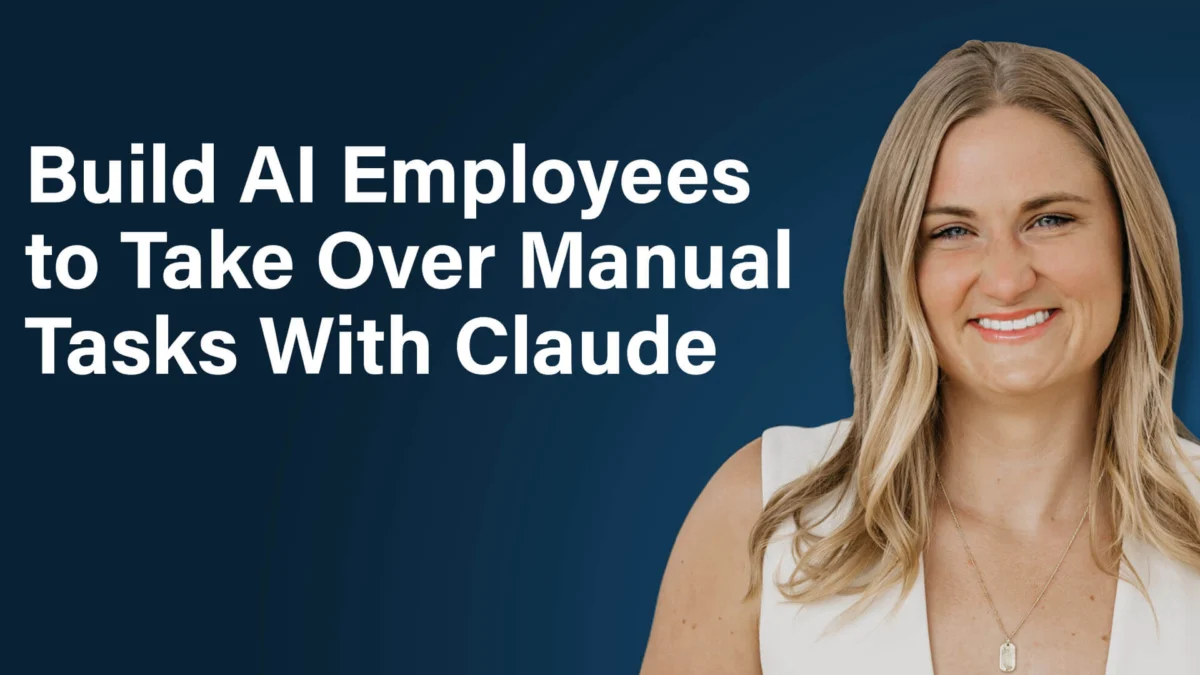
Faulkner, whose company is currently on pace to hit roughly $40 million in revenue with a lean team of just 50 human employees, argues that true operational leverage requires a fundamentally different mindset. It requires moving beyond simple prompting to build, train, and schedule AI employees: reusable, specialized AI systems designed to perform specific business functions as well as—or better than—a human counterpart.
Main Facts: Redefining Human-AI Collaboration
The core thesis behind building AI employees is simple yet transformative: human workers should be elevated out of repetitive, manual tasks and into strategic, creative roles that light them up.
An "AI employee" is not a vague concept; it is a trained, persistent digital asset configured to handle complex workflows autonomously. Far from shrinking headcounts, this approach expands enterprise capacity. Faulkner notes that while her firm operates at a revenue-per-employee scale that would have required a massive workforce a decade ago, she has never laid off an employee due to AI adoption.
Instead, a profound operational divide is emerging in the hiring market. Companies are discovering that employees who refuse or fail to adopt AI workflows cannot keep pace with those who master them. In one instance cited by Faulkner, a company brought on an untrained marketer who took weeks to deliver simple sales pages and images. Meanwhile, AI-trained staff members within the same organization were producing tenfold the output in a single day. The issue wasn’t that AI replaced the marketer; it was that modern roles demand humans who can act as strategic directors, leveraging AI to execute tasks at unprecedented speeds.
Chronology: The Evolution from Chat Window to Autonomous Agent
For organizations looking to bridge the gap between casual AI use and true automation, the path forward follows a structured, evolutionary timeline.
Phase 1: The Self-Audit and Time Tracking
The journey begins by auditing how time is spent across an organization. Leaders and team members must identify every daily, weekly, or monthly task that generates revenue but drains energy, or tasks that fall below a high-value threshold (such as $50 an hour).
This includes tasks like generating sales proposals, outlining presentations, or editing digital content. Even tasks where workers consider themselves experts must be scrutinized. Often, once AI is trained on an expert’s proprietary process, its output can match or exceed human performance, turning the worker from a manual creator into a high-level editor.
Phase 2: The "AI Interview" Method
Once a target task is isolated, the builder opens a chat interface in an advanced LLM (such as Claude) and outlines the context: who they are, what their company does, and what excellence looks like. Crucially, before executing the task, the user instructs the AI to conduct an interview, asking five high-impact questions to extract the human’s exact internal methodology.
Because rich context is critical, industry leaders recommend using voice-to-text tools (such as Wispr Flow) during this phase. Speaking naturally captures nuances, idioms, and procedural details that users typically edit out or truncate when typing.
Phase 3: Packaging into Reusable "Skills"
After iterating with the AI to achieve an A-plus output, the chat session is transformed into a saved, reusable instruction set—referred to in the Claude ecosystem as a "Skill." A skill acts like a prompt on steroids: a single command that triggers a deeply trained, complex business process.
To maximize these skills, builders construct a centralized "Business Brain"—a clean repository of pricing structures, brand guidelines, past wins, ideal client profiles, and historical data. Much like onboarding a brilliant new hire on their first day, an AI employee is only as effective as the documentation it can access.
Phase 4: Rigorous Testing and Refinement
Most users settle for mediocre B-minus or C-plus AI outputs because they accept the first response. Faulkner stresses that building an elite AI employee requires "testing the living daylights" out of every skill.
When an output falls short, builders must push back aggressively, instructing the AI to try again as if its performance depended on it. By feeding corrections back into the system—explicitly showing the AI how a human would rewrite a paragraph and diagnosing why the previous instructions failed—the skill gradually matures into a reliable digital worker.
Phase 5: Autonomous Scheduling via Co-Work
Once tested and refined, AI employees can be scheduled to run automatically without human intervention. Using desktop integration features like the Claude Co-Work app (running on a dedicated office machine), users can program skills to execute at specific days, times, and frequencies.
Supporting Data: Real-World Applications and Efficiency Gains
The practical applications of scheduled AI employees span virtually every department:
- Marketing & Social Media: Instead of spending days manually designing visual assets or researching competitor strategies, teams can deploy automated researchers. For instance, an "Instagram Researcher" skill can be scheduled to run every Monday at 6:00 AM, scanning competitor accounts for viral content angles, analyzing hooks, and depositing curated ideas directly into a Notion database for human approval.
- Operations & Knowledge Management: Hourly or daily scheduled tasks can pull meeting transcripts from transcription tools (like Granola), categorize them, and feed them directly into corporate knowledge bases.
- Copywriting and Sales: Human copywriters can evolve into managers of rosters of AI assistants—overseeing AI hook generators, draft writers, and quality-assurance reviewers while reserving their cognitive energy for high-level creative direction.
The investment required is substantial but yields compounding returns. Faulkner notes that crafting her primary voice-copywriter AI employee took roughly 15 hours of iterative training. Yet, that investment mirrors the real-world timeline of training a human employee to master a brand’s unique voice—with the crucial difference that the AI asset never forgets, burns out, or leaves the company.
Official Responses and Strategic Frameworks
Integrating AI employees into an enterprise requires disciplined management to avoid technical bottlenecks. Industry practitioners recommend several governance frameworks:
- The Board of Directors Technique: When tackling complex or unfamiliar business problems—such as designing executive compensation structures or multi-tier bonus packages—users can prompt LLMs to synthesize frameworks from renowned business leaders (e.g., Mark Cuban or Sara Blakely), grounding AI-generated business coaching in battle-tested methodologies.
- Explicit Skill Synchronization: In environments like Claude Projects, internal memory and formal skills can occasionally fall out of sync. Best practices dictate explicitly instructing the LLM to update the core skill file during conversations and manually confirming changes to prevent local memory drift.
- Centralized Notion Tracking: Scaling organizations should maintain a master database (such as a Notion repository) tracking every built skill, its version history, its creator, and its designated department owner. Periodic skill audits during quarterly reviews ensure that automated workflows do not become outdated as company offers and messaging evolve.
Implications: The Future of Work and Organizational Design
The transition from casual prompt engineering to the deployment of autonomous AI employees signals a fundamental shift in organizational design.
As shortcut-seeking becomes the new work ethic, the competitive advantage no longer belongs to companies that can afford the largest manual labor force. Instead, it belongs to agile teams capable of codifying their institutional knowledge, communicating precisely with machine systems, and acting as master editors of high-speed AI output.
Far from rendering human workers obsolete, this shift places a premium on uniquely human traits: strategic vision, creative direction, and the ability to ask the right questions. Businesses that master the art of building and scheduling AI employees will not merely cut costs; they will scale their operations to heights previously unimaginable for small-to-midsize enterprises, leaving legacy competitors struggling to catch up in a manual world.