For the past two years, the professional marketing landscape has been defined by a singular, frantic pursuit: mastering the art of the prompt. Marketers have treated generative AI as a digital assembly line—a "content factory" where a request is fed into an interface, an asset is churned out, and a human editor frantically scrubs the output to strip away the unmistakable, sterile sheen of machine-generated prose.
This transactional relationship, however, is beginning to show its limitations. According to A. Lee Judge, founder of the B2B content production powerhouse Content Monsta, the industry is approaching a critical inflection point. The race to use AI to replace the writer is stalling; the real opportunity, he argues, lies in using AI to elevate the thinker.
The Paradigm Shift: From Content Factory to Thought Partner
The traditional model of AI usage in marketing is inherently flawed because it treats the technology as a subordinate, rather than a collaborator. When a marketer asks an LLM to "write a blog post about X in the style of Y," they are limiting the tool to its most basic, and arguably least valuable, function: mimicry.
Judge suggests that the most successful marketers are moving away from this "production-first" mindset. Instead, they are reorienting their workflows toward "collaboration-first" strategies. The objective is no longer to have the AI write like the brand; the objective is to have the AI think with the brand.
"AI isn’t meant to replace human content creators; it’s meant to elevate them," says Judge. By utilizing the technology to extract expertise from subject matter experts (SMEs), surface strategic insights that might otherwise remain buried in data silos, and refine messaging to be more precise, marketers can achieve a "human edge" that a simple prompt-response loop could never replicate.
Brain Siphoning: The New Standard for Content Strategy
Central to Judge’s philosophy is a concept he calls "brain siphoning." In a professional setting, the most valuable assets are the tacit knowledge, unique perspectives, and industry expertise held by a company’s leadership and specialized employees. However, capturing this "brilliance" and translating it into scalable content has historically been a time-consuming, bottleneck-heavy process.
Brain siphoning is the discipline of using AI to extract that existing, high-value knowledge and scaling it with purpose. Under this framework, the AI acts as a sophisticated interviewer or research assistant. It interrogates the SME, organizes their disparate thoughts, challenges their assumptions, and maps their expertise against market needs.
The AI does not provide the "soul" of the content—that remains the domain of the human expert—but it provides the structural integrity and the clarity that allows that soul to be communicated effectively. When the draft is finally written, it isn’t just a generic output; it is a distillation of an expert’s mind, polished by the speed and analytical capabilities of the machine.
The Data Speaks: The End of the "Prompting" Era
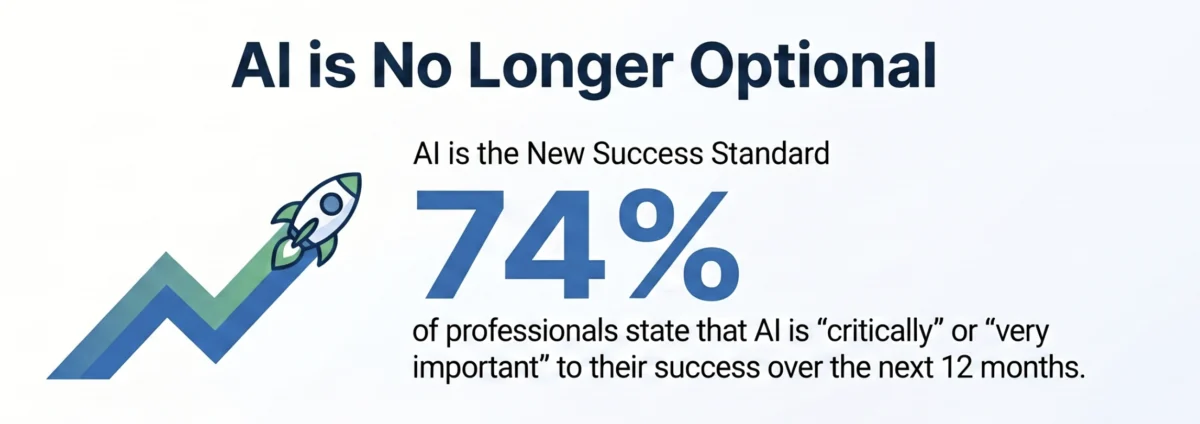
This shift in sentiment is not merely anecdotal; it is reflected in the most comprehensive data currently available on the industry. The 2026 State of AI for Business Report, which surveyed over 2,100 professionals—86% of whom are B2B marketers—reveals a profound change in what the workforce actually values.
For the past 18 months, "prompt engineering" was the most requested training topic. It was the "how-to" manual for a new machine. However, the 2026 data shows that prompting has fallen to the bottom of the list of priorities. Only 15% of respondents identified it as a training priority.
This drop-off signals a maturation of the workforce. Professionals are no longer concerned with the mechanics of "how do I talk to AI." They have mastered the basics of syntax and parameter setting. Now, they are asking more sophisticated, high-level questions:
- How do I integrate AI into my strategic decision-making?
- How do I use AI to identify market gaps?
- How do I ensure ethical and accurate knowledge synthesis?
The transition from "prompting" to "partnership" marks the evolution of AI from a novelty to an essential business utility.
Chronology of the AI Integration Wave
To understand why this shift is occurring now, one must look at the timeline of AI adoption in the marketing sector:
- 2022: The "Gold Rush" Phase. With the release of ChatGPT, the industry saw an explosion of AI-generated content. The primary goal was volume. Marketing departments used AI to solve the "blank page syndrome" and increase output speed.
- 2023: The "Editing" Phase. As the novelty of AI-generated content wore off, the limitations of LLMs became apparent. Marketers spent the majority of their time editing and "humanizing" AI outputs. The focus shifted to "Prompt Engineering" to minimize hallucinations and improve quality.
- 2024–2025: The "Governance and Integration" Phase. Businesses began focusing on security, data privacy, and the legal implications of AI. Companies implemented "Human-in-the-loop" (HITL) policies, and the conversation shifted toward AI governance.
- 2026: The "Strategic Collaboration" Phase. We have arrived at the present. The focus has moved from the tool itself to the workflow. The goal is no longer just to generate content, but to integrate AI into the creative process at the ideation and strategy stages—the "Brain Siphoning" approach.
Supporting Data and Industry Implications
The implications of this shift are significant for B2B organizations. When marketers stop using AI as a cheap substitute for labor, they begin to see the technology as a leverage point for growth.
According to various industry studies, the "human-in-the-loop" model, when combined with high-level strategic inputs, results in content that is 40% more likely to resonate with target audiences than "pure" AI content. This is because the human-AI partnership preserves the emotional intelligence and specific cultural context that AI still struggles to replicate on its own.
Furthermore, as the market becomes saturated with low-quality, AI-generated "noise," the value of human-led, AI-assisted "signal" increases. Companies that can effectively "siphon the brains" of their experts will produce content that stands out as authoritative and trustworthy. This is not just a content strategy; it is a competitive advantage in an era where AI-generated mediocrity is the new floor.
The Path Forward: Preparing for the Summit
As the industry moves toward this new era of collaboration, the focus for professional development must change. Training modules are no longer about "the best prompt for a LinkedIn post." They are about "how to facilitate an AI-assisted strategy session" or "how to audit AI-synthesized data for bias and strategic alignment."
For those looking to bridge the gap between where they are and where the industry is heading, the conversation must continue at the highest levels. A. Lee Judge is set to address these exact themes at the upcoming AI for B2B Marketers Summit on June 25. His presentation, titled Content with a Human Edge: How AI Makes You a Better Marketer, will dive deeper into the mechanics of brain siphoning and the shift toward the "thought partner" model.
Implications for the Future of Marketing
What does this mean for the future of the marketing department?
- The Rise of the "AI Strategist": The role of the content writer will evolve into the role of the "Content Strategist and Editor," where the human is the director of the creative output, not just the typist.
- Diminishing Returns on Volume: The era of mass-producing content just to satisfy SEO algorithms is ending. Quality and expertise will reign supreme.
- The Premium on Human Insight: As AI becomes better at summarizing and organizing, the human ability to form unique opinions, express empathy, and build genuine, long-term relationships will become the most valuable commodity in the business world.
In conclusion, the "content factory" is a legacy model. It served its purpose in the initial rush of AI adoption, but it is insufficient for the demands of the modern, sophisticated buyer. By shifting the focus from production to partnership, and from prompting to brain siphoning, marketers can reclaim their role as architects of ideas rather than just managers of machines. The future belongs to those who view AI not as a tool to do their work, but as a catalyst to think better, deeper, and more humanly.
Cathy McPhillips is the Chief Marketing Officer at SmarterX and the Marketing AI Institute. For more information on the AI for B2B Marketers Summit, visit https://www.marketingaiinstitute.com/events/ai-for-b2b-marketers-summit.