More than three years after ChatGPT’s initial launch catalyzed the global generative AI boom, OpenAI is signaling a strategic shift in its product philosophy. Moving beyond its origins as a high-octane tool for coders, writers, and individual productivity, the San Francisco-based AI giant is now setting its sights on the American household.
OpenAI is actively recruiting a dedicated product manager in San Francisco tasked with building bespoke experiences for families, caregivers, and older adults. This move marks a significant evolution for a company that once defined itself by its technical prowess and developer-first mentality. As the demographic profile of AI users shifts, OpenAI is recalibrating its roadmap to address the complex, trust-sensitive requirements of intergenerational technology use.
The Strategic Shift: Building for the Household
The job posting for a "Product Manager, Families" explicitly seeks a candidate with a background in building products for parents and families—a domain that demands a higher standard of safety and design than the typical enterprise software suite.
Ben Bajarin, chief executive of the technology consultancy Creative Strategies, views this hiring as a watershed moment for the industry. "This is a pivotal shift," Bajarin told TechCrunch. "OpenAI is beginning to conceptualize its products not just as solitary tools for individual productivity, but as foundational technology designed for the entire household. We are witnessing a trajectory similar to the one Apple, Google, and Meta followed as their platforms became deeply embedded in the fabric of everyday life."
However, Bajarin notes that the stakes for AI are fundamentally different. "When a tech giant embeds itself in the home, it’s usually about content curation or device management. With AI, the assistant is an active participant in conversations, decision-making, and learning. That introduces a level of complexity and responsibility that we haven’t fully grappled with yet."
Demographic Realignment: Who is Actually Using AI?
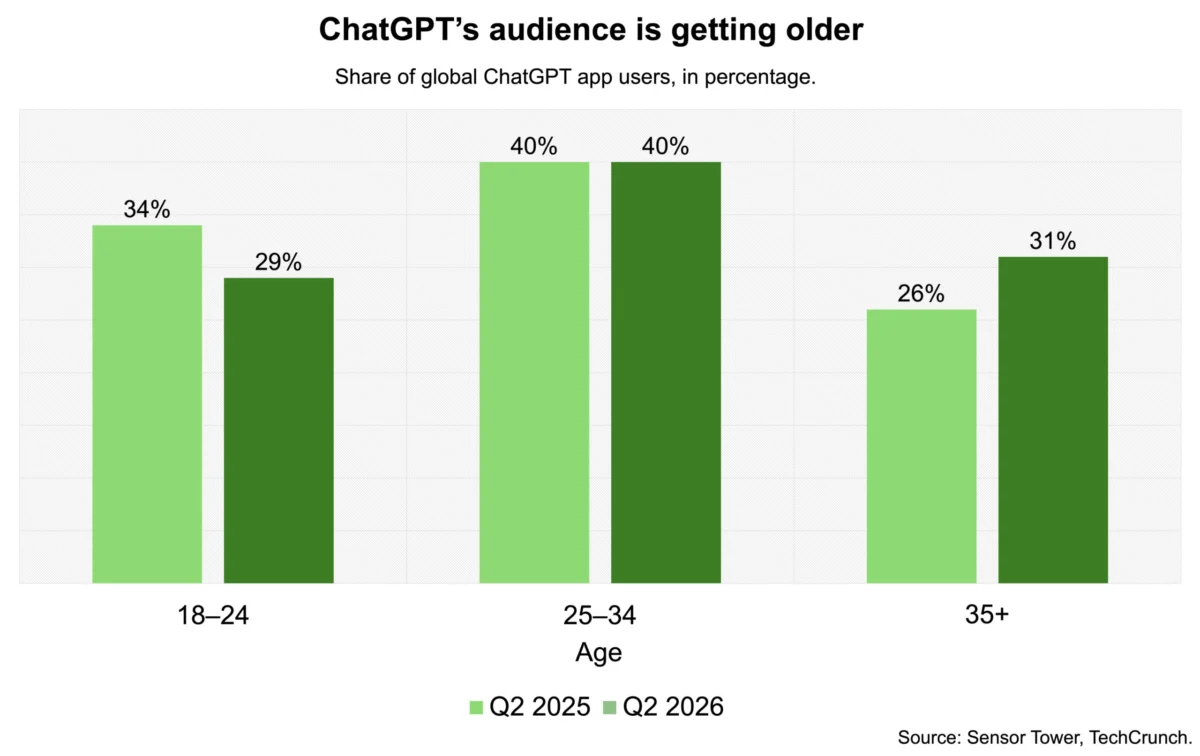
The pivot toward family-centric product design is driven by a clear, data-backed shift in user demographics. According to exclusive estimates from market intelligence firm Sensor Tower, the user base of ChatGPT is aging alongside the technology itself.
In the second quarter of this year, the share of global ChatGPT users aged 35 and older rose to 31%, up from 26% a year prior. Conversely, the core demographic of 18-to-24-year-olds saw a decline, dropping from 34% to 29%. This trend is even more pronounced in the United States, where nearly one in four smartphone users who are parents reported using ChatGPT during the second quarter—a significant jump from 16% just twelve months earlier.
This demographic data suggests that the "AI early adopter" phase is giving way to a "mass market" phase. While ChatGPT is currently experiencing the fastest growth among users aged 45 and older—rising three percentage points year-over-year—its competitors are seeing different results. While Google’s Gemini and Anthropic’s Claude maintain a strong hold on the 25-to-34 age bracket, ChatGPT’s aggressive acquisition of older, parent-aged users underscores its potential to become a household utility.
A Chronology of Safety and Scrutiny
The road to a family-focused strategy has not been without turbulence. The push to design for younger users comes amid intense regulatory and legal scrutiny regarding the potential harms of generative AI.

OpenAI has faced a series of high-profile lawsuits from parents who allege that ChatGPT played a contributing role in the distress of their children, including several tragic cases involving teen suicide. These legal challenges have forced the company to accelerate its safety infrastructure.
- Late 2025: Amid mounting pressure, OpenAI began routing sensitive, potentially distressed conversations to more advanced, reasoning-heavy models designed to identify crisis signals.
- September 2025: The company officially rolled out comprehensive parental controls for teen accounts, allowing for greater visibility and restrictions on content.
- May 2026: In a significant safety update, OpenAI introduced a "Trusted Contact" feature. This optional tool allows the AI to trigger alerts to designated family members or caregivers if it detects indicators of potential self-harm.
Despite these measures, the gap between parental perception and reality remains wide. A recent study by the Family Online Safety Institute (FOSI), which surveyed over 4,000 families across the United States and Australia, revealed a striking disconnect: while only 27% of U.S. parents believed their child had used generative AI in the past week, 38% of the children themselves reported doing so.
Implications: The "Safety by Redesign" Imperative
The need for a dedicated family product manager is, in part, a recognition that the "one-size-fits-all" approach to AI is no longer viable. Stephen Balkam, CEO of the Family Online Safety Institute, describes this transition as "safety by redesign."
"The initial products were released into the wild without children in mind," Balkam explained. "They were built for power users, researchers, and professionals. To now try to force those tools to be safe for a ten-year-old is a challenge. Hiring specialized product leads is a necessary reaction to that reality."
Balkam argues that true "family-safe" AI requires a complete overhaul of the user experience. He advocates for:
- Strict Age-Appropriate Experiences: Interfaces that simplify complex language and provide context-aware responses suitable for younger cognitive development.
- Human-AI Distinction: Consistent, inescapable reminders that the user is interacting with a machine, not a sentient human, to prevent emotional reliance or manipulation.
- Parental Oversight Modules: Tools that allow parents to define boundaries without compromising the privacy of the child’s exploration.
"We have an opportunity here to learn from the mistakes of the social media era," Balkam added. "For years, platforms treated teenagers like adults, with disastrous results for mental health and privacy. OpenAI has the chance to get it right by building safeguards into the architecture of the AI itself."
The Future Landscape: What Comes Next?
As OpenAI looks toward a future of "household AI," the industry is bracing for a new wave of product categories. Based on current trends and industry expert projections, the next few years will likely see the following developments:
- Shared Household Memory: AI assistants that understand the context of a family—who has allergies, who needs a ride to soccer practice, and what the family’s shared calendar looks like.
- AI Tutoring and Coaching: Building on recent collaborations, such as those with the San Antonio Spurs Community Impact organization, we can expect AI to become a standard tool for personalized education and youth sports coaching.
- Multi-User Profiles: Similar to streaming services, AI accounts may soon allow for multiple, segmented profiles under a single subscription, with distinct safety filters for each user.
While OpenAI declined to comment on its specific hiring plans or future product features, the intent is clear. The company is transitioning from an experimental research lab to a provider of daily household infrastructure.
For the average consumer, this means the AI of 2027 will look very different from the ChatGPT of 2023. It will likely be more embedded, more guarded, and significantly more attuned to the nuances of family life. Whether these safeguards will be sufficient to satisfy regulators and concerned parents remains the primary question for the next chapter of the AI era. As Bajarin noted, "We are moving into an era where the AI in your living room will know more about your family than any piece of technology ever has. The design decisions made today will dictate the trust we place in those systems for decades to come."