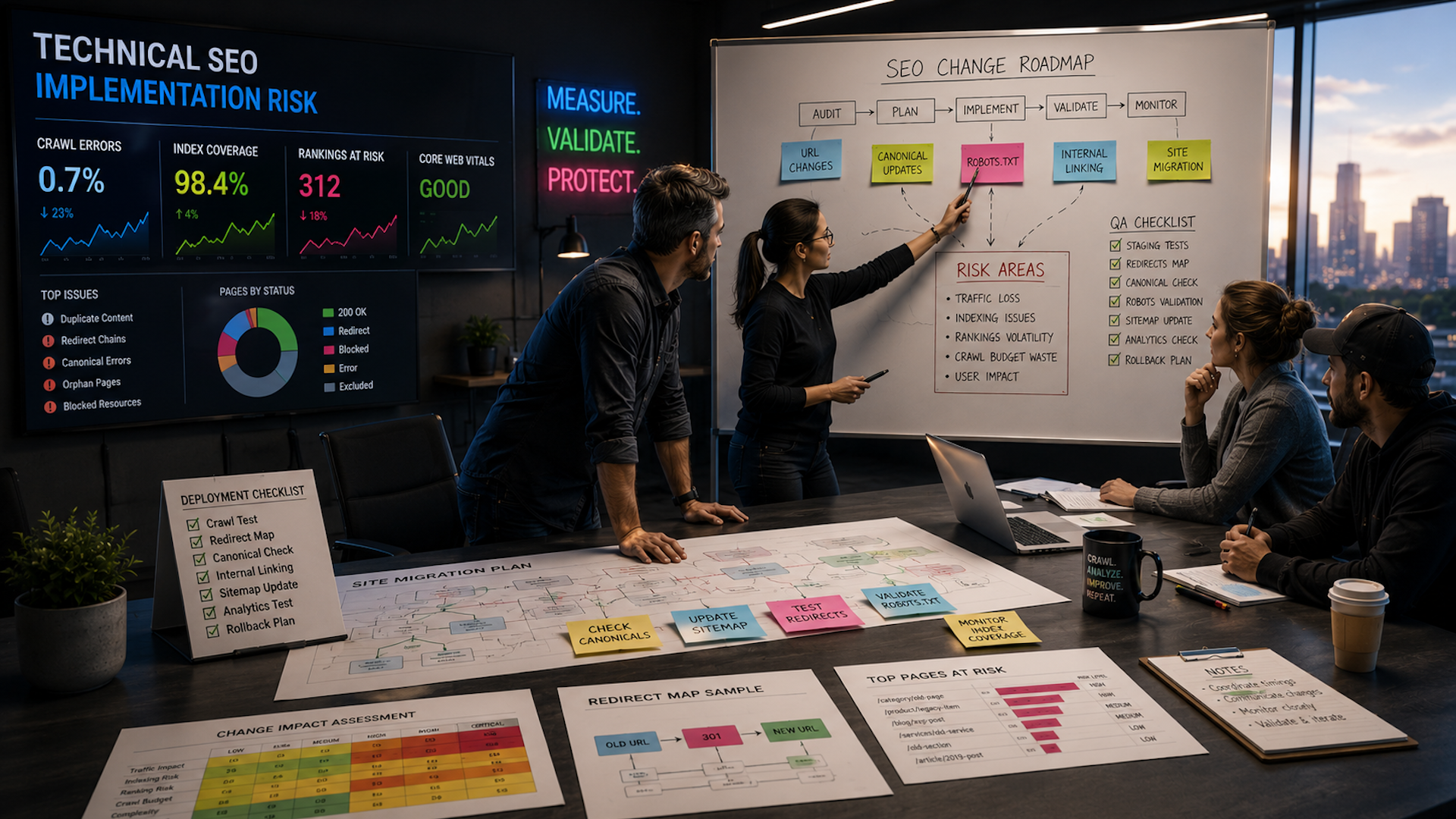
Technical search engine optimization (SEO) remains one of the most powerful levers for driving organic visibility, yet it is also one of the most misunderstood. While strategic content and backlink acquisition often dominate marketing discussions, the underlying technical infrastructure of a website dictates how search engines access, interpret, and rank that content.
However, the technical SEO landscape is defined by a sharp paradox: the recommendations that carry the greatest potential for positive organic growth also carry the highest risk of catastrophic failure. A single misconfigured directive can instantly erase years of search equity, drop key landing pages from search indexes, and severely disrupt corporate revenue streams.
Consequently, modern technical SEO has evolved from a simple diagnostic exercise into a complex discipline of risk management, cross-functional project coordination, and rigorous quality assurance.
Main Facts: The Intersection of Impact, Effort, and Risk
The primary challenge of technical SEO lies in the execution. Automated crawling tools and auditing suites are highly effective at generating massive lists of site "errors," but they lack the business context required to prioritize them. To transform an audit into an actionable, low-risk roadmap, digital marketers and webmasters must evaluate every recommendation through a multi-dimensional framework:
- Severity of the Issue: Does the technical flaw actively prevent search engine crawlers from indexing high-value pages, or is it merely a minor compliance warning?
- Expected Business Outcome: Will resolving this issue yield a measurable increase in organic traffic, conversions, or user experience, or is it a low-impact cosmetic fix?
- Scope of Impact: How many page templates and unique URLs are affected by the proposed change?
- Implementation Effort: What resources—measured in developer hours, budget, and CMS flexibility—are required to deploy the fix?
- Operational Risk: What is the worst-case scenario if the implementation fails, and do we have a rollback plan?
The Pitfalls of Automated Audits
A common mistake in digital marketing is treating automated SEO audits as absolute directives. Auditing platforms frequently flag minor issues—such as missing meta descriptions, slightly long title tags, or minor image alt-text omissions—with the same visual urgency as critical indexation blocks.
While these surface-level elements are easy for automated tools to measure, they rarely move the needle on business-critical metrics. Conversely, systemic infrastructure flaws, such as JavaScript rendering issues or complex canonicalization loops, require manual validation and deep technical expertise to diagnose.
Without manual verification and site-specific context, organizations risk wasting valuable engineering resources on low-value fixes while high-risk structural flaws remain unaddressed.
Chronology: The Lifecycle of a Technical SEO Implementation
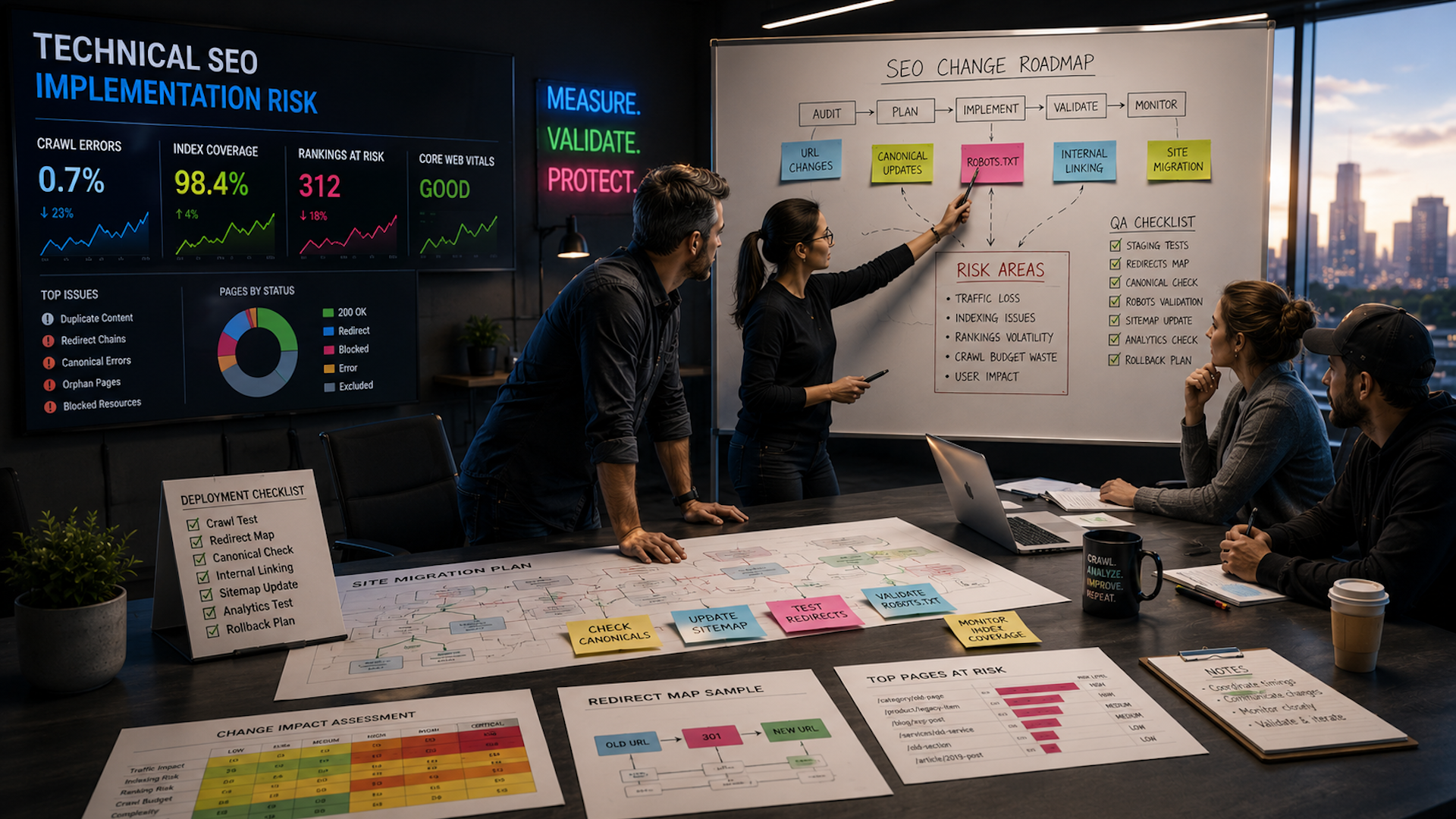
A successful technical SEO initiative does not end when the audit is delivered. To minimize risk and ensure measurable success, organizations must follow a structured, chronological implementation pipeline.
[Phase 1: Audit & Discovery]
       │
       ▼
[Phase 2: Validation & Prioritization]
       │
       ▼
[Phase 3: Pre-Production & Staging Testing]
       │
       ▼
[Phase 4: Production Deployment & QA]
       │
       ▼
[Phase 5: Post-Launch Monitoring]
Phase 1: Audit and Discovery
The lifecycle begins with a comprehensive technical audit. Using enterprise crawlers, log file analyzers, and search console data, the SEO team maps the website’s current architecture, identifying crawl bottlenecks, duplicate content, indexing errors, and page speed deficiencies.
Phase 2: Validation and Prioritization
Once the raw data is gathered, the SEO team manually validates the findings against the site’s business goals. High-impact, low-risk recommendations are prioritized for immediate implementation, while high-risk initiatives (such as URL migrations or sitewide internal linking changes) are scheduled for extensive planning. During this phase, the SEO team collaborates with product owners and developers to secure buy-in and align resources.
Phase 3: Pre-Production Testing (Staging)
No technical SEO change should be deployed directly to a live production environment. In this phase, developers implement the approved recommendations within a isolated staging or development environment. The SEO team then performs rigorous quality assurance (QA) testing, using specialized staging crawlers to verify that the changes behave exactly as intended without introducing secondary errors.
Phase 4: Production Deployment
With staging tests approved, the changes are scheduled for deployment to the live website. These deployments are ideally scheduled during low-traffic periods to minimize the business impact of any unforeseen service disruptions.
Phase 5: Post-Launch Monitoring and Validation
Immediately following deployment, the SEO team conducts a post-launch audit to verify that the live changes mirror the staging environment. Continuous monitoring is maintained for several weeks to track search engine crawl rates, indexation status, organic rankings, and traffic fluctuations.
Supporting Data: The Five High-Risk Technical SEO Red Zones
To understand why technical SEO requires such meticulous planning, it is necessary to examine the five areas where changes have the most profound influence on search engine behavior.
┌─────────────────────────────────────────────────────────────────────────┐
│                    HIGH-RISK TECHNICAL SEO RED ZONES                    │
├───────────────────┬─────────────────────────────────────────────────────┤
│ 1. URL Structure  │ Preserves search equity, backlinks, and authority   │
│    & Redirects    │ via clean 301 mapping.                              │
├───────────────────┼─────────────────────────────────────────────────────┤
│ 2. Canonical      │ Consolidates ranking signals; prevents duplicate    │
│    Tags           │ content indexing issues.                            │
├───────────────────┼─────────────────────────────────────────────────────┤
│ 3. Robots.txt     │ Controls search crawler access; manages crawl       │
│    Directives     │ budget allocation.                                  │
├───────────────────┼─────────────────────────────────────────────────────┤
│ 4. Internal       │ Distributes PageRank; defines site hierarchy and    │
│    Linking        │ content relationships.                              │
├───────────────────┼─────────────────────────────────────────────────────┤
│ 5. Site           │ Combines multiple high-risk shifts (CMS, domain,    │
│    Migrations     │ design) into one launch.                            │
└───────────────────┴─────────────────────────────────────────────────────┘
1. URL Architecture and Redirect Strategies
Whether reorganizing content into logical subfolders, consolidating outdated pages, or updating URL slugs for clarity, URL changes are highly common. However, search engines treat any changed URL as an entirely new page.
Without a flawless redirect strategy, the historic search authority, rankings, and backlink equity of the original page are lost.

- The Risk: Implementing incorrect redirect mappings, creating infinite redirect loops, or introducing multi-step redirect chains can degrade page load speeds and exhaust search engine crawl budgets.
- The Mitigation: A comprehensive 301 redirect map must be compiled and tested in staging. Once live, internal links and XML sitemaps must be updated immediately to point directly to the new, canonical destination URLs, bypassing the redirects entirely.
2. Canonical Tag Optimization
Canonical tags act as a critical signaling mechanism, telling search engines which version of a page should be indexed when duplicate or highly similar content exists. This is especially vital for e-commerce sites, where dynamic sorting, filtering, and product variations generate thousands of near-identical URLs.
- The Risk: If a canonical tag is pointing to the wrong template or a non-existent URL, search engines may drop entire categories of high-value pages from their index. Conflicting signals—such as page A pointing to page B, while page B points back to page A—can confuse search crawlers, leading to unpredictable ranking drops.
- The Mitigation: Canonical configurations must be systematically checked across all page templates. Automated scripts should be used to ensure that self-referential canonicals are dynamic and that parameterized URLs resolve to their clean, static equivalents.
3. Robots.txt Modifications
The robots.txt file is the gatekeeper of a website. It dictates which directories and files search engine bots are permitted to crawl. Optimizing this file is a powerful way to block low-value pages (such as internal search results, admin portals, or staging environments) from wasting valuable crawl budget.
- The Risk: A single misplaced slash (
/) or syntax error in arobots.txtdirective can block search engines from crawling the entire website. This is particularly common during site migrations, where a stagingrobots.txtfile containing a blanketDisallow: /directive is accidentally deployed to the live production environment. - The Mitigation: Developers and SEOs must utilize testing suites, such as Google Search Console’s Robots Testing Tool, to validate every directive before deployment. Real-time alerts should be configured to detect sudden drops in crawl rate or indexation.
4. Internal Linking Restructuring
Internal links are the pathways search engines use to discover content and distribute algorithmic authority (PageRank) across a website. Modifying sitewide navigation menus, footers, or contextual linking blocks can fundamentally alter how search engines prioritize different sections of a site.
- The Risk: Large-scale navigation changes can inadvertently "orphan" high-value pages by removing all inbound internal links, making them virtually undiscoverable to search crawlers. Conversely, linking to outdated staging URLs or non-public pages can confuse search bots and degrade user experience.
- The Mitigation: Before modifying sitewide menus, a complete crawl of the site should be conducted to map the existing link architecture. Post-change crawls must verify that no critical pages have been pushed too deep into the site’s directory hierarchy (ideally keeping key pages within three clicks of the homepage).
5. Full-Scale Site Migrations
A site migration—whether moving to a new domain, transitioning to a different Content Management System (CMS), rebranding, or undergoing a complete design overhaul—is the ultimate test of a technical SEO team. It combines all of the aforementioned technical changes into a single, high-stakes event.
- The Risk: Even minor oversights during a migration can lead to a catastrophic drop in organic traffic and revenue. If redirects fail to launch, canonicals break, or sitemaps are not updated simultaneously, the site’s search presence can collapse overnight.
- The Mitigation: A detailed, multi-stage migration checklist must be established. This includes pre-launch benchmarking, staging environment audits, a synchronized launch-day plan, and intensive post-launch monitoring of search consoles and analytics platforms to catch and resolve issues in real time.
Stakeholder Perspectives: Resolving the SEO-Developer Tension
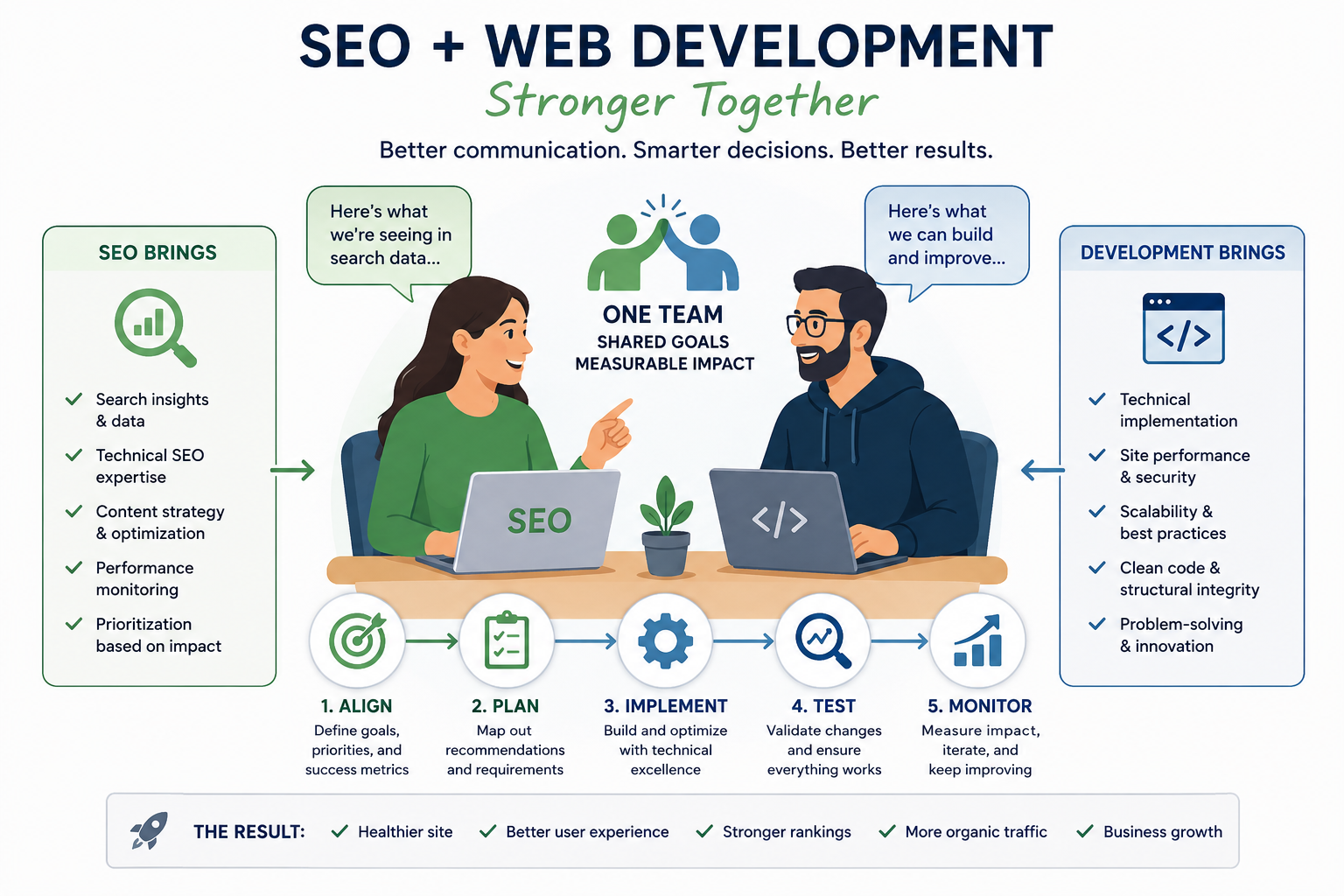
Technical SEO cannot exist in a vacuum. Its execution relies heavily on collaboration between diverse, cross-functional teams, including in-house developers, external agencies, product managers, and content creators.
Historically, this relationship has been marked by tension. Developers often view SEO requests as vague, disruptive to sprint cycles, or technically impractical. Conversely, SEO teams sometimes feel that critical technical tickets are perpetually relegated to the bottom of the development queue.
Bridging the Communication Gap
To resolve this friction and ensure successful implementation, SEO professionals must adapt how they communicate technical recommendations:
- Translate SEO Impact into Engineering and Business Metrics: Rather than simply stating that a page is slow, SEOs should demonstrate how page speed improvements correlate with reduced server load, higher conversion rates, and increased organic revenue.
- Provide Clear, Structured Documentation: Technical recommendations should be delivered as detailed, actionable engineering tickets (e.g., Jira tickets). These tickets must clearly define the issue, outline the exact steps required for implementation, provide concrete examples of the affected code, and establish clear acceptance criteria.
- Acknowledge Technical Limitations: Every platform and CMS has its constraints. By understanding the development stack and working within existing technical boundaries, SEOs can propose pragmatic, alternative solutions that achieve the desired outcome without requiring a complete code rewrite.
Implications: Technical SEO in the Era of AI and Search Evolution
The importance of technical SEO is expanding rapidly beyond the confines of traditional search engine results pages. As search engines transition into answer engines powered by Generative AI, Large Language Models (LLMs), and Retrieval-Augmented Generation (RAG), the underlying technical architecture of websites has become even more critical.
The Rise of AI Crawlers
AI-driven search platforms rely on specialized web crawlers to gather information for their knowledge bases. Managing how these AI bots interact with a website requires the same technical SEO mechanisms—such as robots.txt directives, structured data markup, and clean site architectures—used for traditional search crawlers.
If a website’s technical foundation is broken, AI engines will fail to access, digest, and reference its content, rendering the brand invisible to a growing segment of searchers.
Structured Data and Schema Markup
Search engines increasingly rely on structured data (Schema markup) to understand the explicit meaning and context of web content. Properly implemented Schema allows search engines to display rich results, such as product prices, review stars, event dates, and FAQ dropdowns directly in search results.
As search becomes more visual and interactive, the technical implementation of structured data is no longer a luxury—it is a baseline requirement for maintaining search visibility.
Final Takeaway
Technical SEO is not a one-time project or a simple post-audit checklist. It is an ongoing process of optimization, communication, and risk management.
While the temptation to implement rapid, sitewide changes is strong, the potential risks demand a disciplined, methodical approach. By balancing opportunity with risk, testing every change in staging, and fostering strong collaborative relationships across development and product teams, organizations can build a resilient, highly visible digital presence that thrives amidst the continuous evolution of search.