The landscape of professional web development is undergoing a seismic shift. As Artificial Intelligence (AI) matures from a novelty into a core operational component, WordPress agencies are finding themselves at a critical juncture. Do they resist the tide, or do they build a sustainable, future-proof framework for AI integration?
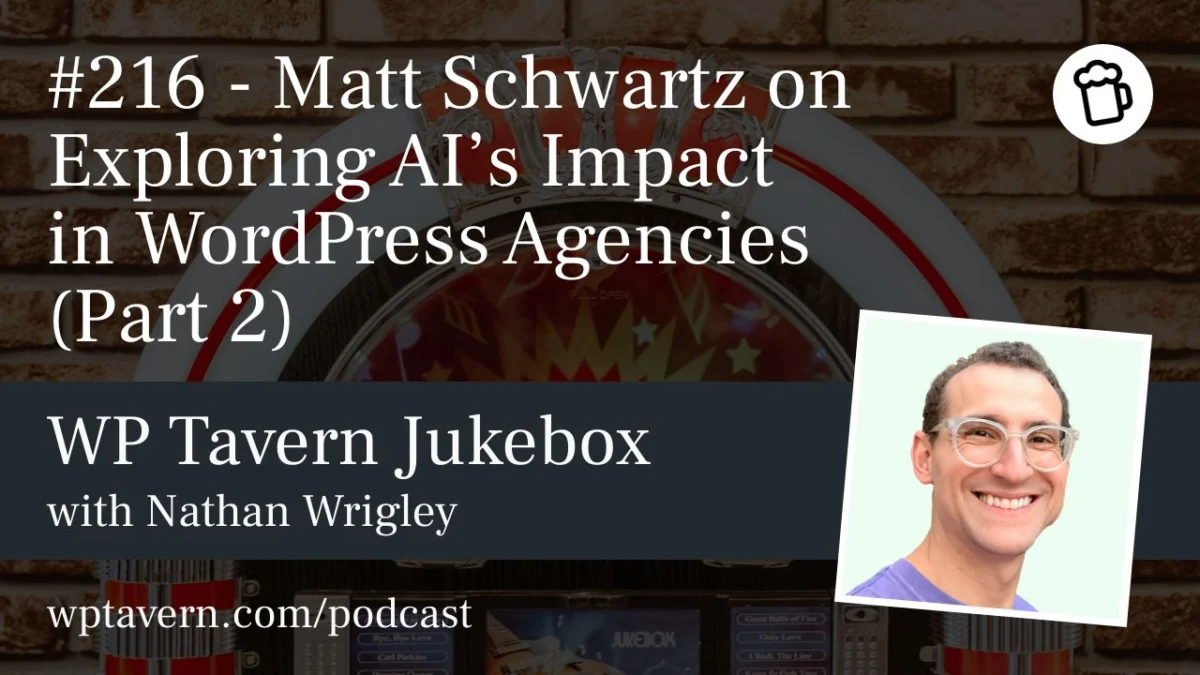
In a recent two-part deep dive on the WP Tavern Jukebox podcast, host Nathan Wrigley sat down with agency veteran Matt Schwartz to dissect the practical, ethical, and operational realities of bringing AI into the WordPress agency fold. Schwartz, who has been active in the WordPress ecosystem since 2011 and operates an agency in Atlanta, argues that the key to success lies not in reckless adoption, but in "smart and cautious" implementation.
The Strategic Shift: Managing the Agency Brain
For many agencies, the primary hurdle in AI adoption is not the technology itself, but the lack of contextual data. Schwartz highlights a powerful strategy often referred to as "giving AI access to your agency’s brain."
By connecting internal knowledge bases—such as project management tools like ClickUp or Asana, and internal wikis—to AI chatbots, agencies can transform generic AI into a bespoke expert. Instead of the AI "hallucinating" or providing generic advice, it is instructed to cross-reference agency-specific documentation. This ensures that when a team member asks, "How do we handle a client launch?", the AI pulls from the agency’s actual Standard Operating Procedures (SOPs). This strategy effectively bridges the gap between raw generative power and actionable internal policy.
The Rise of Model Context Protocol (MCP)
As agencies scale their AI efforts, they often hit a wall of complexity regarding API management. This is where the Model Context Protocol (MCP) has emerged as a potential game-changer.
MCP acts as a standardized, open-source bridge that allows AI agents to securely interact with external systems—such as databases, help desks, or WordPress REST APIs—without requiring the developer to build custom, fragile API integrations for every single task. By treating the MCP as a secure "gatekeeper" or proxy, agency leaders can ensure that their staff and AI agents have the access they need to perform tasks without exposing sensitive API keys to every individual user. This layer of security is essential for agencies managing high-stakes client infrastructure.
Vibe Coding and Internal Tooling: The Risk Calculus
A burgeoning trend in the agency world is "vibe coding"—the practice of using AI to rapidly generate internal tools or scripts. While this allows for unprecedented speed in development, it carries significant risks if not managed correctly.
Schwartz advocates for a strict risk-based approach:
- Internal Tools: These are relatively safe environments for experimentation. Reporting dashboards, time-tracking aggregators, and profitability analyzers are excellent candidates for AI-assisted development.
- Public-Facing/Mission-Critical Systems: This is where the "vibe" must give way to rigor. Building custom website management dashboards or automated migration tools using AI without extensive manual code review is a recipe for disaster.
The consensus is clear: if the tool manages client infrastructure, it requires human-in-the-loop validation. The goal is to use AI to handle the "low-hanging fruit"—the tasks that never made it onto the to-do list—rather than replacing robust, proven SaaS solutions simply to save a nominal monthly fee.
QA, Checklists, and the Human-in-the-Loop
Quality Assurance (QA) remains one of the most labor-intensive aspects of agency life. Here, AI excels as an assistant rather than a replacement. By utilizing tools like "Claude Skills," agencies can automate the execution of complex, repeatable processes.
However, Schwartz warns against total automation of high-risk items. Even when an AI successfully handles 99% of a site-launch checklist, the final 1%—such as verifying that a "no-index" tag isn’t accidentally left on a production site—must remain a human-verified task. The philosophy here is to let AI handle the heavy lifting of documentation and routine verification, freeing up human developers to perform the "deep review" that protects the agency’s reputation.
The Impact on the WordPress Plugin Market
Perhaps the most contentious point raised in the discussion is the ripple effect AI is having on the WordPress plugin ecosystem. As agencies and individual developers use AI to "generate" utility plugins for specific needs, the demand for small, single-purpose plugins is shrinking.
This poses a significant threat to the diversity of the WordPress community. Smaller developers, who often cut their teeth in the ecosystem by building and maintaining niche plugins, are seeing a decline in sales and engagement. This leads to a concerning trend: the potential "haemorrhaging" of the community spirit that has defined WordPress for decades. If the barrier to entry shifts from collaborative code-sharing to private, AI-generated, one-off scripts, the collective intelligence of the ecosystem may begin to erode.
Risks, Cautions, and the Future of Hiring
As the industry matures, agencies must confront the reality of their reliance on a handful of AI vendors. The cost of these services is currently subsidized by venture capital, but that era is likely coming to an end.
Key Risks for Agencies:
- Data Privacy: Any data fed into public AI models should be considered public record. Agencies must be extremely cautious about inputting proprietary client information.
- Overdependence: If an agency builds its entire workflow around a single AI vendor, a price hike or a shift in tool capability could be catastrophic.
- Error Propagation: AI is prone to "hallucinations." Without proper logging and error-handling, an AI-driven tool can silently fail, causing issues that might go undetected until a client notices.
The Outlook for 2026 and Beyond
The hiring landscape is already shifting. Many agencies are slowing down their recruitment of junior, non-specialist roles as AI handles entry-level execution. However, this is not necessarily a permanent decline in demand for talent. Instead, the focus is shifting toward "AI Managers"—professionals who can oversee, test, and validate the output of AI systems.
The future of the agency model, according to Schwartz, is one of productized services. By combining deep niche knowledge (e.g., specialized sites for plumbers) with AI-powered operational efficiency, agencies can provide more value than ever before.
Conclusion
The transition into an AI-augmented agency is not a sprint; it is a strategic marathon. The most successful agencies will be those that maintain a "wide-eyed" approach—leveraging the immense power of AI for efficiency while maintaining a rigorous, human-centric framework for quality, security, and community engagement.
As Nathan Wrigley noted in the closing of the Jukebox podcast, the future is undoubtedly going to be interesting. For those willing to document their processes, implement robust guardrails, and stay mindful of the risks, AI represents not the end of the agency model, but its next great evolution.