
Most marketing teams operate on a "launch and pray" philosophy. They invest weeks of labor into a campaign, push it live, and then either celebrate a win or mourn a failure before moving on to the next task. This binary approach, while common, leaves significant revenue on the table.
In the modern digital landscape, where user behavior shifts in response to global trends, economic fluctuations, and competitive pressures, a one-time test is merely a snapshot of a moment that has already passed. The solution is iterative testing—a methodology that transforms marketing from a series of disjointed bets into a continuous, evidence-based cycle of improvement.
Understanding the Iterative Testing Paradigm
Iterative testing is the practice of repeatedly testing, measuring, and refining marketing assets based on the insights gleaned from previous cycles. Borrowed from agile product development, this approach emphasizes small, incremental changes over radical overhauls.
Why Marketers Must Embrace the Cycle
Traditional marketing "flops" are rarely explosive disasters; they are typically "slow leaks"—subtle friction points in the user journey that drain marketing budgets day after day. Iterative testing acts as the patch for these leaks.
By committing to a process of continuous experimentation, marketers can:
- Identify hidden friction: Discover exactly why visitors are dropping off, rather than guessing.
- Maximize ROI: Shift budget away from underperforming elements toward those that drive verifiable growth.
- Future-proof strategy: Ensure campaigns remain relevant as user expectations evolve.
For instance, industry data suggests that content complexity is a major conversion factor. The 2024 Conversion Benchmark Report revealed that landing pages written at a 5th-7th grade reading level convert at a rate of 11.1%—more than double the efficacy of professional-level copy. Iterative testing allows a team to test their specific audience’s tolerance for complexity, moving from a generic best practice to a custom-tailored strategy.

The Shift: From "Home Runs" to "Base Hits"
The biggest psychological barrier in marketing is the desire to hit a home run with every campaign. However, the data is clear: those who swing for the fences strike out more often than they connect.
Iterative testing favors "consistent base hits." By focusing on small, actionable insights, teams can make data-driven decisions that compound over time. These micro-wins—a 2% increase here, a 3% decrease in bounce rate there—accumulate into massive, predictable growth.
1. Accelerating Feedback Loops
In the past, marketing feedback cycles were dictated by quarterly reviews. Today, an iterative model shrinks those cycles to days. With modern tools, marketers can identify what resonates with an audience long before the entire budget is exhausted. This speed is a competitive advantage; while competitors are still debating the results of a "big launch," an iterative team has already run four tests and implemented the winning variations.
2. Evidence-Based Budgeting
With marketing budgets tightening, the "spray and pray" method is no longer viable. Iterative testing allows teams to test concepts on small, high-intent segments before scaling. If a headline tweak proves ineffective on a small test group, you have saved the budget that would have been wasted on a full-scale deployment.
3. Adapting to Evolving User Needs
User behavior is not static. For example, while 83% of landing page traffic now originates on mobile devices, desktop traffic often continues to outperform mobile in conversion rates. An iterative approach allows you to reconcile this discrepancy by testing device-specific messaging or layout adjustments, ensuring your strategy adapts to how your users actually consume your content.
The Six-Step Iterative Testing Framework
To implement this, marketing teams need a repeatable, low-friction process. This step-by-step framework is designed to prioritize speed and learning.

Step 1: Define a Focused Hypothesis
The most common failure point is testing too many variables at once. If you change your headline, button color, hero image, and form length simultaneously, you will never know which variable drove the change.
The Rule: A good hypothesis should be narrow. For example: "Changing the CTA button text from ‘Submit’ to ‘Get My Free Guide’ will increase click-through rates by 5% because it emphasizes value over action."
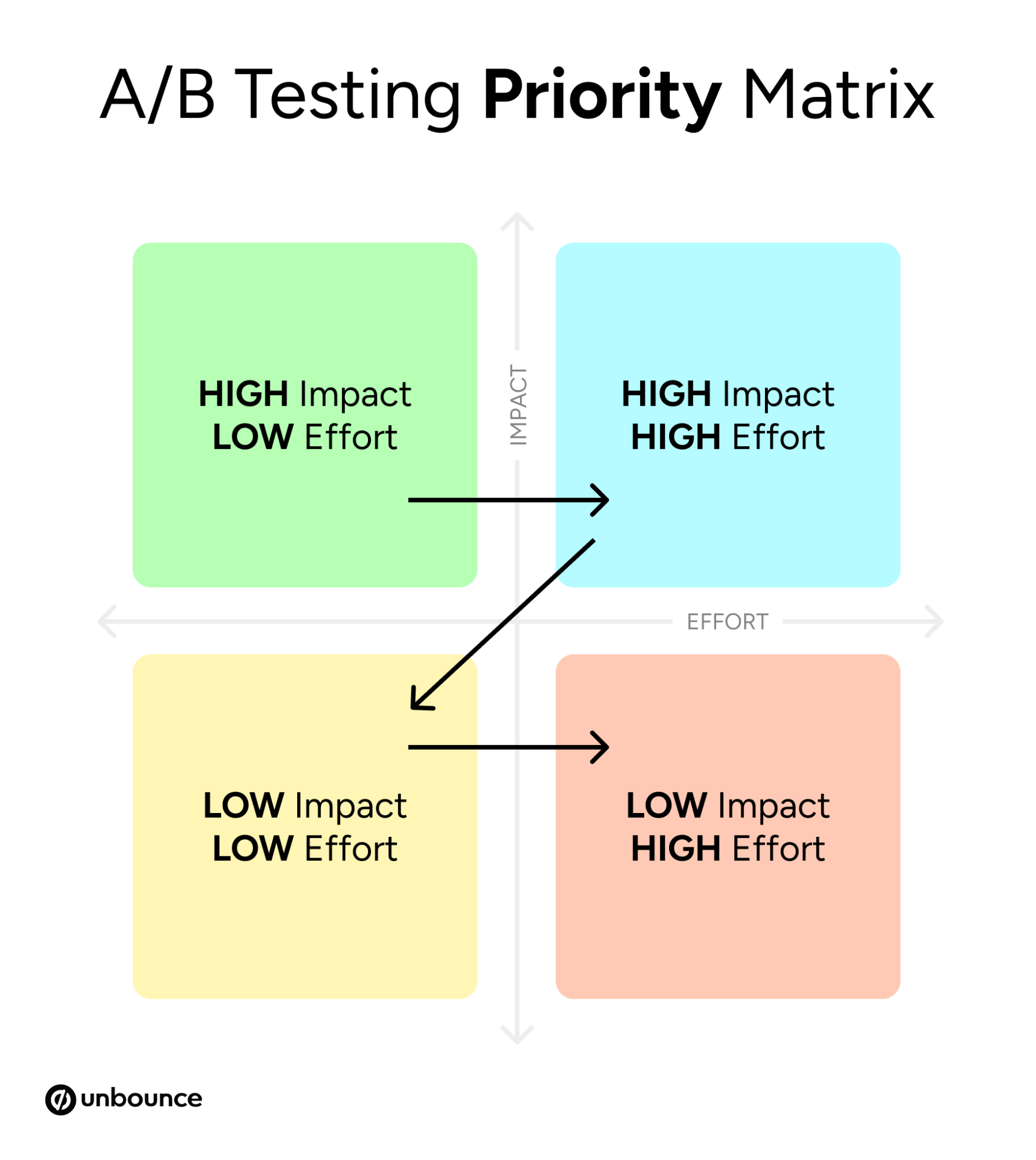
Step 2: Prioritize via Impact vs. Effort
Not all tests are equal. Use a 2×2 matrix to categorize your ideas:
- High Impact/Low Effort: The "Quick Wins"—do these first.
- High Impact/High Effort: Strategic projects for the roadmap.
- Low Impact/Low Effort: Fillers to run when time permits.
- Low Impact/High Effort: Discard these entirely.
Step 3: Build a Minimal, Testable Variation
Keep your variations clean. Use an A/B testing platform that allows you to duplicate your control page and modify only the element you are testing. This ensures that the data you collect is clean and attributable to a specific change.
Step 4: Launch and Collect Meaningful Data
Statistical significance is the difference between a real insight and a lucky guess. Avoid the temptation to pull the plug on a test just because you see a positive trend early on. Wait for a large enough sample size to ensure the results are reliable. Without this discipline, you are just making decisions based on noise.
Step 5: Analyze and Extract Insights
When a test concludes, the result is never just "Variant B won." Ask the "why" behind the numbers. Did users prefer shorter forms? Did they respond better to professional or conversational copy? Transform these data points into organizational knowledge that informs future campaigns.
Step 6: Iterate, Expand, and Scale
Once you have a winner, you have a choice: replicate the success on other pages, apply the insight to a new channel (like email or social ads), or use it to inform your next, more advanced test. Each test is a stepping stone.
Best Practices for Long-Term Success
Speed Over Perfection
The best test is the one you actually run. Do not get bogged down in internal bureaucracy or "analysis paralysis." If you can run 10 simple tests in the time it takes your competitor to run one complex, "perfect" experiment, you will win on sheer volume of learning.
Focus on Core Metrics
Don’t get lost in vanity metrics. Focus on the core KPIs that drive your business: click-through rate, conversion rate, and cost-per-acquisition. If a change doesn’t move these needles, it is likely noise.
Foster Cross-Functional Collaboration
Marketing doesn’t exist in a silo. Your customer support team knows exactly what questions your prospects are asking before they buy. Your sales team knows what objections kill deals. Tap into these teams to build a backlog of testing ideas. When a test is inspired by a real-world customer pain point, the results are almost always more impactful.
Implications for the Future of Marketing
The move toward iterative testing represents a fundamental shift in how businesses grow. It moves the discipline away from "creative intuition" toward "scientific rigor."
As AI and automation tools become more prevalent, the ability to iterate will become the primary differentiator for high-performing marketing teams. Companies that can effectively synthesize data into rapid, iterative actions will not only outpace their competitors in conversion rates—they will develop a deeper, more empathetic understanding of their customers.
In conclusion, iterative testing is not a one-time project; it is a culture. It is the acknowledgement that we do not have all the answers, but by asking the right questions—and testing them one by one—we can ensure that every marketing dollar spent is an investment in a better, more effective future.