In the high-stakes world of Software-as-a-Service (SaaS), the fundamental mechanics of revenue generation have remained remarkably consistent for over a decade. However, as the industry matures and market pressures shift, the way companies reward their sales force is undergoing a quiet but significant transformation. New data from the 2026 ICONIQ GTM benchmark survey, which analyzed over 150 B2B organizations, provides a definitive look at how sales compensation—and the role of the Account Executive (AE)—is evolving to meet the demands of a more efficient, growth-oriented economy.
The Core Economics: The 20% Baseline
At the heart of any SaaS compensation strategy lies a golden rule: the total On-Target Earnings (OTE) for a sales representative—comprising both base salary and performance bonuses—should generally represent between 20% and 25% of the total annual revenue they generate.
This ratio acts as the "North Star" for sales leadership. If a company pays significantly more, the business model risks becoming unsustainable, particularly as marketing and customer acquisition costs (CAC) continue to mount. If a company pays significantly less, it risks failing to attract the top-tier talent necessary to scale.
The Breakdown by Market Segment
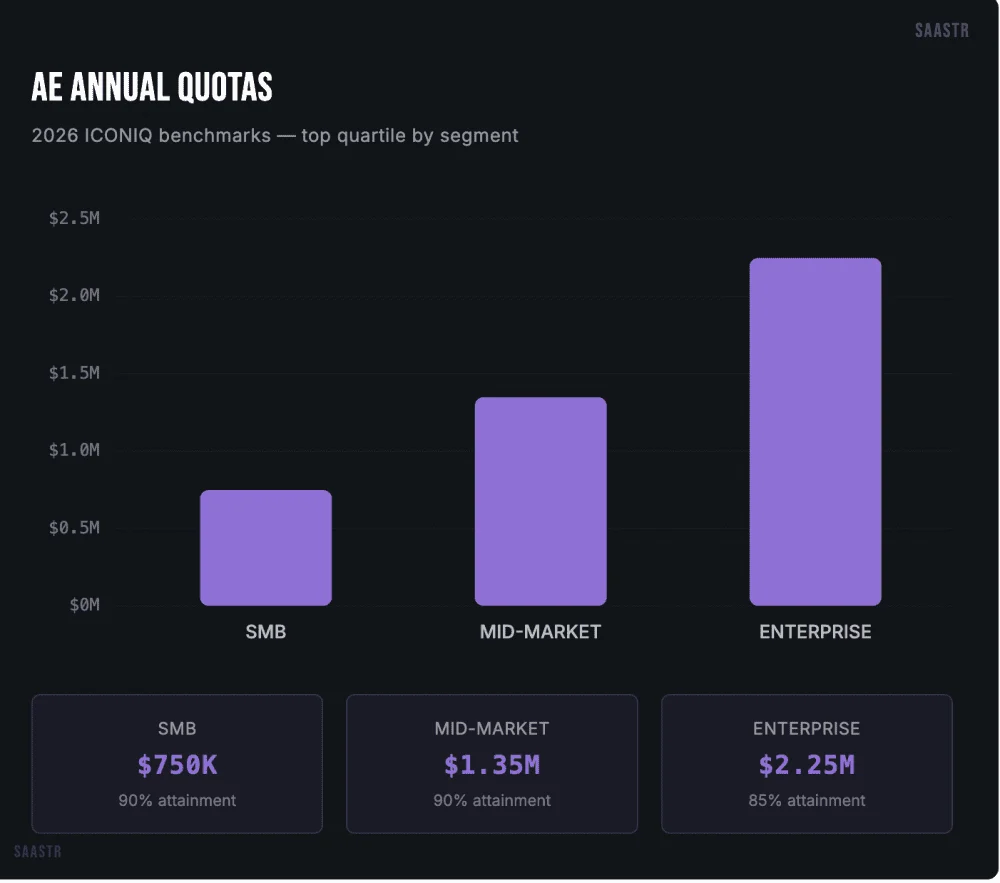
The efficiency of a sales rep is typically measured by their quota-to-OTE ratio. While these figures vary based on deal complexity, the industry standard remains:
- SMB (Small-to-Medium Business): Reps generally bring in 3x to 4x their OTE.
- Mid-Market: The target shifts to 4x to 5x their OTE.
- Enterprise: Due to the complexity and length of sales cycles, reps are expected to generate 5x or more of their OTE.
While venture-backed startups in their infancy may temporarily subsidize higher commission structures to gain early market share, this is rarely a long-term strategy. The 50/50 split between base salary and variable bonus remains the dominant industry standard, providing a predictable floor for the employee while maintaining high-performance incentives for the company.
The Sustainability Ceiling
A recurring theme in SaaS finance is the "break-even" reality. When more than 25% of the first-year Annual Contract Value (ACV) is allocated to sales compensation, the business model becomes dangerously fragile. This is especially true for companies with high net churn. If a customer leaves after the first year, the high acquisition cost creates a deficit that is difficult to recover.
In high-cost-of-living urban centers like San Francisco or New York, smaller deal sizes (e.g., $3,000 ACV) create a mathematical conflict. If a company adheres strictly to the 20% rule, the OTE might be too low to attract competitive talent. In these cases, leadership must choose between subsidizing the sales team at the expense of profitability or shifting their GTM strategy toward higher-value enterprise targets.
The "AI Anomaly" and Market Demand
While the 20% rule holds for most, the emergence of AI giants has introduced a new variable. Companies like Anthropic have fundamentally altered the landscape, often operating with demand levels so extreme that traditional quotas become irrelevant.
When a company has more inbound interest than its sales team can possibly service, the traditional "hunter" model is replaced by a "fulfillment" model. In these outliers, quotas can be set significantly higher than in traditional SaaS companies because the friction of the sale is reduced by extreme product-market fit. However, experts warn that this is a luxury afforded only to the most high-demand AI leaders. For the vast majority of SaaS firms, the traditional quota model remains the only reliable engine for growth.
Chronology of the "Hunter-Farmer" Shift
Historically, the SaaS industry favored a division of labor: "Hunters" (Account Executives) were responsible for closing new business, while "Farmers" (Account Managers or Customer Success Managers) handled the long-term relationship, renewals, and upsells.
The 2026 data indicates a seismic shift away from this siloed approach. The industry is moving back toward a model where the original Account Executive retains ownership of the account throughout its lifecycle.

The Timeline of Transition
- Pre-2020: The "Siloed Era." Rapid scaling led companies to specialize roles to optimize for velocity. Hunters were rewarded for closing; farmers were rewarded for NRR (Net Revenue Retention).
- 2021–2023: The "Efficiency Pivot." As capital tightened, companies began re-evaluating the cost of handoffs. Internal friction between sales and success teams was identified as a primary cause of churn.
- 2024–2025: The "Full-Cycle AE" Experiment. High-performing companies began testing the efficacy of the AE-owned renewal model.
- 2026: The "Integration Standard." Benchmark data confirms that the most successful organizations now treat the hunter-farmer remit as a singular function, driving a significant uptick in NRR.
Supporting Data: Why the Shift Matters
The recent shift isn’t merely philosophical; it is driven by hard data. When AEs own the full customer lifecycle, their incentive structures have necessarily evolved. According to the latest benchmarks, Net Dollar Retention (NDR) compensation jumped 5 points (from 18% to 23%), and NRR compensation saw a dramatic 8-point jump (from 25% to 33%) in a single year.
This indicates that companies are no longer just paying AEs to "close and move on." They are paying for the quality of the revenue. By tying commissions to long-term account health, firms are forcing their sales teams to be more selective, more strategic, and more consultative.
Organizational Structure: The Rise of the Flat Organization
Complementing the shift in compensation is a change in management structure. The 2026 data shows that high-performing sales organizations are moving toward flatter reporting lines, with an average of 9.2 to 9.8 individual contributors (ICs) per manager.
While this is only a slight increase from the traditional 7-8:1 ratio, it represents a deliberate attempt to reduce management overhead and increase the autonomy of the sales force. In a flatter structure, the AE becomes a more independent operator, which aligns with their increased responsibility for renewals and upsells.
Implications for the Future of Sales
The message for founders and sales leaders is clear: the era of the "transactional closer" is being phased out in favor of the "relationship owner."
1. The Death of the Handoff
The "hand-off" between Sales and Customer Success is increasingly viewed as a point of failure. Companies that force their AEs to maintain skin in the game regarding the customer’s long-term success are seeing higher retention rates. This creates a stronger incentive for the AE to sell to the right customer, not just the easiest customer.
2. Compensation as a Strategic Lever
Compensation is no longer just a salary; it is a signal of business strategy. By increasing the percentage of variable pay tied to NRR and NDR, companies are signaling that the value of the business is no longer tied solely to new bookings, but to the compounding growth of the existing customer base.
3. The Need for Generalists
As AEs take on more responsibility, the profile of the "ideal" salesperson is changing. Companies are now looking for candidates who possess not only the closing drive of a hunter but the analytical and relationship-building skills of a customer success manager. This will likely lead to higher base salaries for top-tier talent who can handle this dual workload.
Conclusion: A More Sustainable Path
The 2026 data suggests that the SaaS industry is moving toward a more mature, stable, and sustainable growth model. By aligning sales incentives with long-term retention and flattening management structures, organizations are building more resilient revenue engines.
While the 20% rule remains the baseline for a healthy business, the way those funds are distributed—and the expectations placed on the professionals receiving them—will continue to evolve. For the modern sales organization, success in the coming years will depend on one’s ability to move beyond simple transaction-based growth and embrace the complex, relationship-heavy reality of modern B2B software.