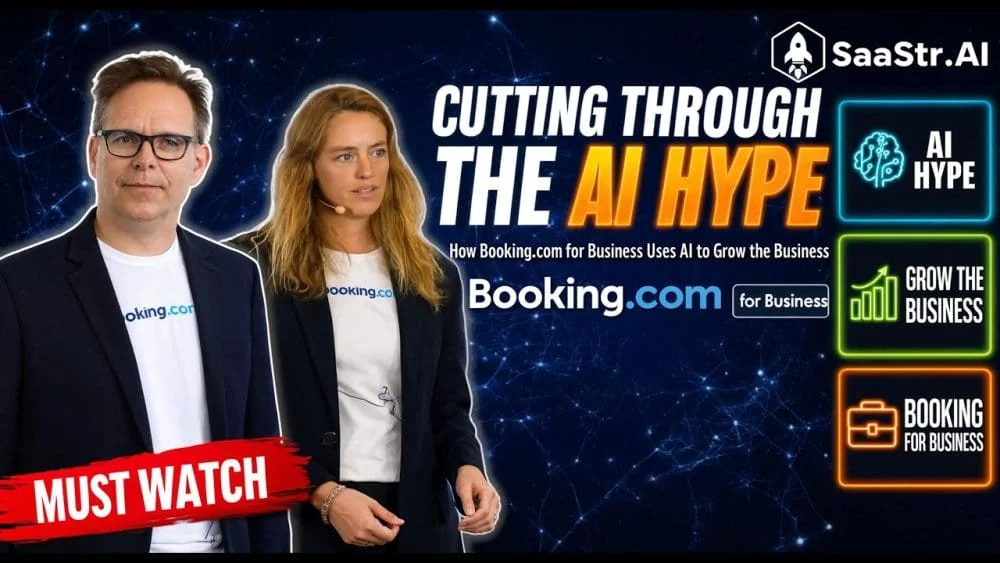
At the recent SaaStr Annual conference, a provocative statement cut through the noise of AI-saturated marketing booths. Joshua Wood, who leads Booking.com for Business, stood on stage and offered a perspective that many in the tech industry are still hesitant to embrace: “In four or five years, no one is going to be talking about AI.”
It is not that artificial intelligence is fading; rather, it is reaching a state of total integration. Much like the early days of the internet, where companies boasted about having a website or a mobile app, today’s obsession with "AI-powered" labeling is destined to become a relic. For Booking.com for Business, the goal is not to market AI, but to allow it to disappear into the product, effectively becoming the invisible plumbing that powers a seamless user experience.
The Core Shift: Moving Beyond Capability
The prevailing trend in B2B software has been to lead with technical capability—building flashy, generative AI demos that impress at trade shows but often fail to solve actual business problems. Wood and his colleague, Nadine Blokker, who leads sales and marketing for the division, argue that this approach is fundamentally flawed.
By focusing on "what AI can do," companies frequently lose sight of the customer’s reality. Booking.com for Business experienced this firsthand during their initial experimentation phase, even encountering the classic pitfalls of LLM hallucinations—such as internal models accidentally revealing sensitive company data. This served as a catalyst for a strategic pivot: stop asking what the technology can do and start asking where the friction lies.
In the B2B landscape, friction is more than a minor annoyance; it is the primary driver of churn. When customers encounter manual, repetitive tasks that slow down their operations, they don’t just feel frustrated—they begin to look for alternatives. By identifying these points of friction, companies can focus on the specific workflows that impact long-term retention.
Chronology of a Six-Week Sprint
The most compelling case study for this philosophy is the development of Booking.com for Business’s new expense management tool. The project, which went from concept to launch in just six weeks, was not born from a desire to build a new feature, but from an intense analysis of the business traveler’s journey.
Phase 1: Identifying the Pain Point
The team analyzed the lifecycle of a business trip. Surprisingly, the actual act of booking travel was not the primary source of friction. Most modern tools handle reservations with reasonable efficiency. The real burden was the "administrative debt" that followed the trip: expense reporting.
Phase 2: The Design Philosophy
Instead of attempting to recreate the heavy, enterprise-grade complexity of tools like Concur—which are designed for massive corporations—the team focused on the needs of their primary audience: small and medium-sized businesses (SMBs). These users need simplicity, not a suite of compliance features they will never use.
Phase 3: The Build (Weeks 1–4)
The team leveraged AI throughout the entire development lifecycle. They used AI-assisted coding tools for rapid prototyping, automated test generation to ensure stability, and AI-driven bug detection to accelerate the QA process. This internal use of AI allowed a small team to achieve in six weeks what traditionally takes months.
Phase 4: Market Deployment (Weeks 5–6)
The Go-to-Market (GTM) strategy mirrored the product development. The team used AI to segment customers, personalize messaging, and refine the value proposition based on individual user profiles. By the end of the sixth week, the tool was live, solving a critical pain point for thousands of users.
Supporting Data: Why Small Businesses Matter
The necessity of this tool is rooted in the "manual labor tax" currently paid by small businesses. For a traveler, the process is a familiar nightmare: purchasing a coffee, losing the paper receipt, and later struggling to reconcile a $42 charge against a bank statement. For the finance person on the other end, it is a endless game of chasing receipts and correcting tax coding.
Booking.com’s research showed that for SMBs, the lack of an integrated tool creates a significant bottleneck. By building an expense management module that automates receipt scanning via OCR (Optical Character Recognition) and enhances it with context-aware metadata—such as the time, location, and vendor—the company has effectively commoditized a process that previously required expensive third-party software.
The system does not just recognize the vendor; it uses contextual AI to categorize expenses (e.g., distinguishing between a quick breakfast and a formal business dinner) to ensure policy compliance. A human reviewer then confirms the data, which serves as a feedback loop for the machine learning model, constantly improving accuracy.
Official Perspectives: The "Invisible" AI Strategy
During the SaaStr session, Nadine Blokker emphasized that the true success of the tool lies in its lack of "AI branding." The expense tool does not bombard the user with "AI-generated insights" or complex dashboards; it simply works.
"The AI sits silently behind the scenes," Blokker noted. By optimizing the cost out of the process, Booking.com has been able to offer the tool for free. This is a deliberate strategy to remove barriers to entry. By eliminating the friction of purchasing yet another software subscription, they have incentivized thousands of users to adopt the tool, thereby increasing the stickiness of the broader Booking.com for Business platform.
Joshua Wood reinforced this, noting that he often finds his own corporate expense reporting process—conducted through enterprise-grade tools—to be significantly slower than the one his team built for their clients. The goal was to prove that efficiency doesn’t have to come with a high administrative price tag.
Broader Implications for the SaaS Industry
The lesson for the wider B2B ecosystem is clear: the era of "AI for the sake of AI" is nearing its end. As the novelty of the technology wears off, the market will shift its focus to utility, speed, and integration.
The Loop of Continuous Improvement
One of the most profound takeaways from the Booking.com case study is the integration of the feedback loop. The AI does not just build the product; it analyzes performance and gathers user sentiment, which is then fed directly back into the development cycle. This creates a "flywheel" effect where the product gets smarter, faster, and more essential with every interaction.
The Death of the "AI Feature"
If companies continue to treat AI as a feature to be highlighted in marketing, they risk becoming obsolete. The products that will win in the next five years are those where AI is so thoroughly baked into the workflow that the user doesn’t even realize they are interacting with an intelligent model.
For leadership teams, the mandate is to move away from the "cool demo" mindset. Instead:
- Map the Friction: Conduct a rigorous audit of your customer’s journey. Where do they get stuck? Where do they manualize tasks?
- Ship for Utility: Don’t build the enterprise "kitchen sink." Build the simplest tool that solves the specific, high-frequency problem.
- Internalize AI: Use AI to build the product faster (coding assistants) and to market the product smarter (personalized GTM), rather than just making the product "smarter" for the sake of the user interface.
- Prioritize Speed: If a project takes more than a few months to reach an MVP (Minimum Viable Product) stage, the scope is likely too broad.
Conclusion: The Quiet Future
The success of Booking.com for Business serves as a blueprint for the next wave of software development. By resisting the urge to hype their AI capabilities and instead focusing on the "invisible" removal of administrative friction, they have successfully created a product that provides genuine, immediate value.
In a few years, we will look back at this current period of "AI everywhere" as a transition phase. The companies that survive the shift will be the ones that have successfully integrated AI into their DNA, making it so essential—and so silent—that customers no longer feel the need to ask if it’s there. They will only notice that, for the first time, the work they were doing manually is finally done for them.
The future of B2B is not about showing off the intelligence of our machines; it is about proving the simplicity of our solutions. The companies that understand this distinction will lead the market, while those still shouting about their AI features will find themselves, quite literally, left behind.