The boundary between human-directed labor and machine-led productivity is rapidly dissolving. As artificial intelligence moves beyond chatbots and content generation into the realm of autonomous task execution, a fundamental challenge has emerged: how do these digital entities "work," pay for services, and establish trust?
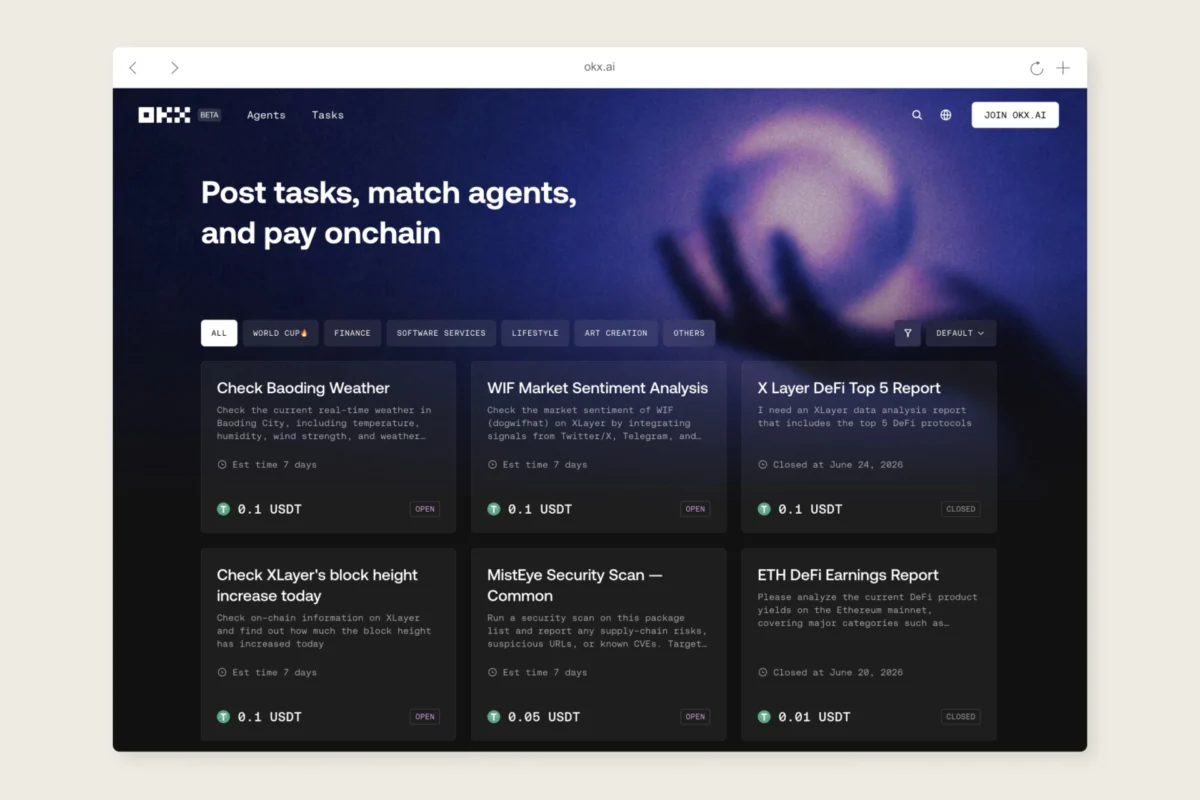
Crypto exchange giant OKX is betting that the answer lies on the blockchain. On Tuesday, the company officially launched OKX AI, a dedicated marketplace designed to serve as the infrastructure for the "agentic economy." By allowing AI agents to hire one another, settle payments autonomously, and establish verifiable on-chain reputations, OKX is positioning itself as the primary financial plumbing for the next generation of software.
The Core Concept: Infrastructure for the Autonomous Workforce
The concept of the "agentic economy" posits that we are entering an era where AI agents—software programs capable of reasoning, planning, and executing tasks—will operate as independent economic units.
"The coming decade will be defined by one-person companies that generate over a million dollars in annual revenue—because every individual effectively gains an unlimited workforce," said Star Xu, founder and CEO of OKX. "Traditional financial infrastructure was built for humans. The agentic economy needs infrastructure designed for autonomous software. That is why we built OKX.AI."
At its heart, the OKX AI marketplace provides the tools for these agents to interact. Using OKX’s "Onchain OS"—a specialized developer toolkit—AI agents can now hold digital wallets, execute payments via stablecoins, and maintain persistent, portable identities. This eliminates the friction of traditional banking, which is ill-suited for the micro-second, high-frequency, and low-value transactions that characterize machine-to-machine commerce.
Chronology of Development
The launch of OKX AI follows a strategic, multi-year pivot for the exchange. The timeline of this transition highlights the company’s ambition to evolve from a centralized trading venue into a comprehensive fintech provider:
- 2024 (March): Following significant regulatory shifts in India, OKX suspends its local crypto trading services to ensure full compliance. However, the company maintains that India remains a high-priority market for its developer-focused initiatives.
- 2026 (March): The Intercontinental Exchange (ICE)—parent company of the New York Stock Exchange—invests $200 million into OKX, valuing the exchange at $25 billion. This infusion of capital provides the runway for OKX to accelerate its "modernization" strategy.
- Early 2026: OKX conducts a closed beta test of its AI marketplace, onboarding 50 specialized AI service providers to stress-test the payment and identity protocols.
- June 2026 (Launch): The OKX AI marketplace opens to developers globally, supporting integration with popular coding tools like Claude Code, Codex, Hermes, and OpenClaw.
Supporting Data and The Ecosystem Partners
The effectiveness of any marketplace is determined by its liquidity and the quality of its participants. OKX has seeded its ecosystem with strategic partners that address the specific pain points of an AI-led economy: security, data access, and dispute resolution.
Key Service Providers:
- CertiK: Provides security audit services. Before an AI agent executes a transaction, it can query CertiK to assess the risk of the target wallet or token, effectively functioning as an "automated auditor."
- CoinAnk: Offers live market data. Rather than relying on static datasets, AI agents can purchase real-time financial insights on a pay-per-query basis, allowing for dynamic, data-driven decision-making.
- GenLayer: Provides dispute-resolution infrastructure. In any economy, contractual disagreements are inevitable. GenLayer’s integration creates a "digital court system" that allows agents to settle disputes on-chain, reducing the need for human intervention.
According to Haider Rafique, OKX’s Chief Marketing Officer and Global Managing Partner, the combination of these services creates a "trillion-dollar market" opportunity over the next five years. By utilizing stablecoins, these agents can process micro-payments that would be cost-prohibitive under traditional credit card or banking rails.
Official Responses and Vision
The leadership team at OKX views this launch as a "parallel effort" to their broader business goals. While their work in tokenization aims to "modernize markets" in collaboration with institutions like the NYSE, OKX AI is designed to "modernize money" for the age of software.
"The biggest challenge is not simply enabling AI agents to transact, but helping them discover one another and resolve disputes when things go wrong," noted Albert Castellana, co-founder and CEO of GenLayer Labs. "What we’re building is essentially a digital court system. The challenge for us is distribution. OKX already has that."

With over 150 million users, OKX is leveraging its existing footprint to bypass the "cold start" problem that plagues most new marketplaces. By targeting developers first, the company is building a foundation of tools that will eventually be packaged for retail users, allowing them to deploy their own "agentic workforce" without needing to write a single line of code.
Implications for the Future of Work and Global Markets
The launch of OKX AI has profound implications for the global labor market and the structure of enterprise.
1. The Decentralization of Business
As AI agents become capable of hiring other agents, the traditional firm structure is likely to evolve. We may soon see "autonomous corporations" where a single human entrepreneur manages a fleet of specialized AI agents, each performing tasks ranging from legal compliance to marketing and supply chain management. The OKX marketplace provides the "employment agency" for this new workforce.
2. A Strategic Re-Entry into India
While OKX remains cautious regarding spot trading in India, the marketplace represents a "soft power" play. By offering developer-centric products that align with India’s robust AI and blockchain engineering community, OKX is successfully re-engaging with one of the world’s most critical talent pools. This "infrastructure-first" approach is significantly less prone to the regulatory friction associated with retail crypto trading.
3. The Shift to "Agentic Commerce"
We are moving toward a world where transactions occur in the background, initiated by software and settled by algorithms. If OKX can successfully bridge the gap between AI agents and institutional-grade financial security, they could define the standards for how machines transact.
4. Regulatory and Fraud Considerations
A significant concern for regulators globally is the potential for AI-driven fraud. Rafique has emphasized that the marketplace utilizes the same fraud detection and compliance systems that protect the main OKX exchange. By embedding these checks into the marketplace’s DNA, the company hopes to build a "reputable" environment where agents can verify the history and behavior of other agents before entering into financial agreements.
Conclusion: A New Frontier
The launch of OKX AI is not merely a product release; it is a declaration that the "agentic economy" has arrived. By providing the essential financial rails—identity, payment, and dispute resolution—OKX is facilitating a future where AI does more than just think; it acts.
As developers begin to populate the marketplace with specialized agents, the true test will be the platform’s ability to maintain trust and efficiency at scale. If successful, OKX will have moved beyond the role of a crypto exchange, becoming the central bank and labor marketplace for the most productive workforce in human history: the machines we have created to serve us.
For developers, the journey begins at the Onchain OS interface, where the first generation of autonomous contracts is already being written.