In the rapidly evolving landscape of digital search, the shift from traditional keyword-based queries to generative AI-powered answers represents the most significant transformation since the inception of the search engine. For years, Search Engine Optimization (SEO) professionals have relied on a reliable feedback loop: monitor keywords, track rankings, analyze click-through rates, and adjust content strategies. However, the rise of Generative AI (GenAI) has created a “black box” effect.
Unlike traditional search results, where performance reports provide granular data on impressions and clicks, visibility in AI-generated answers remains elusive. This lack of transparency has left publishers, marketers, and SEO specialists in a state of professional guesswork. However, a significant shift is underway. Microsoft’s Bing, positioning itself as a leader in AI-driven search transparency, has unveiled and subsequently upgraded its "AI Performance Report" within Bing Webmaster Tools—offering the industry its first real glimpse into the mechanics of AI visibility.
The Problem: The "Black Box" of Generative Search
For most website owners, the transition to an AI-first search experience has been marked by a decline in traditional organic traffic without a clear explanation of what is replacing it. Currently, Google’s Search Console aggregates AI Overviews with traditional organic listings, making it virtually impossible for webmasters to distinguish between traffic driven by a standard blue link and traffic (or visibility) generated by an AI summary.
The situation is even more restrictive with platforms like ChatGPT. Unless a publisher has entered into a formal licensing agreement with OpenAI, data regarding how their content is being synthesized or cited remains entirely proprietary. This lack of visibility presents a critical challenge for content creators: if you cannot measure your presence in an AI summary, how can you optimize for it?
Chronology: From Guidebooks to Data Dashboards
The journey toward this level of reporting began in early 2024. Recognizing that the industry was struggling to adapt to the nuances of Generative Engine Optimization (GEO) and AI Engine Optimization (AEO), Microsoft took the proactive step of publishing its "Guide to AEO and GEO." This document served as a foundational manifesto for how publishers should structure their content to be more “AI-friendly.”

Weeks after releasing this guidance, Microsoft followed up with a tangible tool: the AI Performance Report in Bing Webmaster Tools. Initially a rudimentary tracking feature, it was met with high interest but limited utility. Recognizing that SEO professionals required more actionable intelligence, Microsoft recently pushed a significant update to this report, expanding the scope of metrics and improving the interface, thereby setting a new industry standard for platform transparency.
Supporting Data: Inside the AI Performance Report
The updated Bing AI Performance Report is designed to track citations across Microsoft Copilot, Bing’s AI-generated summaries, and select AI partner integrations. While the platform currently does not allow users to filter by specific channels or identify individual partners, the data provided is a significant improvement over the industry status quo.
The Anatomy of the Report
The dashboard is split into two primary segments: "Grounding Queries" and "Pages."
-
Grounding Queries: This section tracks the specific terms or phrases that triggered an AI response containing a citation from your site. It provides data on:
- Intent: The underlying user goal behind the query.
- Topic: Categorical clustering of the search interest.
- Citations: The total count of times your content was cited for that query.
- Citation Share: Your percentage of total citations for that specific query compared to the broader competitive landscape.
-
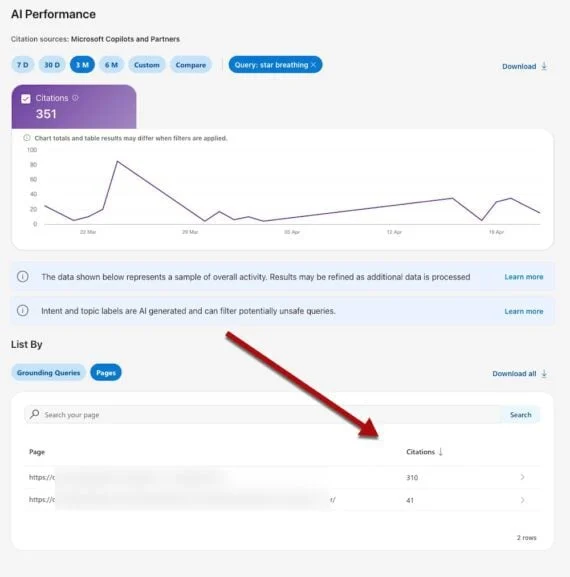
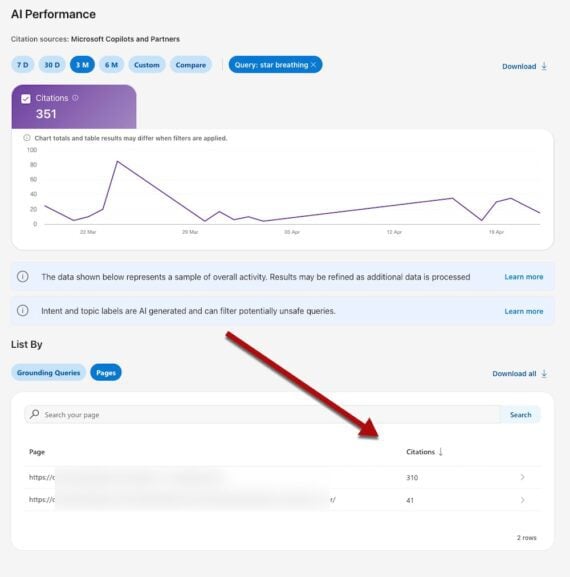
Pages: By clicking on any specific Grounding Query, users can drill down to see exactly which URLs were cited. The report tracks the frequency of these citations, allowing site owners to identify which content pieces are most trusted by the AI model.
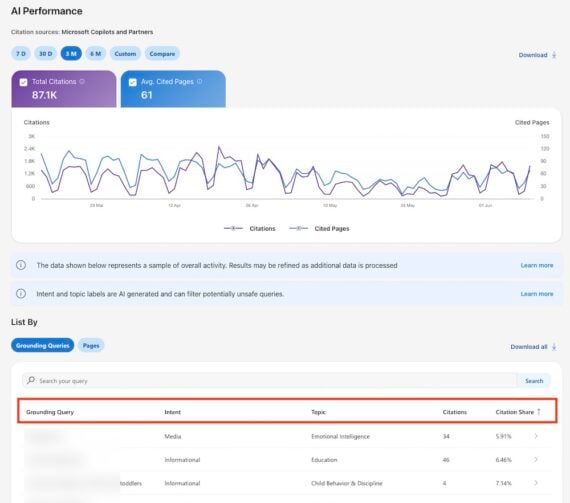
The ability to export this data into a spreadsheet for deeper analysis—such as filtering by citation frequency or cross-referencing with conversion data—is a massive win for data-driven marketers. By analyzing these lists, SEOs can identify patterns: Are the AI models favoring long-form guides, structured data tables, or concise definitions?
Implications: The New Era of "Grounding" Optimization
The data provided by Bing has immediate implications for content strategy. In the context of AI, "grounding" is the process by which an AI model anchors its response in factual, verifiable, and authoritative content. If your content is consistently appearing as a source in the AI Performance Report, it means your site is acting as a "grounding" authority.
Strategic Shifts for Content Creators
- Prioritizing Authority: The report highlights that AI models are not just looking for keywords; they are looking for reliable sources. Optimizers should focus on content that provides clear, verifiable facts, original research, and expert commentary—the types of content that the AI is most likely to "cite."
- The Decline of "Click-Bait": Because the report tracks citations rather than just traffic, it rewards content that provides value within the AI response. If your content is cited, you have successfully contributed to the user’s answer, even if they don’t click through to your site immediately. This shift suggests a move toward brand awareness and authority as primary SEO goals.
- Actionable Feedback Loops: With the ability to see which pages are being cited for specific queries, publishers can now perform a "content audit" specifically for AI. If a high-value query is being answered by the AI but not citing your site, you can analyze the competition’s cited pages to see how your own content can be improved to earn that citation.
Official Responses and Industry Outlook
Microsoft’s move to provide this level of transparency is largely viewed as a strategic play to gain favor with the publishing community. By providing these tools, Microsoft is effectively incentivizing publishers to keep their content accessible to Bing’s crawlers.
Industry analysts have praised the initiative. “For the first time, we aren’t flying blind,” notes one leading digital marketing strategist. “While it’s not perfect—we still lack the granular click-through data we are used to in traditional search—it gives us a baseline to measure our effectiveness in the generative era.”
However, critics point out that this is still a one-sided arrangement. The lack of granular traffic data (i.e., exactly how many users arrived at your site via an AI citation vs. a traditional link) remains a point of friction. Microsoft has remained tight-lipped on whether it intends to provide direct traffic attribution, likely due to the complex nature of AI interaction where the user may find the answer entirely within the chat interface.
Getting Started: Integrating Bing’s Tools
For those who have not yet utilized Bing Webmaster Tools, the barrier to entry is minimal, particularly for those already using Google Search Console (GSC).
- Authentication: Log in to Bing Webmaster Tools using your Microsoft account.
- Import: Select the "Add Site" feature and choose the "Import from GSC" option. This will pull your existing site data into the Bing ecosystem almost instantly.
- Observation: Once authenticated, it takes approximately 24 hours for Bing to begin populating the AI Performance Report.
Once the data starts flowing, users should make it a weekly habit to review their "Grounding Queries." Look for shifts in Citation Share. Are you losing ground to a competitor? Is a specific page suddenly gaining traction in AI responses? These insights are the foundation of a modern, future-proof SEO strategy.
Conclusion: Adapting to the Future of Search
The introduction of the AI Performance Report is a clear signal that the era of "anonymous" AI search is coming to a close. As search engines continue to prioritize generative experiences, the metrics of success will continue to evolve.
While the SEO industry will always miss the simplicity of the traditional blue link, the data provided by Bing’s latest update offers a path forward. By understanding how AI models perceive, trust, and cite our content, we can move beyond the fear of the "black box" and into a new phase of strategic optimization. In this new landscape, success will not be measured merely by ranking, but by the ability to remain an essential, cited, and authoritative source in the ever-expanding world of generative intelligence.