
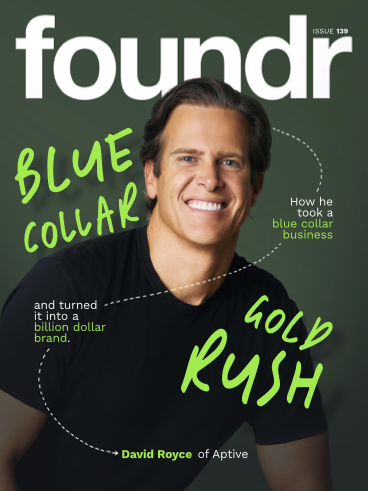
In the high-stakes world of entrepreneurship, success is often mythologized as a pursuit of the latest tech trend or a disruptive software-as-a-service (SaaS) platform. We are taught to look for the "next big thing" in venture capital-backed boardrooms. David Royce, the founder and chairman of Aptive Environmental, flipped that narrative on its head. He didn’t build his fortune by chasing the zeitgeist; he built it by dominating an industry his finance-degree peers wouldn’t touch with a ten-foot pole: residential pest control.
Royce’s journey—from a student who struggled to focus in a traditional classroom to the architect of the third-largest residential pest control service in North America—is a masterclass in grit, unconventional wisdom, and the strategic mastery of "unsexy" business models.
The Genesis: From Academic Struggle to Sales Prodigy
David Royce’s early life was defined by a feeling of intellectual inadequacy. Like many undiagnosed individuals with ADHD, he found the traditional school system stifling. "I struggled in school because I couldn’t focus unless I cared deeply," Royce recalls. It wasn’t until the sixth grade, under the mentorship of a teacher named Mrs. Luft, that he began to believe in his own potential.
This early validation set the stage for a pivotal shift. Royce discovered that while he struggled in environments that failed to capture his interest, he excelled in high-pressure, meritocratic arenas. Sales and entrepreneurship became the first places where his restless brain felt like a strategic asset rather than a liability.

His entry into the pest control industry was serendipitous. While in college, he heard of a peer making $25,000 in a single summer selling pest control door-to-door. Seeking the same opportunity, he headed to Sacramento—and promptly hit a wall. He spent his first week selling nothing, earning zero dollars in commission while his peers flourished.
Rather than packing his bags, Royce treated his failure as a data point. He spent his weekends studying sales psychology, clocking 90 minutes of deliberate practice every day. By the end of that summer, he was the top sales rookie out of 200 representatives. He had learned his first great lesson: Persistence is genius in disguise.
Chronology of an Empire
Royce’s career trajectory is marked by a series of deliberate, high-velocity growth phases:
- The Apprenticeship: After his success as a summer sales rep, Royce considered investment banking. However, his mentor—who had recently sold a pest control startup for $10 million—challenged him to start his own firm. Royce opted for the "unsexy" route, using $300,000 he had saved from his summers of door-to-door sales as seed capital.
- The Growth Crisis: In his first year in Los Angeles, Royce achieved the unthinkable: he secured 7,500 new customers, nearly doubling his projections. This success nearly bankrupted him. The business model required upfront commission payments to sales reps before recurring revenue had been collected. Royce learned a hard, essential lesson: "Revenues are vanity. Profits are sanity. But cash flow is reality."
- The Serial Entrepreneurial Model: Royce developed a unique asset-deal structure. He sold three consecutive companies to the same strategic buyer, specifically carving out his leadership team and sales force from each deal. This allowed him to retain his "golden goose"—his human capital—and restart with better capitalization and no equity dilution.
- The Aptive Era: With Aptive Environmental, Royce scaled to over $500 million in annual revenue, leveraging advanced software, gamified sales tournaments, and a culture that prioritized employee ownership.
Supporting Data: Why "Boring" Wins
The numbers support Royce’s contrarian approach. According to data, the top 0.1% of U.S. income earners—those making upwards of $2.3 million annually—are frequently found in industries that are far from glamorous. Approximately 43% of these individuals operate in "boring," blue-collar sectors.

Why? Because these industries possess high, defensible margins and a level of economic resilience that tech startups often lack. As Royce notes, "Recessions come and go. But bugs don’t read The Wall Street Journal." Furthermore, the ongoing wave of baby boomer retirements has created a massive acquisition vacuum, as many business owners in these sectors lack a succession plan, providing fertile ground for growth-oriented entrepreneurs to consolidate markets.
The Philosophy of Culture and Leadership
Royce’s leadership style is defined by a radical commitment to his team. After reading Tony Hsieh’s Delivering Happiness, Royce realized that culture is not just a collection of "vibes" or perks; it is an engineered product. While Aptive gained notoriety for its extravagant employee retreats and office amenities, Royce emphasizes that these were merely the "sugar." The "protein" was the training and the path to ownership.
The most profound element of his strategy was the decision to distribute 25% of the company to his employees. When the business reached its exit phase, this commitment resulted in life-changing payouts for team members. "Ownership is a far better retention tool than ping-pong tables," Royce says.
Strategic Shifts and Lessons Learned
No journey of this magnitude is without its setbacks. Royce’s transition from a hands-on CEO to an architect of the business was a painful evolution. He learned that "staying out of it" is the hardest part of leadership. When he tried to scale by hiring a "big company" executive—a CFO with experience at a billion-dollar tech firm—he experienced a significant failure.

The executive, despite his impressive resume, lacked the granular operational understanding required for the nuances of Aptive’s business. The resulting "misses" in their financial forecasts cost the company a high-value exit opportunity during a sale process. This taught Royce three vital lessons:
- Trust but verify: Never assume a title equates to competency.
- Protect the forecast: When running a sale process, missing projections destroys leverage.
- Process as education: Even if a sale doesn’t close, the process provides invaluable insight into what buyers truly value, allowing the business to improve before the next attempt.
Implications for Future Entrepreneurs
David Royce’s story serves as a critical counter-narrative for modern founders. It suggests that the most lucrative opportunities are not found by scanning for the latest trends, but by identifying industries that are ripe for modernization through better management, data-driven sales, and superior culture.
His emphasis on "the climb" over "the summit" is perhaps his most lasting piece of advice. When asked about his "number"—the amount of money that would signal he had done enough—Royce echoes the sentiment of many serial entrepreneurs: the goal is always "just a little more." However, he cautions that if the entrepreneur does not find joy in the daily discipline, the summit will ultimately prove hollow.
"If there’s a legacy I care about," Royce reflects, "it’s not the valuation. It’s the leaders we helped build along the way."
In an era where many chase the illusion of overnight success, Royce stands as a testament to the power of the "unsexy" path. By choosing the opportunity over the image, he built a billion-dollar empire—and in doing so, he provided a blueprint for anyone willing to do the work that others simply refuse to touch.