The digital security landscape underwent a seismic shift in the first quarter of 2026, as cybercriminals pivoted away from traditional malware toward highly evasive, infrastructure-based phishing tactics. According to the latest email threat intelligence report from Microsoft, the scale of these attacks is staggering, with nearly 8.3 billion phishing threats detected between January and March alone.
This latest data confirms a troubling trend: while security awareness among users has improved, the sophistication of threat actors has outpaced standard defenses. By leveraging legitimate cloud services, deploying "quishing" (QR-code phishing), and utilizing CAPTCHA-gated barriers, attackers are successfully bypassing traditional automated detection systems, signaling a new era of complex, persistent, and highly targeted digital threats.
The Core Data: A Quarter of Unprecedented Phishing Volume
Microsoft’s findings present a stark reality for enterprise security teams. During the first three months of 2026, the volume of phishing threats remained massive, characterized by a fundamental change in the "delivery vehicle."
Key Statistical Highlights:
- Total Threats: 8.3 billion detected incidents.
- Link-Based Dominance: Approximately 78% of all observed phishing attacks relied on malicious links, moving away from the previously common tactic of embedding malware within attachments.
- The "Quishing" Surge: QR-code phishing saw an explosive growth of 146%, climbing from 7.6 million incidents to 18.7 million in a single quarter.
- BEC Persistence: Business Email Compromise (BEC) remains a primary threat, accounting for 10.7 million targeted attacks.
The report highlights that the shift toward link-centric phishing is a calculated strategic move. By abandoning attachment-based delivery, attackers successfully circumvent sandboxing and endpoint detection systems that are primarily designed to scan files for malicious code.
Chronology of Evolution: From Malware to Managed Infrastructure
The history of email-based threats has long been defined by an "arms race" between defenders and attackers. In previous years, the primary threat was the payload—a malicious .exe or macro-enabled document. However, as email providers improved their ability to quarantine dangerous attachments, threat actors pivoted.
Early 2025: The Transition Phase
The seeds of current trends were sown throughout 2025, as cybercriminals began to exploit "Living off the Land" (LotL) techniques. Instead of building their own malicious infrastructure, they began hosting phishing pages on trusted cloud platforms like SharePoint, Google Drive, or legitimate website builders.
Q1 2026: The Integration of Evasion
By January 2026, the threat landscape matured into what Microsoft describes as "infrastructure-heavy" phishing. Attackers began deploying:
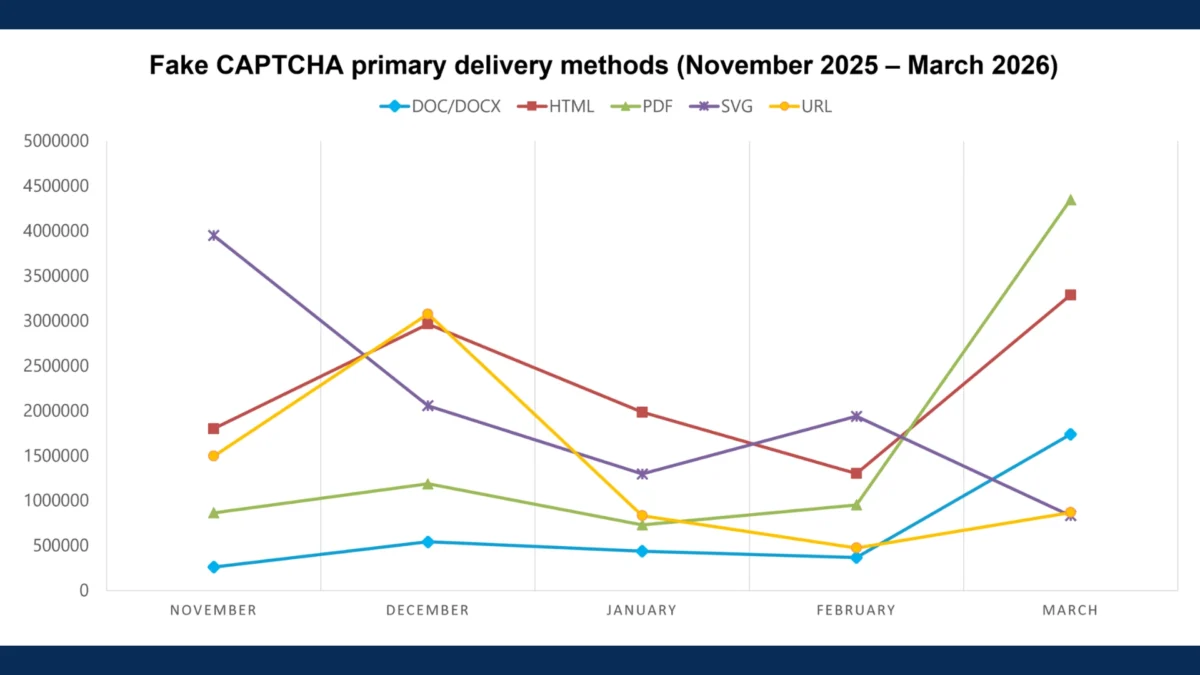
- CAPTCHA-Gated Pages: To prevent automated security crawlers from indexing their phishing sites.
- Adversary-in-the-Middle (AitM) Kits: Tools like the now-disrupted Tycoon2FA that intercept session tokens.
- QR-Code Obfuscation: Masking the final destination of a malicious link by hiding it behind a scan-only QR code.
Deep Dive: The Rise of "Quishing" and CAPTCHA Barriers
Two specific tactics have emerged as the primary catalysts for the recent increase in successful credential theft: QR-code phishing and CAPTCHA-gated landing pages.
The Quishing Phenomenon
"Quishing" has proven particularly difficult to mitigate because it inherently targets the mobile device—an environment where security visibility is often lower than on a corporate workstation. By embedding QR codes in professional-looking PDF attachments or email bodies, attackers trick users into using their personal phones to scan the code. This action effectively bypasses the corporate network’s perimeter security and content filtering, redirecting the user to a credential harvesting site that appears identical to a standard Microsoft 365 or corporate login portal.
CAPTCHA as a Shield for Criminals
Historically, CAPTCHA (Completely Automated Public Turing test to tell Computers and Humans Apart) was designed to stop bots. In a twist of irony, cybercriminals are now using it to stop security bots. By placing a legitimate CAPTCHA verification in front of a phishing page, attackers ensure that only real human users can reach the malicious destination. Automated URL scanners, which lack the ability to bypass these verification screens, are "locked out" of the phishing site, allowing the malicious infrastructure to remain active for significantly longer periods without being flagged or taken down.
Business Email Compromise (BEC): The Human Factor
While automated mass phishing grabs the headlines, BEC remains the most financially damaging category of email threat. Unlike automated campaigns, BEC relies on the art of social engineering.
Microsoft notes that these 10.7 million BEC attacks are often "low and slow." Attackers spend time researching their targets, sometimes compromising a legitimate email account within a partner company to conduct a "man-in-the-middle" conversation. By injecting themselves into an ongoing thread—often regarding invoices or urgent wire transfers—they make the malicious request appear entirely authentic.
The threat is compounded by the use of "legitimate infrastructure." When an attacker uses a compromised, validly authenticated account to send an email, the message often passes through spam filters that would otherwise block an external, suspicious sender. This "trust-based" delivery method makes detection incredibly difficult for traditional automated systems.
Official Responses and Strategic Disruptions
Microsoft’s Threat Intelligence unit has not been a passive observer. A significant portion of the report details the successful disruption of the Tycoon2FA platform. Tycoon2FA was a prominent "phishing-as-a-service" (PaaS) operation that provided criminals with the tools to steal session tokens, allowing them to bypass multi-factor authentication (MFA).
Following the disruption efforts in Q1 2026, Microsoft reported a 15% decline in phishing activity associated with this specific framework. However, the company offers a sober warning: the infrastructure of cybercrime is highly resilient. When one service is dismantled, others—often utilizing similar codebases or business models—quickly emerge to fill the void.
Implications: The New Requirements for Security
The evidence provided by Microsoft’s Q1 2026 report suggests that the era of "set it and forget it" email security is over. Authenticated email—such as messages that pass SPF, DKIM, and DMARC checks—can no longer be assumed to be safe, because the content itself is being sent from trusted or compromised infrastructure.
The Road Ahead for Enterprise Defense
To mitigate these evolving threats, organizations must shift their strategy toward a more holistic, multi-layered approach:
- Context-Aware Analysis: Moving beyond URL scanning to analyze the intent and behavior of the email sender, including anomalous patterns in communication.
- Zero-Trust Authentication: Implementing hardware-backed security keys (FIDO2) to render session-token theft, such as that facilitated by Tycoon2FA, ineffective.
- Endpoint Security Integration: Strengthening the link between mobile device management (MDM) and corporate security policies to monitor for mobile-based phishing attempts.
- Advanced Awareness Training: Training employees not just to "avoid clicking links," but to recognize the signs of high-context social engineering and the dangers of scanning QR codes in an enterprise environment.
- Proactive Threat Hunting: As automated systems struggle with CAPTCHA-gated sites, security teams must move toward manual threat hunting and intelligence-sharing to identify emerging phishing infrastructure before it reaches the inbox.
Conclusion: The Future of Email Safety
As we move through 2026, the distinction between a "safe" email and a "malicious" one is increasingly blurred. The findings from Microsoft make it clear that while mailbox providers are tightening sender authentication and bulk email enforcement, the responsibility for security is shifting back toward the enterprise.
The growth of link-based phishing, the explosion of quishing, and the hardening of phishing sites through CAPTCHA barriers represent a fundamental evolution in cyber-warfare. For organizations to survive this environment, they must embrace a security posture that assumes breach, demands robust authentication, and treats every email—regardless of its perceived origin—with a necessary degree of healthy skepticism. The battle for the inbox is no longer about blocking known bad actors; it is about outsmarting an adversary that is constantly evolving to look, act, and feel like a trusted colleague.