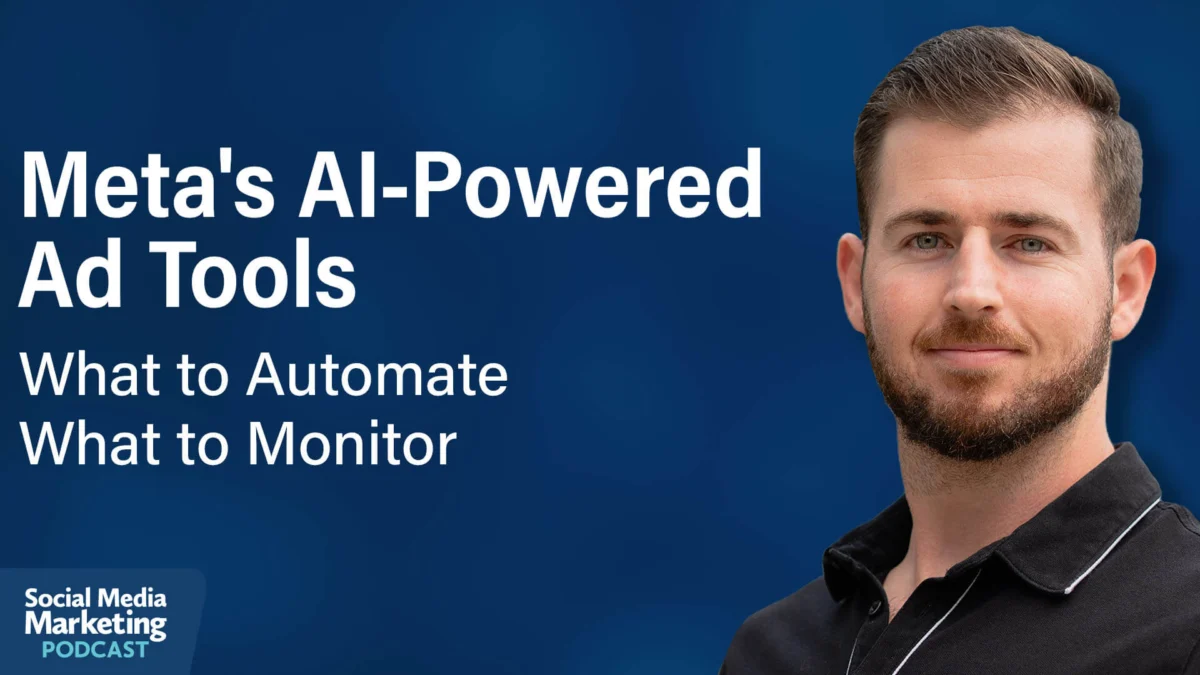
In the fast-paced world of digital advertising, the landscape is shifting beneath the feet of marketers. Meta, the parent company of Facebook and Instagram, is aggressively pushing a transition: moving advertisers away from granular, manual campaign management and toward a "guided control" model powered by artificial intelligence. While this evolution promises increased efficiency and faster paths to conversion, it leaves many agency owners and business managers grappling with a fundamental question: When should you trust the algorithm, and when is human oversight non-negotiable?
Drawing on insights from industry veteran and agency owner Nick Theriot, this analysis explores how to leverage Meta’s new AI-powered tools while maintaining the strategic edge that only a human marketer can provide.
The New Era: Algorithmic Autonomy vs. Human Oversight
For years, digital marketing success was defined by the "media buyer"—a professional who spent hours optimizing account structures, setting precise bid caps, and manually segmenting audiences. Today, that barrier to entry has lowered significantly. Meta’s AI now handles much of the heavy lifting, from pixel placement to creative delivery.
The trade-off is clear: by relinquishing manual control, marketers gain access to Meta’s massive dataset and predictive modeling. However, this shifts the professional requirement from "technical execution" to "strategic supervision." The primary risk for modern marketers is becoming a passive observer rather than an active director of their advertising spend.
Chronology of the Shift
- 2018–2019: The era of "complex structures." Success was tied to granular campaign settings, manual bidding, and complex account hierarchies.
- 2020–2021: The pivot toward creative. As tracking became more difficult, the industry realized that the "ad itself" was the most effective targeting tool.
- 2023–Present: The AI Integration phase. Meta begins embedding AI agents directly into the workflow, automating everything from data tracking to content generation.
1: Automating the Foundation: The AI-Powered Pixel
The Facebook pixel has long been the backbone of tracking, but it was historically a headache for non-technical business owners. Meta’s new AI-driven pixel integration has changed this dynamic. By automatically connecting and mapping data—such as product availability and SKU details—directly from a website, Meta has removed the immediate need for a dedicated developer to manage tracking code.
Strategic Implementation
Nick Theriot identifies this as a "black-and-white task"—a perfect candidate for automation. By utilizing one-click integrations (common in platforms like Shopify), businesses can feed the algorithm high-quality data from day one.
Why it matters: Even if you aren’t currently running ads, installing the pixel allows the algorithm to begin "learning" your specific customer behavior. When you finally decide to launch a campaign, the algorithm won’t be starting from scratch, significantly reducing the cost of optimization.
2: AI Connectors and the Risk of Account Bans
The integration of third-party AI agents—such as Manus or Claude—into Meta’s Ad Manager represents a leap forward in productivity. These tools can now generate dashboards, automate reporting, and even ideate content strategies.
However, caution is warranted. Recent reports suggest that some ad accounts have faced temporary suspensions shortly after connecting to third-party AI interfaces. The working theory? When AI tools are used to "spam" the API with a high volume of rapid-fire requests, Meta’s safety protocols may flag the activity as malicious or automated abuse.
The Human-in-the-Loop Protocol:
- Use, but verify: Treat these connectors as assistants, not autonomous managers.
- Avoid over-automation: Do not allow AI to trigger mass edits to your campaigns simultaneously.
- Strategic Research: Never outsource high-level audience research to AI. Generic outputs lead to generic targeting. Human marketers must still define the "why" behind an audience segment to ensure the creative resonates on an emotional level.
3: The AI Business Assistant: A Double-Edged Sword
Meta’s AI Business Assistant is essentially a ChatGPT-style interface built into Ads Manager, designed to provide real-time recommendations. For beginners, this is a massive equalizer, potentially saving thousands of dollars in consulting fees.
The "Spend More" Trap
Theriot warns that the Assistant’s advice is often biased toward Meta’s own internal incentives. Specifically, suggestions to increase daily budgets overnight should be viewed with extreme skepticism.
- The Math Audit: Not all AI models handle numbers equally. While Claude is robust at mathematical analysis due to its coding architecture, other models may struggle with spreadsheet data. When scaling a business with a thin return on ad spend (ROAS), a rounding error or a miscalculated projection can be catastrophic.
- The Rule of Thumb: Use AI for structure and insights, but never blindly follow automated "scale budget" prompts without validating the data against your own internal performance metrics.
4: Creative as the New Targeting Lever
If structure is no longer the key to winning, what is? The answer is creative. Prospects don’t see your account structure; they see your images, videos, and copy.
Today’s winners are those who use AI to amplify their creative ideas, not replace them. Theriot notes that the most successful marketers use AI to speed up the transition from "idea" to "ad."
The Evolution of Workflow
- Copywriting: AI writes 90% of the initial draft. The human marketer then acts as a "Copy Chief," applying the final 10% of nuance, brand voice, and emotional hook.
- Visuals: Experienced creators use AI to generate high-fidelity assets, but they steer the model with specific, informed directions. The "generic AI look" is a red flag for consumers; original, high-intent visuals remain superior.
- The Disclaimer Mandate: As AI-generated content becomes indistinguishable from reality, legal requirements are catching up. Advertisers should prepare for strict disclosure mandates regarding AI-generated spokespeople—a trend beginning in states like New York.
Implications: The Rise of the Marketing Manager
As these tools become ubiquitous, the role of the traditional "media buyer" is fading, replaced by the "Marketing Manager." This new role requires a synthesis of skills:
- Communication: The ability to treat AI prompts like a real conversation, iterating based on output.
- Strategy: Creating offers that scale and articulating product value.
- Performance Oversight: Holding the AI accountable to real-world business outcomes.
The 80/20 Rule for Growth
To balance innovation with security, Theriot advocates for the 80/20 rule. Allocate 80% of your resources toward the strategies that are currently proven to drive revenue, and 20% toward exploring new Meta features, such as one-click checkout or AI-shopping integrations.
While one-click checkouts offer convenience, they can sometimes hurt conversion rates for complex, high-ticket items. Consumers often need a "buffer"—a moment to think, research, and validate their purchase—that is disrupted by an overly aggressive "Buy Now" button.
Final Thoughts: The Human Advantage
The overarching trend is clear: Meta is making it easier to start, but harder to win without a clear, human-led strategy. The AI tools available today are amplifiers. If your underlying business logic is flawed, AI will simply help you lose money faster. If your value proposition is strong, AI will help you scale that message with unprecedented speed.
The future of advertising is not "AI vs. Human." It is the human who masters the AI, ensuring that the machine is fed high-quality data, provided with creative direction, and held to the highest standard of mathematical accuracy. In the coming years, the marketers who win will be those who treat AI as an intern—highly capable and fast, but always in need of a manager to check the work.