In the corporate corridors of the modern enterprise, the directive from the C-suite is uniform and relentless: scale artificial intelligence, accelerate adoption, and deliver measurable return on investment. Yet, as marketing and AI leaders scramble to integrate these powerful technologies, they are operating within a reality defined by a fast-moving, high-stakes narrative—one that may be obscuring more than it reveals.
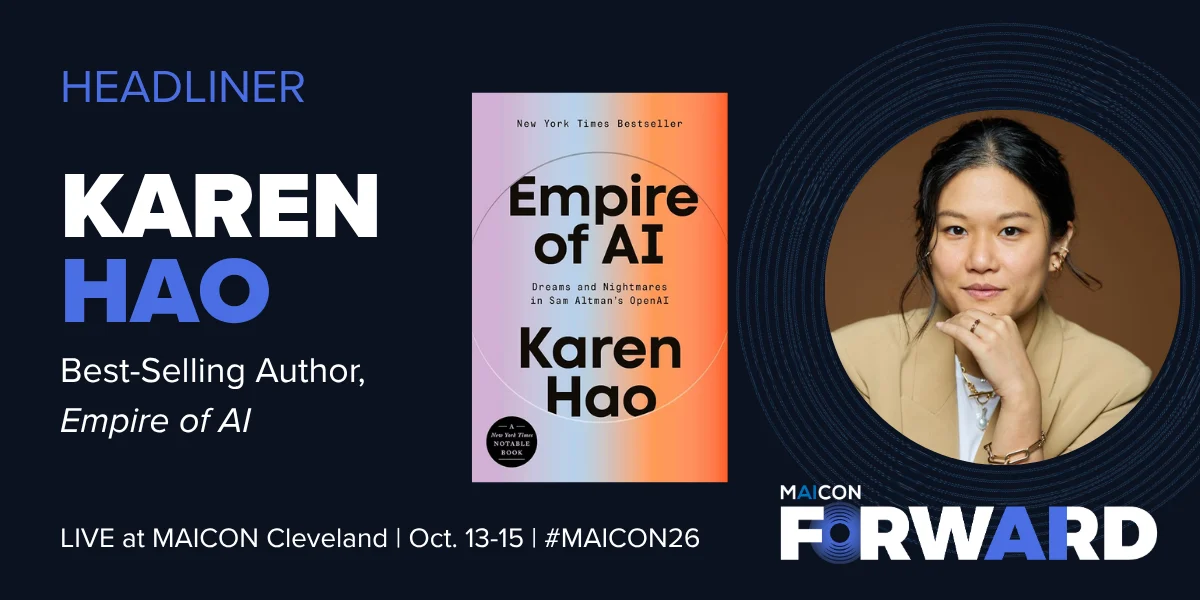
At the upcoming Marketing AI Conference (MAICON) 2026, industry leaders will be invited to step back from the frenzy. Karen Hao, the New York Times bestselling author of Empire of AI and a leading voice in technology journalism, will deliver a keynote address designed to dismantle the prevailing myths surrounding AI development and replace them with a grounded, systemic understanding of the field.
The Architect of Critical Inquiry
Karen Hao’s return to the MAICON stage is significant. Having first appeared at the conference in 2019, her evolution mirrors the trajectory of the industry itself. Since that first appearance, she has solidified her status as one of the most authoritative voices on the ethics, mechanics, and power dynamics of artificial intelligence.
Named one of the most influential people in AI by TIME and Business Insider, Hao currently leads the Pulitzer Center’s AI Spotlight Series and co-hosts the BBC’s acclaimed technology podcast, The Interface. Her work is characterized by a refusal to accept the glossy press releases of Silicon Valley at face value. Instead, she engages in deep, original reporting that traces how AI is actually built, who controls it, and how it is governed.
Her keynote at MAICON 2026 promises to leverage this expanded body of research, offering attendees a rare, transparent look at the forces currently shaping the trajectory of business and society.
The Systems Shaping AI Today: Deconstructing the "Empire"
The central thesis of Hao’s Empire of AI is that the current landscape of artificial intelligence is not a wild, decentralized frontier, but a highly consolidated one. A small, select group of corporations has amassed unprecedented influence over the direction of AI research and application.
The Power of the Narrative
Hao’s research explores how the dominant narrative surrounding generative AI and Artificial General Intelligence (AGI) has been meticulously constructed. This narrative dictates how organizations perceive "progress." It establishes a standard where success is measured by the adoption of the latest large language models (LLMs) and the pursuit of human-level machine intelligence.
However, Hao posits that this obsession with the "new" creates a dangerous blind spot. Many of the most practical and beneficial applications of AI—those that could truly revolutionize healthcare, education, and climate sustainability—rely on machine learning systems that were developed long before the current generative AI wave. By prioritizing the industry’s flashy, AGI-focused marketing, organizations may be ignoring more stable, impactful, and cost-effective technologies that are better suited for their specific goals.
A Heroic Investigation
Shoshana Zuboff, Professor Emerita at Harvard Business School and author of The Age of Surveillance Capitalism, has lauded Hao’s work as a "heroic work" and "essential public education." By stripping away the veneer of tech-utopianism, Hao reveals the underlying incentives—profit consolidation, data extraction, and proprietary control—that govern the current generation of AI tools.
Chronology: From Academic Curiosity to Corporate Mandate
To understand why Hao’s perspective is critical for 2026, one must look at the timeline of AI’s integration into the business world:
- 2019–2020 (The Awareness Phase): AI was largely viewed as an experimental tool for data science teams. Conferences like MAICON began focusing on the potential for marketing automation and predictive analytics.
- 2021–2022 (The Foundation Phase): The release of foundational models began to shift the conversation. Businesses started exploring the integration of APIs into their tech stacks.
- 2023–2024 (The Generative Explosion): The launch of ChatGPT and similar tools sparked a "gold rush" mentality. Organizations rushed to adopt generative AI to avoid "falling behind," often without robust governance or long-term strategic alignment.
- 2025–2026 (The Reckoning): As we reach MAICON 2026, the focus has shifted from simple adoption to the struggle for ROI. Companies are finding that the "black box" nature of proprietary AI systems presents significant risks in terms of security, ethics, and strategic dependency.
This timeline demonstrates that we have moved from the "novelty" stage to the "infrastructure" stage. As AI becomes the backbone of corporate strategy, the need to understand the "empire" building these tools has never been more urgent.
Implications for AI Strategy and Governance
For the leaders responsible for AI strategy, these issues are far from theoretical. They influence high-stakes decisions every day. If the assumptions behind a company’s AI strategy are flawed, the downstream consequences can be severe.
The Cost of Incomplete Assumptions
If a leadership team views AI solely through the lens of generative models, they may be ignoring:
![Karen Hao: Are We Betting on the Wrong AI Narrative? [MAICON 2026]](https://www.marketingaiinstitute.com/hubfs/Karen%20Hao-1.png)
- Resource Misallocation: Directing massive budgets toward generative tools that may not provide as much value as smaller, task-specific machine learning models.
- Competitive Dependency: By relying on a handful of large AI providers, companies risk becoming "tech-takers," tethered to the pricing, terms, and model updates of external giants.
- Governance Failures: If companies do not understand how the models they are using were trained, they cannot effectively manage legal, ethical, or reputational risks.
Hao’s work offers a roadmap for leaders to cut through this noise. She provides a framework for evaluating the environment in which decisions are made, enabling leaders to move from a reactive posture to a proactive one.
A Call for Leadership: Beyond Reactivity
A core question that Hao will address at MAICON 2026 is: What role should leaders play in influencing the direction of AI, rather than simply reacting to it?
Currently, most organizations are passive consumers of technology provided by the "Empire of AI." Hao argues that this dynamic is not inevitable. She contends that the way we develop and deploy technology is currently "fundamentally broken," but she remains optimistic that it can be fixed.
The fix, according to Hao, begins with collective awareness. When leaders understand the systemic pressures—the venture capital incentives, the data-hoarding behaviors, and the race for computational power—they can advocate for more transparent, open, and responsible development cycles. They can choose to build partnerships with smaller, more specialized AI firms, or invest in open-source alternatives that provide more autonomy.
Preparing for MAICON 2026
The MAICON 2026 keynote is not an exercise in prophecy. Attendees should not expect a session about "what the future of AI will look like in 2030." Instead, they will receive a cold, hard look at the gears and pulleys that are moving today.
For those in leadership, this is an opportunity to sharpen their strategic vision. By understanding the forces that shape AI, they can ensure their organizations are not just adopting technology, but mastering it.
Join the Conversation
The path forward for AI in the enterprise requires a blend of technological literacy and critical inquiry. Karen Hao’s presence at MAICON 2026 is a cornerstone of this year’s mission: to provide the most rigorous, real-world, and honest assessment of the AI landscape available today.
Joining Hao will be a cohort of 50+ business leaders, technologists, and strategists, all dedicated to the same goal: moving past the hype to build sustainable, ethical, and effective AI-driven businesses.
As the industry stands at this critical juncture, the question for every leader is no longer just "How do we implement AI?" but rather, "How do we implement AI in a way that aligns with our long-term goals, our values, and the realities of the global market?"
Karen Hao’s keynote provides the answer to that question. It is an essential session for anyone who considers themselves a steward of their organization’s future in an AI-powered world.
Are you ready to lead your organization through the complexities of the AI era?
Join us at MAICON 2026 to hear from Karen Hao and a lineup of industry experts. Learn more about registration options, agenda highlights, and networking opportunities by visiting the official Marketing AI Institute website.
To follow Karen Hao’s ongoing reporting and analysis, keep an eye on the Pulitzer Center’s AI Spotlight Series and subscribe to her work via her official channels. The future of AI is being built today—ensure you understand how.