SAN FRANCISCO — The transformation of Go-To-Market (GTM) operations is no longer a futuristic thought experiment. At SaaStr, a fleet of 21 artificial intelligence agents now operates in active production, driving millions of dollars in revenue. These autonomous entities book meetings on Saturday nights, resurrect dormant leads abandoned over six months prior, manage invoicing and collection follow-ups, and continuously update Salesforce logs—all without requesting human oversight or intervention.
The results are staggering. A lean human GTM team of roughly 1.5 full-time equivalents (FTEs) is now managing a workload that previously required six or more human professionals. Yet, industry insiders agree that the enterprise software ecosystem has barely scratched the surface of what autonomous agents can achieve.
While AI can effortlessly replace traditional Sales Development Representative (SDR) functions, handle first-line customer support, and execute a substantial portion of Customer Success Management (CSM) responsibilities, a glaring gap remains. Despite massive advancements showcased across industry stages, not a single deployed AI agent has successfully closed a complex, high-stakes enterprise deal entirely on its own.
As the tech sector accelerates toward a self-serve and agent-serve paradigm, startup founders and sales leaders are discovering an unpriced structural gap: the true, autonomous AI Account Executive (AE) does not yet exist.
Main Facts: What AI Agents Can—and Cannot—Do Today
To understand the current limits of sales automation, industry leaders must look past the marketing hype and examine real-world deployments. Agent-generated revenue is often cited in pitch decks, but operational reality reveals a strict division of labor between software and human staff.
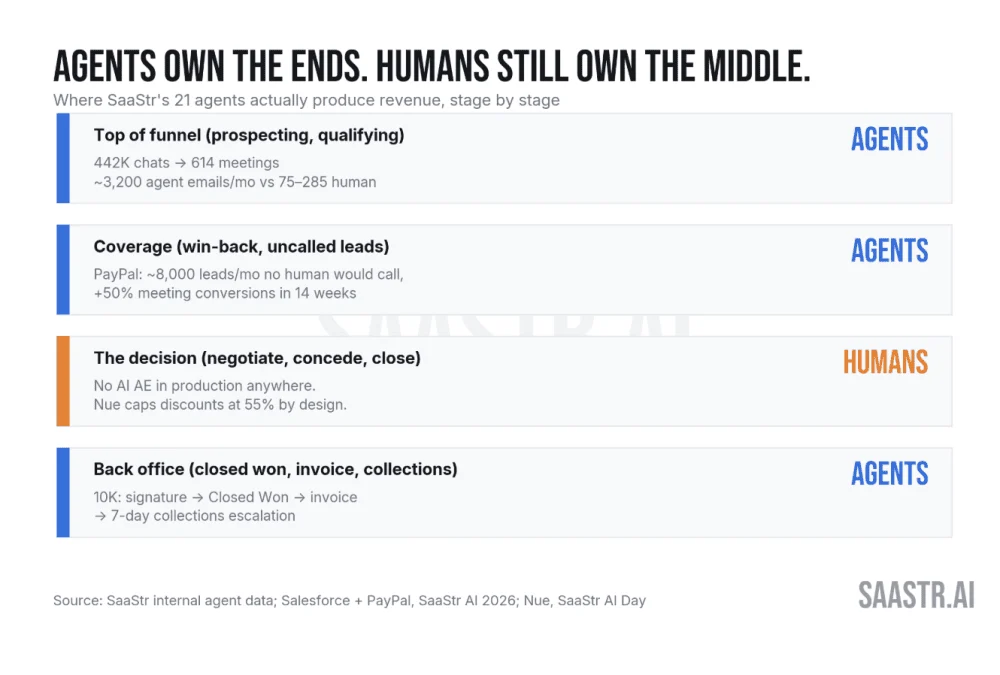
At SaaStr, inbound conversion tools like Qualified have processed over 442,000 chats, converting them into 614 booked meetings and helping secure more than $1 million in sponsorship revenue. However, the agent’s role was strictly logistical: qualifying, routing, and scheduling. It did not negotiate rate cards or bespoke contracts.
Similarly, automated win-back campaigns utilizing platforms like Salesforce Agentforce achieved staggering 72% open rates and over 10% response rates across roughly 1,000 ghosted sponsor leads. By maintaining relentless follow-up discipline—a trait unique to software that never grows bored, tired, or discouraged—these systems generated closed deals from contacts that human sales teams had written off half a year prior.
At the top of the funnel, AI-driven SDR layers routinely dispatch 3,200 personalized outreach emails per month, dwarfing the output of human counterparts who historically managed between 75 and 285 emails. Meanwhile, administrative back-office agents handle post-sale workflows end-to-end: upon detecting a signed PandaDoc agreement, the system flips the opportunity to "Closed Won" in Salesforce, appends missing contact information, generates and dispatches Bill.com invoices, and executes automated collection reminders complete with seven-day escalation protocols.
Yet, despite handling the opening and closing bookends of the sales cycle, the critical middle phase—the moment where a buyer decides to commit capital—remains stubbornly human.
Chronology: The Evolution of GTM Automation in 2026
The maturation of autonomous GTM architectures has accelerated dramatically over the past several quarters, highlighted by key industry milestones and data releases:

- January 2026: Anthropic structural overhaul led by Eleanor Dorfman sees the company rebuild its sales organization, resulting four months later in 54% of new enterprise logos closing via self-serve channels. Concurrently, the release of the ICONIQ State of Go-to-Market 2026 report surveys over 150 B2B GTM executives, mapping out structural headcount efficiencies across various ARR bands.
- Spring 2026: Industry events like SaaStr AI 2026 spotlight operational case studies. Pylon executives Marty Kausas and Advith Chelikani demonstrate how a 5,000-person enterprise deflected 50% of support tickets using AI without changing support headcount. Concurrently, PayPal and Salesforce showcase how Agentforce successfully processed 8,000 monthly unworked leads, driving a 50% increase in meeting conversions within 14 weeks.
- Late May 2026: Job market data from AI pioneers paints a revealing picture. Anthropic’s corporate careers page lists 72 open sales roles against 67 research and engineering positions, proving that high-growth AI companies eventually lean heavily into traditional sales infrastructure as they scale.
- Summer 2026: Data from Emergence Capital’s survey of over 560 B2B companies confirms that SDR/BDR headcount reductions have peaked at 36%, while Account Executive headcounts have paradoxically increased by 28% to handle increasingly sophisticated technical deployments.
Supporting Data: The Compression of the Sales Funnel
Market data from leading venture capital firms highlights an uneven compression across sales roles. According to Emergence Capital’s enterprise study, the prospecting layer has borne the brunt of automation:
| Sales Function | Net Headcount Trend (Emergence Survey) | Daily AI Adoption Rate |
|---|---|---|
| SDR / BDR | -36% (Highest Decrease) | 71% |
| Marketing | Moderate Decline / Optimization | 65% |
| Account Executives (AEs) | +28% (Net Increase) | 57% |
| Sales Engineers (SEs) | -14% (Minimal Decrease) | N/A |
| Customer Success | Moderate Optimization | 41% |
Furthermore, ICONIQ’s GTM research demonstrates that AI-forward companies operating between $10M and $25M ARR function with roughly 20 total GTM FTEs compared to 35 for their lower-adoption peers—representing a 43% leaner organization that simultaneously achieves a higher quota attainment rate (67% vs. 59%).
However, as companies scale into higher revenue bands, this efficiency gap steadily narrows:
- $25M – $100M ARR: 45 vs. 65 FTEs (31% leaner)
- $100M – $250M ARR: 125 vs. 165 FTEs (24% leaner)
- $250M – $500M ARR: 275 vs. 350 FTEs (21% leaner)
This diminishing delta confirms that as contract values escalate and deals demand complex human negotiation, traditional headcount requirements stabilize. If AI agents were capable of executing complex enterprise closes, the scalability curve would continue to diverge rather than converge.
Official Responses and Industry Insights
Tech leaders and platform operators gathered at recent industry summits have offered varied perspectives on the shift toward agentic GTM strategies:
- Andrew Bialecki (CEO, Klaviyo): Emphasized that building successful agentic workflows involves hitting a ceiling where models achieve 50% to 70% resolution rates before requiring human handoff—the exact threshold where human expertise begins to generate tangible value.
- Adam Alfano (President, Salesforce) & Eitan Saban (Head of Sales for NA Mid-Market, PayPal): Noted that deploying agentic automation to sweep neglected lead pipelines does not cannibalize AE pipelines; rather, it monetizes coverage that human sales professionals could never physically reach.
- Grant Lee (CEO, Gamma): Reflected on scaling his firm to $100M ARR with minimal sales infrastructure, advising founders that rapid self-serve growth is often a reactive byproduct of product-led momentum rather than a blueprint designed to replace enterprise sales entirely.
- Maia Josebachvili (Stripe): Highlighted an emerging paradigm shift: the future may see AI agents acting as commercial buyers rather than sellers. In an agent-to-agent transactional economy, human-grade closing skills become obsolete, replaced entirely by programmatic catalogs, API policies, and automated payment rails.
Implications: Why Closing is Structurally Harder Than Qualifying
While qualification, follow-up, and quote-to-cash workflows are fundamentally deterministic classification, scheduling, and data-processing problems that software excels at solving, closing a deal is fundamentally an exercise in judgment under ambiguity.
Four primary barriers prevent current AI models from functioning as standalone Account Executives:
- Organizational Politics and Trust: Enterprise buyers invest heavily in vendor relationships, relying on human empathy, accountability, and professional intuition to mitigate financial and operational risk.
- Custom Procurement and Legal Negotiation: Complex enterprise agreements require navigating unpredictable security reviews, customized indemnity clauses, and creative pricing terms that fall far outside rigid price books.
- Multi-Stakeholder Consensus: B2B purchasing decisions often involve resolving internal corporate friction, conflicting stakeholder priorities, and competing departmental agendas.
- Competitive Real-Time Adaptation: Reading a virtual room, detecting unstated objections, and dynamically shifting negotiation strategies require situational awareness that current Large Language Models simulate rather than master.
Strategic Recommendations for Founders
As the GTM landscape adapts to the agentic era, tech founders and sales leaders must adjust their operational playbooks:
- Embrace Technical AEs: Transition away from traditional account executives toward forward-deployed technical AEs who possess the engineering acumen to configure, deploy, and validate products directly with prospective clients during initial pitch cycles.
- Redefine SE-to-AE Ratios: Shift away from legacy 1:1 or 2:1 AE-to-SE models toward technical-heavy structures where product specialists lead client engagements while sales generalists assist with commercial packaging.
- Automate the Edges: Aggressively deploy AI across top-of-funnel prospecting, lead scoring, automatic meeting scheduling, and post-sale invoicing to strip administrative overhead from human teams.
- Prepare for Agent-to-Agent Commerce: Architect software products with clear API-driven documentation, automated provisioning, and programmatic billing rails to capture incoming machine-to-machine transactions.
Conclusion
The missing autonomous AI Account Executive is not a permanent fixture of software limitations; it represents an engineering hurdle that is rapidly being dismantled. As models gain deeper context, sophisticated reasoning capabilities, and enhanced autonomy, the first wave of transactional AI AEs will inevitably emerge within the mid-market.
Until that threshold is crossed, market winners will build their organizations around operational reality: software agents successfully own the top of the funnel and the back-office machinery, human professionals retain control over the pivotal moment of financial commitment, and the sales closers of tomorrow will be the most technical operators in the room.