In the lifecycle of a software company, the "law of large numbers" is typically an inevitability—a gravitational force that slows growth as revenue bases expand into the billions. Most tech titans, having reached their second decade, pivot to a strategy of managed decline: coasting on a massive installed base, milking legacy contracts, and settling for low single-digit growth.
Shopify, however, has chosen to ignore the laws of corporate physics.
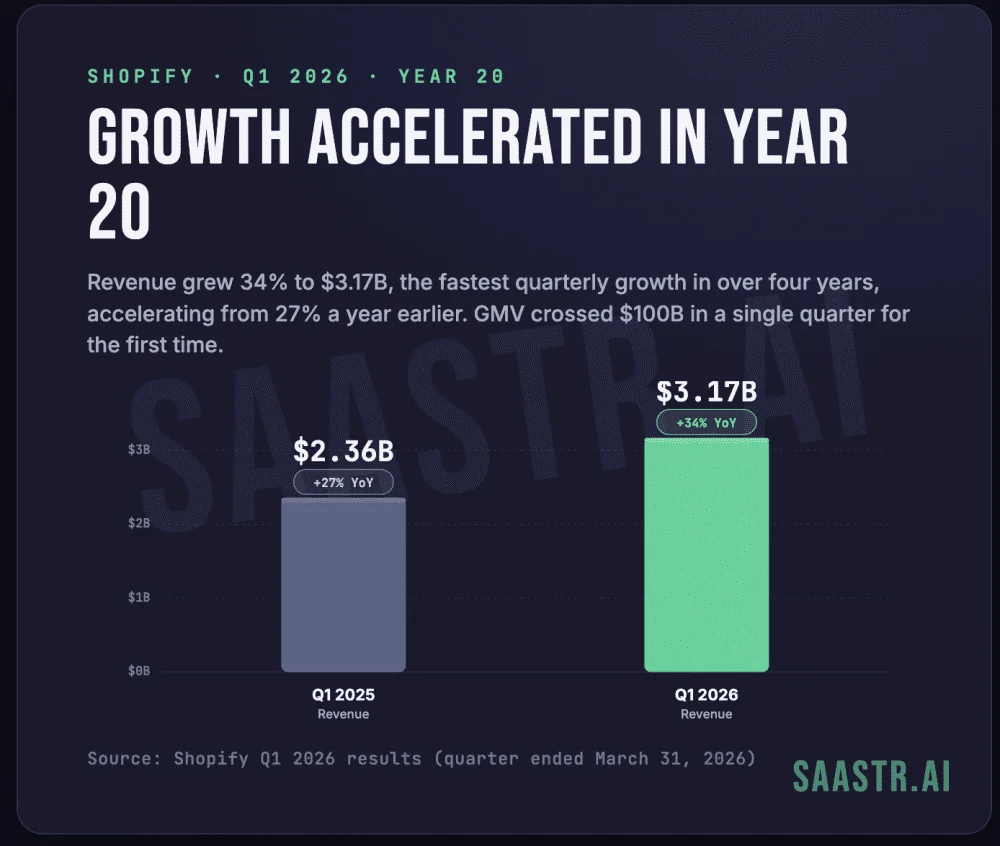
Launched in 2006 by Tobi Lütke, who originally sought only to sell snowboards online via his own custom-built store, Shopify has evolved into the backbone of global commerce. Now celebrating its 20th anniversary, the company isn’t just surviving; it is accelerating. With a revenue run rate exceeding $13 billion and Q1 2026 revenue hitting $3.17 billion—a 34% year-over-year surge—Shopify has posted its fastest growth in over four years.
This performance is not merely a record of financial success; it is a masterclass in platform evolution, demonstrating that "durable" does not have to mean "slow."
The Chronology: From Snowdevil to Global Infrastructure
To understand the scale of Shopify’s achievement, one must look back at its humble origins.
- 2006: Tobi Lütke and his team launch the platform to the public. The initial mission was simple: provide an intuitive tool for small merchants to build their own e-commerce websites, effectively democratizing retail.
- 2010–2015: Shopify moves from a niche tool for hobbyists to a professional-grade platform. The launch of the Shopify App Store and the shift toward mobile-first commerce cement its dominance.
- 2016–2020: The "Merchant Solutions" era begins. Shopify stops being just a website builder and starts becoming a financial services company, integrating payments, capital, and logistics.
- 2020–2022: The pandemic-era surge. Shopify becomes a lifeline for millions of businesses forced to move online overnight, ballooning its user base and transaction volumes.
- 2023–2026: The maturation phase. Rather than slowing down as the pandemic tailwinds faded, the company pivoted toward enterprise-grade performance and AI-driven commerce, culminating in a 34% growth rate in its 20th year.
Supporting Data: The Anatomy of the Surge
Shopify’s recent Q1 2026 earnings report is a statistical anomaly in the modern software landscape.
Financial Highlights
- Revenue: $3.17 billion, up 34% YoY.
- GMV (Gross Merchandise Volume): Crossed the $100 billion threshold in a single quarter for the first time, reaching $100.7 billion—a 35% increase.
- Profitability: Free cash flow margin remains a robust 15%, proving that the company’s growth is not being fueled by reckless spending, but by operational efficiency.
The Success-Based Revenue Model
Perhaps the most critical takeaway is the shift in revenue composition. Subscription fees (the monthly payments merchants make to use the software) now account for only 24% of total revenue. The remaining 76% comes from "Merchant Solutions"—payments, lending, and other financial services.
This is a deliberate strategy. By aligning its success with that of its merchants, Shopify has created a compounding engine. When a merchant sells more, Shopify earns more. With Shopify Payments alone processing $67 billion in GMV—a 41% jump—the company has effectively become a commerce-native bank that scales alongside its customers.
Official Responses and Strategic Pivot
In a statement marking the 20th anniversary, Tobi Lütke reminded the world that the journey was never about building a "software company" in the traditional sense, but about enabling the independent merchant.
The management team’s commentary during the latest earnings call was particularly illuminating regarding their stance on AI. Unlike many companies that treat AI as a marketing buzzword, Shopify has integrated AI into its Cost of Goods Sold (COGS).
"The more merchants use AI products, the more data we acquire," the company noted. By integrating AI into their Catalog product, which has already structured over 1 billion individual product listings, Shopify is creating a proprietary advantage. They have observed that traffic from AI-powered searches converts at twice the rate of traditional search, signaling that their investment in LLMs (Large Language Models) is already yielding tangible economic outcomes.
Implications: The Death of the "Seat-Based" Model
The most profound implication of Shopify’s recent performance is the death knell for the classic, seat-based SaaS model.
The Rise of Success-Based Revenue
For decades, the standard for a "good" software company was high-margin, recurring subscription revenue. However, as AI commoditizes software features, "seat-based" pricing—charging a flat fee per user—is becoming increasingly fragile. Shopify’s model provides a blueprint for the future: the "wedge" is the software, but the "value" is the transaction.
The Enterprise Transition
Shopify has successfully navigated the "middle-market trap." Many companies either remain small and agile or become bloated enterprise platforms. Shopify has managed to bridge both. With B2B GMV growing at 80%, the platform now hosts titans like Meta, SKIMS, and Balmain Paris alongside one-person garage startups. By moving upmarket without abandoning its core product, Shopify has proven that its infrastructure is scalable enough to handle the most demanding global brands while remaining accessible to the individual creator.
The AI Advantage
For founders building in the B2B or AI space, Shopify’s trajectory offers a cautionary tale and a roadmap. The market is moving away from software that merely "manages" a business and toward software that "performs" on behalf of the business. Shopify’s decision to absorb rising LLM costs is a calculated bet: in an era of "agentic commerce," where AI bots will eventually handle the purchasing process, the company that owns the most structured data and the most transaction flow will win.
Conclusion: The "Durable and Fast" Thesis
The prevailing narrative in Silicon Valley has been that of a "bifurcation"—that you must either be a legacy company (stable but slow) or an AI-native startup (explosive but unproven). Shopify is the outlier that defies this binary.
It is a 20-year-old company that acts like a startup. It has successfully decoupled its growth from its age by layering variable, success-based revenue on top of a massive, sticky, recurring base. It has leveraged its scale to capture data that no newcomer can match, and it has used that data to entrench itself as the essential plumbing of the internet economy.
As Shopify enters its third decade, the lesson is clear: for the modern platform, growth is not a finite resource that decays over time. It is a byproduct of being essential. By helping its merchants win, Shopify has ensured its own, and at the 20-year mark, that engine is not just running—it is accelerating.
For investors, competitors, and founders alike, the message is simple: durable does not have to mean slow, and the most successful companies of the next decade will be those that, like Shopify, bet on their customers’ success above all else.