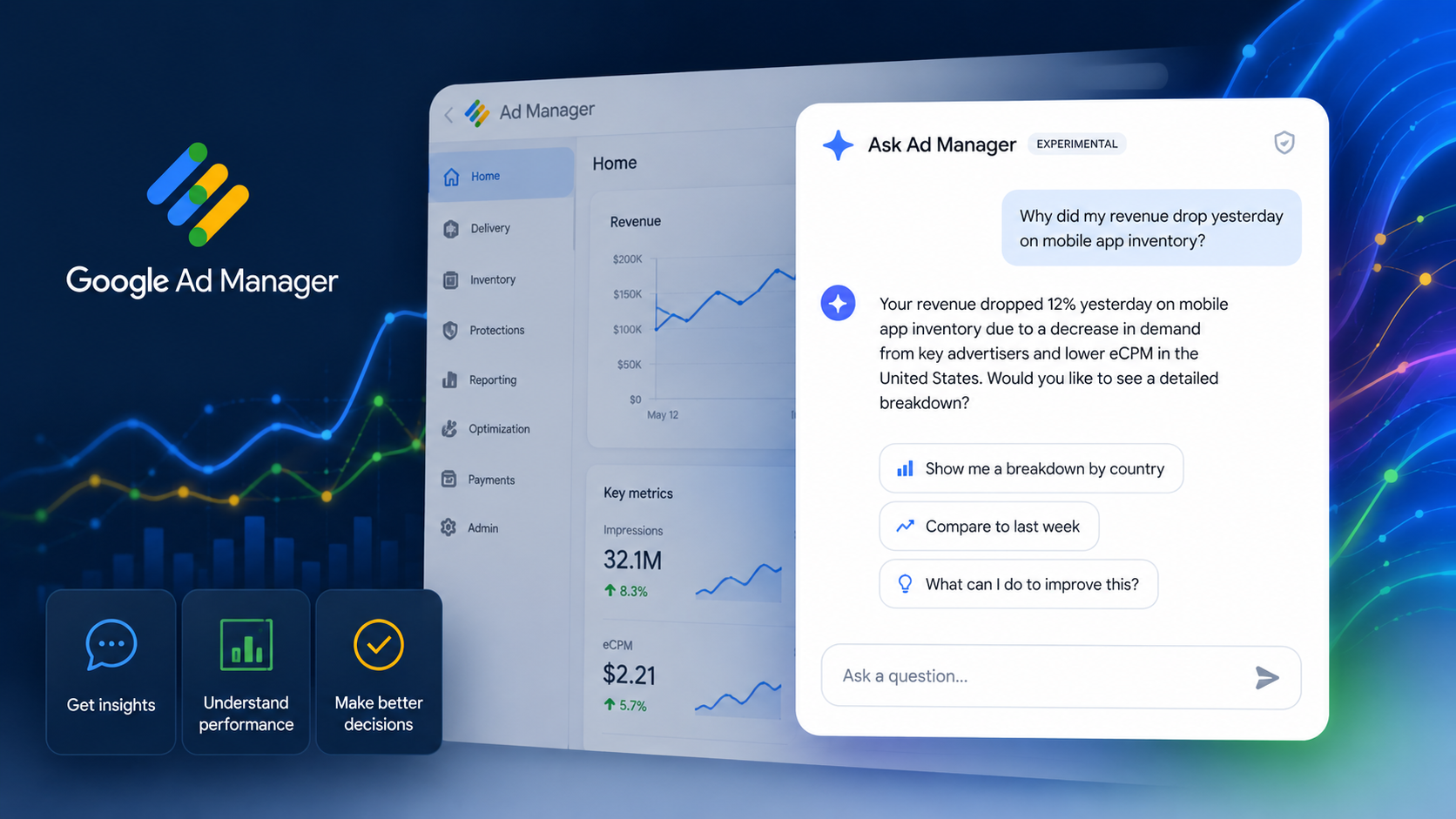
In a significant move to modernize digital advertising infrastructure, Google has announced the integration of generative artificial intelligence directly into Google Ad Manager (GAM). The newly unveiled tool, named Ask Ad Manager, is a Gemini-powered conversational assistant designed to help publishers navigate the complex ad tech platform, analyze yield performance, and troubleshoot campaign delivery issues using natural language queries.
The launch represents a strategic shift for Google as it transitions from traditional static dashboards toward "agentic" artificial intelligence—systems capable of not just presenting data, but executing workflows, diagnosing technical anomalies, and acting on behalf of users. The beta rollout, which begins this month, marks a critical milestone in Google’s broader roadmap to automate and streamline publisher monetization.
Main Facts: What is Ask Ad Manager?
Ask Ad Manager is a specialized conversational AI assistant built explicitly for the publisher-facing side of Google’s advertising ecosystem. Unlike consumer-facing search assistants, this tool is trained on the specific operational logic, terminology, and documentation of Google Ad Manager, and is integrated directly into a publisher’s unique network data.
Rather than navigating multi-layered menus or manually constructing complex database queries, publishers can interact with Ask Ad Manager via a natural language chat interface. The tool focuses on three primary operational areas:
1. Instant Troubleshooting of Delivery Issues
For digital publishers, identifying why a specific advertising campaign is under-delivering or why a line item is failing to win auctions is historically a labor-intensive process. Ad operations teams must typically cross-reference targeting criteria, price floors, competing line items, and historical bid landscapes.
With Ask Ad Manager, users can input conversational questions such as, "Why is my video line item for Client X under-delivering this week?" The AI assistant parses the network’s real-time auction data, identifies potential bottlenecks—such as restrictive geo-targeting, creative rejection, or aggressive floor pricing—and suggests immediate corrective actions.
2. On-Demand Custom Report Generation
Traditional reporting in Google Ad Manager requires users to build custom queries by manually selecting dimensions, metrics, date ranges, and filtering criteria. Ask Ad Manager simplifies this by translating natural language prompts into structured reports.
An ad ops manager can ask, "Show me a comparison of my programmatic CPMs for mobile vs. desktop over the last 30 days, broken down by country," and the tool will instantly compile, format, and display the relevant data, eliminating the need to build and export reports manually.
3. Accelerated Platform Navigation
Google Ad Manager is notoriously feature-rich and complex, often presenting a steep learning curve for new users. Ask Ad Manager acts as an intelligent navigation layer. If a user asks how to modify a specific setting or view a particular yield group, the assistant can automatically direct the user to the correct page within the platform, pre-applying the necessary filters and configuration settings based on the conversational context.
Chronology: The Evolution of AI in Google’s Ad Stack
The introduction of Ask Ad Manager is the latest phase in a multi-year effort by Google to embed machine learning and generative AI across its commercial products. Understanding the timeline of this evolution highlights how Google’s strategy has transitioned from basic algorithmic automation to complex agentic workflows.
[2018–2021: Algorithmic Automation]
  └── Focus: Machine learning for bidding and targeting (Smart Bidding, early Performance Max).

[2023 (May): Conversational Google Ads]
  └── Focus: Conversational campaign construction and asset generation for advertisers.

[2023 (Dec): Launch of Gemini]
  └── Focus: Unveiling of Google's multimodal LLM framework to power enterprise tools.

[Present (June): Launch of Ask Ad Manager Beta]
  └── Focus: Conversational analytics and troubleshooting for publishers.

[Future (Late Year & Beyond): Agentic Ecosystem]
└── Focus: Developer APIs, MCP servers, and autonomous negotiation agents.- 2018–2021: The Algorithmic Automation Era. Google focused on backend machine learning, introducing automated bidding strategies (Smart Bidding) and launching Performance Max (PMax) campaigns. These systems relied on deep learning to optimize advertiser budgets but operated largely as "black boxes" with minimal conversational capability.
- May 2023: Conversational AI in Google Ads. Google introduced generative AI to the buy-side of its business. This allowed advertisers to use conversational prompts to generate ad copy, build campaign structures, and create imagery directly within the Google Ads interface.
- December 2023: The Gemini Era Begins. Google officially launched its Gemini model family, designed to be multimodal and highly capable of complex reasoning. This laid the technological foundation for deeper B2B platform integrations.
- Mid-2024: Expansion of Gemini in Ad Operations. Google began rolling out Gemini-powered tools to help advertisers generate creative assets at scale and refine targeting parameters using conversational prompts.
- Present: The Launch of Ask Ad Manager Beta. Google officially shifts focus to the sell-side (publishers), introducing Ask Ad Manager. This represents a pivot from creative generation to data analysis, platform navigation, and technical troubleshooting.
- Looking Ahead: The "Agentic" Future. Google plans to release REST APIs and Model Context Protocol (MCP) servers later this year. This will allow publishers to connect Ask Ad Manager to external data pipelines and automate complex programmatic negotiations.
Supporting Data: The Operational Burden of Modern Ad Tech
To understand why publishers are demanding conversational interfaces, it is necessary to examine the operational complexity of modern publisher monetization. Large digital publishers rarely rely on a single revenue stream; instead, they manage a highly fragmented ecosystem consisting of direct sales, programmatic guaranteed deals, private marketplaces (PMPs), and open auctions.
According to industry estimates, large-scale publishers manage thousands of active line items and interact with dozens of demand-side platforms (DSPs) simultaneously.

| Metric / Operational Area | Traditional Manual Process | Projected Impact of AI Agents |
|---|---|---|
| Time to Diagnose Line Item Under-Delivery | 2 to 4 hours (requires pulling historical bid logs, reviewing targeting criteria, and cross-referencing floor prices) | Under 2 minutes (AI instantly parses auction diagnostics and offers actionable recommendations) |
| Report Generation & Data Extraction | 15 to 30 minutes per custom report (navigating query builders, selecting dimensions, exporting to CSV, and formatting) | Instantaneous (voice/text prompt compiles, visualizes, and exports data automatically) |
| Platform Onboarding & Training | 3 to 6 months for junior ad operations personnel to master the complex Google Ad Manager UI | Reduced to weeks (conversational navigation acts as an on-demand, interactive platform guide) |
| Ad Operations Overhead | Up to 40% of an ad ops team’s weekly hours are spent on repetitive maintenance and basic troubleshooting | Shifted toward strategic yield optimization, pricing strategy, and direct buyer relationships |
Furthermore, programmatic yield management is highly time-sensitive. A technical misconfiguration—such as an incorrectly applied floor price or a broken creative template—can result in thousands of dollars in lost ad revenue within hours. By reducing the time-to-insight from hours to seconds, conversational tools like Ask Ad Manager directly protect publisher margins in an increasingly competitive media landscape.
Official Responses and Strategic Vision
In announcing the tool, Google emphasized that Ask Ad Manager is not merely an incremental feature, but rather the foundation of a reimagined operational workflow. Writing on the official Google Blog, Google’s product leadership highlighted that the platform is moving toward an "agentic" model where AI acts as an active partner to human operators.
"Ask Ad Manager brings Gemini-powered assistance directly into Google Ad Manager, giving publishers a new way to access insights, resolve issues and manage advertising operations through natural language prompts," the company stated.
Google also clarified that the current beta is the initial step in a broader, long-term technical roadmap. To support this vision, the company plans to introduce developer-centric tools later this year, including:
- REST APIs: Enabling publishers to integrate the analytical capabilities of Ask Ad Manager directly into their proprietary internal dashboards, Content Management Systems (CMS), or Enterprise Resource Planning (ERP) tools.
- Model Context Protocol (MCP) Support: An open-standard protocol designed to facilitate secure, bi-directional communication between LLMs and external data sources. Supporting MCP will allow publishers to securely connect Gemini to their first-party databases, CRM systems, and external yield analytics platforms.
Additionally, Google revealed it is developing specialized agents tailored to specific commercial tasks. These future agents will be capable of helping publishers and agencies discover available inventory, automatically negotiate programmatic deals based on pre-defined yield parameters, and execute complex multi-platform campaigns with minimal manual intervention.
Implications: Transforming the Future of Ad Operations
The deployment of Ask Ad Manager is poised to reshape the digital publishing and ad tech landscape in several structural ways.
Redefining the Role of the Ad Ops Specialist
For over a decade, entry-level roles in digital ad operations have been heavily administrative. Specialists spend significant portions of their day pulling reports, setting up targeting parameters, and manually investigating system alerts. By automating these tasks, Ask Ad Manager is likely to shift the focus of these roles from execution to strategy. Ad ops teams will spend less time writing database queries and more time analyzing yield strategies, testing pricing models, and managing direct buyer relationships.
Lowering the Barrier to Entry for Independent Publishers
While major media conglomerates have dedicated ad operations teams and data scientists, smaller and mid-sized publishers often struggle to optimize Google Ad Manager due to resource constraints. A natural language assistant democratizes access to complex yield optimization techniques, allowing smaller publishers to maximize their ad revenue without needing specialized technical staff.
The Rise of the Agent-to-Agent Economy
Perhaps the most profound long-term implication is the transition toward autonomous programmatic commerce. If publishers deploy AI agents to manage their inventory and yield, and agencies deploy buying agents to discover and purchase ad space, the programmatic marketplace will increasingly consist of AI-to-AI negotiations. In this environment, transaction speeds will accelerate, and pricing efficiency will improve, but it will require robust safeguards to ensure transparency and prevent algorithmic collusion.
Data Privacy and Governance Challenges
As publishers integrate generative AI deeper into their proprietary monetization stacks, questions regarding data security and model training will inevitably intensify. Publishers will require ironclad assurances that their sensitive monetization data, CPM rates, and direct advertiser contracts are kept strictly confidential and are not used to train Google’s foundation models or benefit competing publishers. The integration of the Model Context Protocol (MCP) suggests Google is prioritizing secure, controlled data access, but maintaining publisher trust will remain critical to the tool’s widespread adoption.
Ultimately, Ask Ad Manager signals that the future of enterprise software is conversational. By turning Google Ad Manager from a complex database dashboard into an active, intelligent partner, Google is setting a new benchmark for how publishers monetize digital content in the AI era.