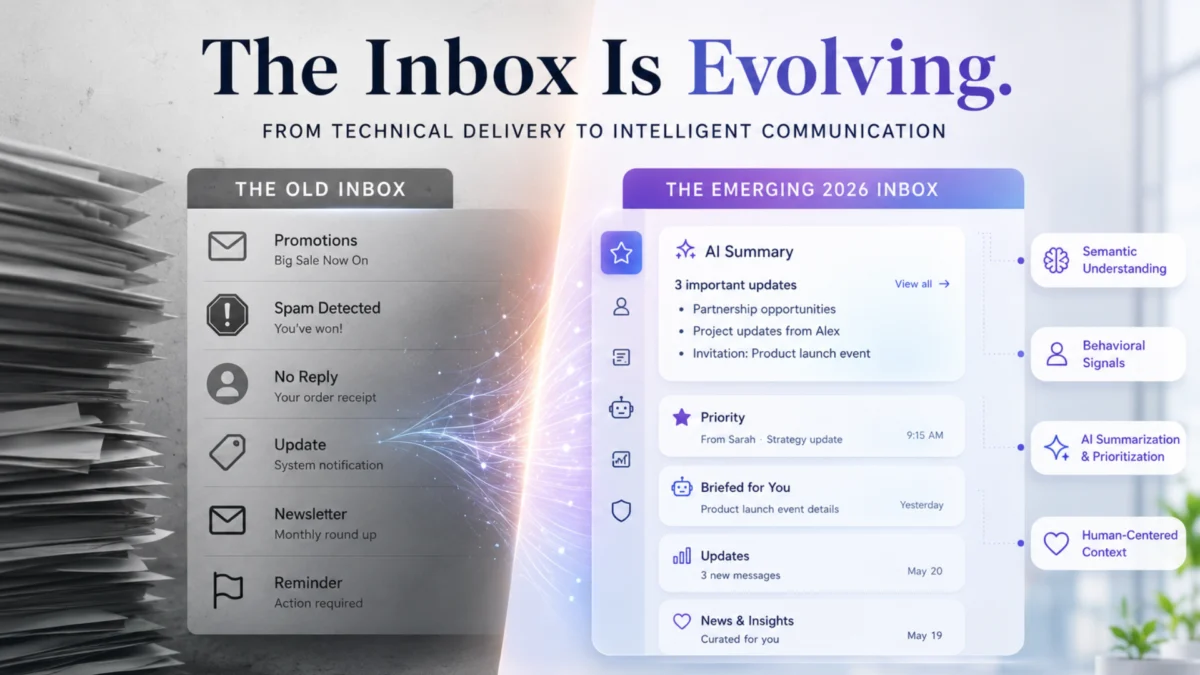
For the better part of the last decade, the email industry has operated on a foundational premise: if we optimize the infrastructure, the message will follow. Success was measured in the cold, hard metrics of deliverability—authentication, inbox placement, sender reputation, rendering, and automation. If a message arrived, was opened, and eventually converted, the system was deemed healthy.
However, a quiet paradigm shift is underway. Universities and research institutions worldwide—including the University of Chicago, Stanford, MIT Sloan, Cambridge, TH Nürnberg, and the National University of Singapore—have begun studying email through a vastly different lens. They no longer view it merely as a delivery mechanism, but as an AI-mediated environment. In this new digital reality, algorithms summarize, prioritize, interpret, and judge our messages long before a human eye ever lands on them.
This article explores the emerging research into machine interpretation, semantic trust, and behavioral modeling, and what it means for a communication channel that remains the bedrock of the global internet.
The Chicago Study: Why AI Prefers AI
The most significant academic contribution to this field in 2026 is undoubtedly “Email in the Era of LLMs,” authored by Dang Nguyen and his team at the University of Chicago. It is a paper that has been widely misconstrued, requiring a careful breakdown of its methodology and findings.
The HR Simulator
The researchers developed an "HR Simulator," a game requiring participants to draft emails resolving complex, emotionally charged workplace scenarios. They analyzed over 600 emails—some written by humans, others by large language models (LLMs). The crucial twist? The judges were also LLMs.
Under the scrutiny of these AI judges, human performance faltered, achieving a 23.5% success rate compared to the 48–54% success rate of the models. The machine-written emails were consistently flagged as more formal and empathetic. However, the study’s most vital takeaway is not that "people prefer AI emails," but rather that AI prefers AI emails.
The Convergence of Taste
As models increase in scale, their judgments of "quality" begin to converge. They share a specific, optimized sense of what constitutes professional communication. For the deliverability professional, this is a warning: we are entering an era where success may depend on whether your AI-generated message aligns with the specific semantic "taste" of the inbox provider’s sorting algorithm.
Crucially, the study found that human-machine collaboration significantly outperformed either party acting in isolation. When a human refined and redirected an AI-drafted message, success rates climbed to nearly 100%. The lesson is clear: automation provides scale and efficiency, but human judgment remains the essential ingredient for efficacy.
Chronology: From Infrastructure to Semantics
The evolution of email research can be viewed as a three-act play:
- The Infrastructure Era (2015–2022): The industry focused on the plumbing. If a message was authenticated via SPF, DKIM, and DMARC, it was considered "good." The goal was to ensure the message reached the inbox without being blocked by spam filters.
- The Engagement Era (2022–2025): The focus shifted to user interaction. Providers began using engagement metrics—click-through rates, time-spent-reading, and complaint ratios—to decide which mail belonged in the "Primary" tab and which belonged in "Promotions" or "Spam."
- The Semantic Era (2026–Present): We have entered the age of AI mediation. The inbox is no longer a passive container but an active, intelligent filter. Email is now being interpreted by models that assess intent, tone, and behavioral alignment.
The Integrity Shift: DKIM2
As semantic interpretation gains importance, the industry is revisiting the very standards of identity. Professor Richard Clayton’s work on DKIM2, presented at the 2026 Deliverability Summit in Barcelona, marks a fundamental pivot from "identity" to "integrity."
Traditional DKIM serves as a passport stamp—it tells the receiver who sent the mail. DKIM2, however, is a chain-of-custody record. It documents the entire lifecycle of an email, including how it was transformed by mailing lists, security gateways, and forwarding systems. By creating a "recipe" of metadata that tracks every modification, DKIM2 ensures that the integrity of the message is preserved from sender to recipient. It is a necessary evolution for a world where AI will soon be parsing the content of messages for authenticity as much as the headers.
Supporting Data: The Plumbing Still Buckles
While researchers dream of semantic trust, the industry is still wrestling with the fragility of existing infrastructure. A study by Tino Hager (Mailtower.app) and Professor Ronald Petrlic (TH Nürnberg) highlighted a sobering reality: even properly authenticated mail often fails security checks due to the inherent chaos of DNS behavior.
Their study of 100,000 test messages revealed that inconsistencies in response sizes, resolver quirks, and provider-specific implementations frequently cause authentication failures. This creates a paradox: while we debate the nuances of AI-driven communication, the foundational "pipes" of the internet still buckle under the weight of ordinary operational strain. For practitioners, this is a reminder that advanced semantic strategies are useless if the basic technical handshake fails.
Implications: The Death of the "Polish" Instinct
For years, marketers have been taught to aim for "clean" design and polished, error-free copy. The current academic research suggests this instinct might soon become a liability.
The "Tell" of Automation
AI models have mastered the art of "professional empathy"—the ability to write in a polite, structured, and helpful tone. However, they struggle to replicate the blunt, informal, or slightly awkward register of authentic human communication. As synthetic, overly polished emails saturate our inboxes, recipients—and the algorithms that assist them—may begin to view excessive polish as a "tell" for automation.
The Rise of Behavioral Personalization
Beyond simple LLM-written copy, we are seeing the emergence of "PersonaMail." This is the next frontier of personalization, where systems are trained on an individual’s specific rhythm, tone, and relational context. Rather than segmenting users by demographic, these systems emulate the sender’s personality. This shift raises profound ethical questions regarding emotional profiling and the nature of consent in digital communication.
Official Responses and Industry Outlook
The consensus among researchers at institutions like MIT Sloan and Stanford is that the "human-in-the-loop" model remains the gold standard. While automation buys speed, distinctiveness remains a scarce, high-value asset.
The industry is currently divided:
- The Tech-Optimists believe that AI will solve the spam problem by "understanding" intent, effectively filtering out low-quality noise.
- The Pragmatists argue that we are moving toward a "model-to-model" communication environment, where the effectiveness of an email is determined by whether the sender’s AI successfully "dances" with the recipient’s AI.
- The Skeptics point to the fragility of DNS and the risks of adversarial gaming, where spammers learn to "speak the language" of the inbox’s AI filters to bypass detection.
Conclusion: A New Frontier for Practitioners
The most critical takeaway for email professionals is that the era of treating the inbox as a black box is ending. Universities have begun to treat the inbox as an interaction layer between people, algorithms, and trust systems.
We are moving into an era where "deliverability" is no longer just about avoiding a blacklist. It is about semantic alignment. If your communication style is too divergent from the norms established by the models that govern the inbox, your mail may be relegated to the shadows, not because it was marked as spam, but because it was judged as "uninteresting" or "incongruent."
The industry is late to this conversation, but the trajectory is clear. As we look toward the next few years, the focus must shift from merely sending mail to ensuring that our communication—both human and machine-assisted—retains the distinct, authentic, and imperfect signals that machines, for all their intelligence, still cannot truly replicate.
As the lines between synthetic and organic communication blur, the most successful communicators will be those who use the efficiency of AI to amplify, rather than replace, their own unique human voice. The inbox of 2027 will not just be a list of messages; it will be a conversation between models, and the humans who know how to guide them.