In the high-stakes world of digital marketing, most businesses are operating with a silent, catastrophic flaw: they are pouring capital into a leaky bucket. You spend thousands of dollars on high-intent ad campaigns, sophisticated social media targeting, and aggressive SEO, only to watch the majority of your traffic vanish the moment they land on your site.
This isn’t just a minor inconvenience; it is a direct erosion of your bottom line. Conversion Rate Optimization (CRO) is no longer a "nice-to-have" experiment for data scientists—it is a fundamental business imperative.
The Financial Case for CRO: Turning Traffic into Revenue
A comprehensive CRO strategy is not about changing the color of a button or tweaking a headline based on a "gut feeling." Those are merely cosmetic adjustments. A true CRO strategy is a systematic, data-driven approach designed to identify conversion barriers and remove them.
The economic payoff is profound. If your current conversion rate is 2% and you manage to nudge it to 3% through systematic optimization, you haven’t just improved by a single percentage point—you have achieved a 50% increase in your conversion volume. For most businesses, this represents a significant windfall in revenue without increasing their ad spend by a single dollar.
By squeezing more value from existing traffic, you lower your Customer Acquisition Cost (CAC) and improve the overall efficiency of your marketing funnel. Unlike paid advertising, which ceases to generate results the moment you stop paying the platform, the insights gained from a successful CRO program provide permanent, compounding improvements to your digital presence.
The Five-Step CRO Framework: A Chronology of Growth
To move from guessing to winning, marketing teams must adopt a structured methodology. CRO is not a project with a start and end date; it is an iterative process.
Step 1: Establishing Measurable Conversion Goals
You cannot optimize what you do not measure. The first stage of any robust strategy is defining what "success" looks like.
- Macro Conversions: These are your primary objectives—a completed purchase, a signed service contract, or a booked demo.
- Micro Conversions: These represent the smaller steps along the journey—newsletter signups, whitepaper downloads, or video engagement.
By aligning these goals with your specific funnel stages, you create a roadmap that reflects the reality of the customer journey. A user at the top of the funnel (a blog reader) requires different conversion incentives than a user at the bottom (a pricing page visitor).
Step 2: Deep-Dive Data Analysis
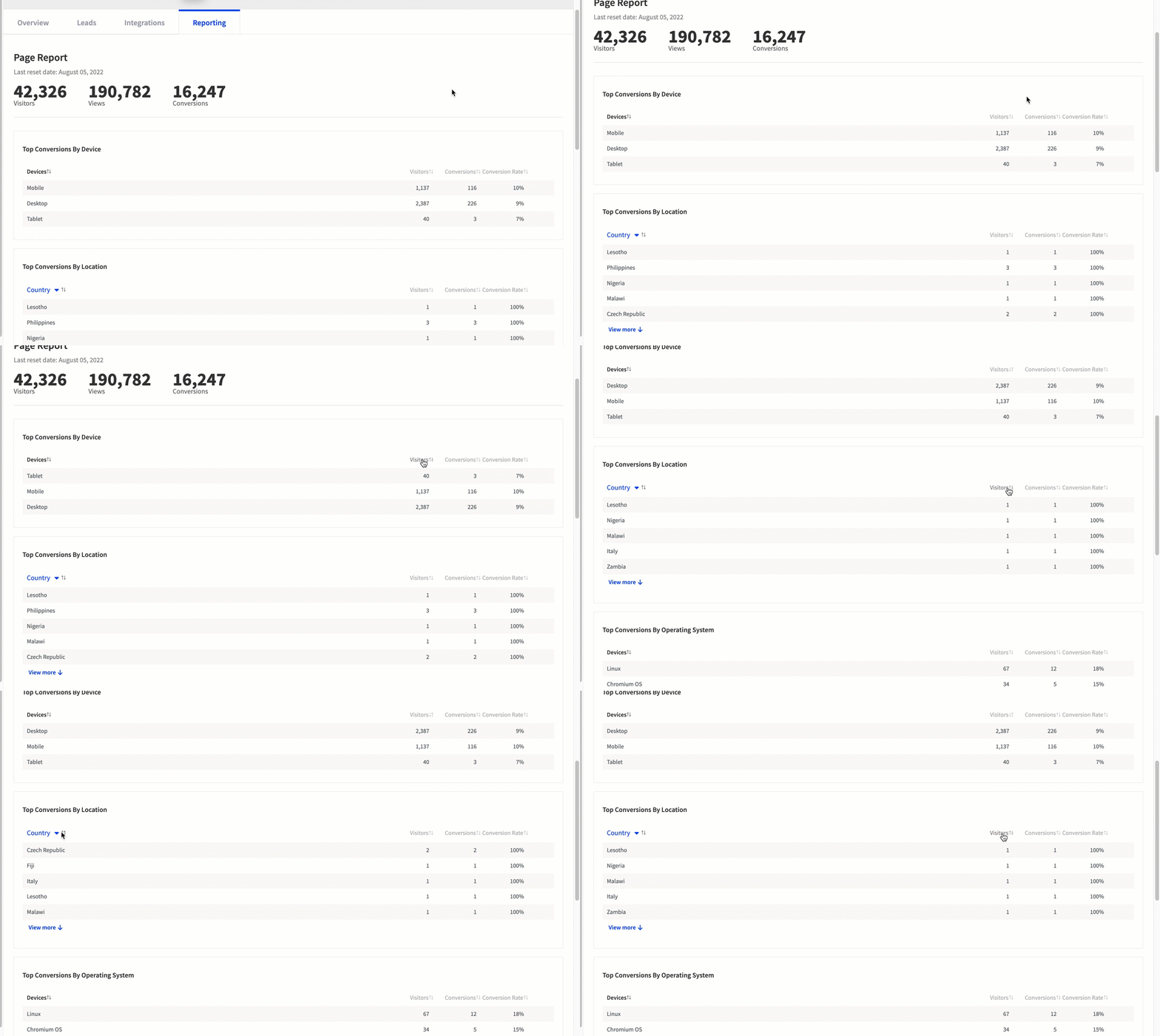
Before testing, you must understand the "why" behind the "what." This phase requires a blend of quantitative and qualitative data.
- Analytics: Review your funnel reports to identify high-traffic pages with low conversion rates. These are your primary "leakage" points.
- Visual Behavioral Tools: Utilize heatmaps and session recordings (like Hotjar or Microsoft Clarity) to observe user friction in real-time. Where are they clicking? Where are they getting stuck?
- Qualitative Feedback: Deploy exit-intent surveys or analyze support chat logs to understand the emotional or functional barriers preventing users from clicking "buy."
Step 3: Prioritizing High-Impact Pages
Not all pages are equal. You should focus your resources on pages that possess the highest potential for impact. Prioritize your checkout flow, pricing pages, and landing pages for high-value campaigns. By fixing friction points here—such as simplifying form fields, adding social proof, or clarifying your value proposition—you see the fastest return on your investment.
Step 4: Testing Hypotheses, Not Hunches
The core of CRO is the A/B test. A professional CRO strategy uses frameworks like ICE (Impact, Confidence, Ease) to prioritize what to test.
- Impact: How much will this change move the needle?
- Confidence: How certain are we that this change will improve performance based on our data?
- Ease: How simple is it to implement?
When running A/B tests, ensure you allow them to run until they reach statistical significance. Stopping a test too early is the most common pitfall for novice teams, often leading to false positives that do not hold up when scaled across the entire site.
Step 5: Building a Culture of Experimentation
The final, and most critical, step is institutionalizing CRO. The most successful organizations treat testing as a routine part of their marketing operations. They maintain a shared knowledge base of past tests—both winners and losers—to ensure that the team is constantly learning rather than repeating past mistakes.
Supporting Data and Industry Benchmarks
According to recent industry reports, the average conversion rate across digital channels hovers around 6.6%, though this fluctuates significantly by sector. For instance, SaaS companies often see trial signups at 3-5%, while e-commerce product pages frequently range from 1-3%.

It is vital to note that these benchmarks should serve as a compass, not a ceiling. The primary metric for success is your own year-over-year improvement. A 2% conversion rate that provides high-quality, high-lifetime-value customers is often superior to a 5% rate that results in churn-prone users.
Official Perspectives: The Value of User Experience
Marketing leaders and CRO experts emphasize that optimization is ultimately about user experience (UX). When a site is optimized, it is not just "salesy"—it is clearer, faster, and more helpful.
"When visitors encounter a smooth, intuitive path to their desired outcome, they build trust," note experts in the field. This trust is an intangible asset that converts visitors into brand advocates, even if they don’t purchase during their first visit. By prioritizing the user’s needs and removing the barriers to their goals, businesses inadvertently optimize their own revenue potential.
Implications for Future Growth
The implications of ignoring CRO are increasingly severe. As digital advertising costs continue to rise due to increased competition and privacy regulations (which make targeting less precise), the "cheap" traffic of the past is gone.
Businesses that invest in CRO are insulating themselves against these rising costs. They are building a self-sustaining growth machine. By moving from a "gut-feeling" approach to a systematic, data-backed methodology, organizations can turn their website from a static brochure into a high-performance engine for revenue.
In summary, the transition to a high-converting website is not a mystery. It is the result of persistent curiosity, disciplined testing, and a relentless focus on the user. If you are not optimizing your site today, you are essentially paying for the privilege of losing customers to competitors who are. The data is waiting; it is time to start listening.