In the high-stakes world of digital marketing, the traditional "set-it-and-forget-it" campaign is becoming a relic of the past. Most marketers operate on a cycle of high-pressure launches: they build a landing page, run a campaign, hold their breath, and mourn or celebrate the results before moving on to the next project. This binary approach—success or failure—misses the most significant opportunity in modern performance marketing: the compounding power of iterative testing.
Iterative testing is not merely a tactic; it is a fundamental shift in philosophy. It transforms marketing from a series of disjointed bets into a continuous cycle of evidence-based improvement. By treating every campaign as a data-collection exercise, marketers can adapt to shifting user behaviors, stop "slow leak" budget drains, and achieve conversion rates that traditional, static approaches simply cannot match.
The Core Concept: Moving Beyond the "Home Run" Mentality
Far too many marketing teams exhaust their resources swinging for the fences, hoping for a viral, high-conversion "home run" that transforms their bottom line overnight. When those massive swings fail, the result is demoralizing and costly.
Iterative testing advocates for a different path: the "base hit" strategy. By focusing on the testing phase as a continuous, cyclical process, marketers make small, incremental changes based on real user data. This approach is rooted in the same principles that have governed software product development for decades. Instead of a complete overhaul, you refine your messaging, design, and user experience through constant, low-risk experiments.
The compounding effect of these small wins leads to superior ROI, faster growth, and more predictable outcomes. When you stop chasing the "perfect" campaign and start chasing the "better" campaign, you create a sustainable machine for conversion rate optimization (CRO).
Chronology of an Iterative Campaign: The Six-Step Workflow
To implement iterative testing effectively, marketers must move away from ad-hoc experimentation and toward a structured, repeatable process. This workflow ensures that every test contributes to a larger repository of organizational knowledge.

1. Defining a Focused Hypothesis
The most common point of failure in testing is the "everything-at-once" trap. Testing a headline, a hero image, a button color, and a form length simultaneously yields a mess of data that makes it impossible to isolate which variable actually moved the needle. A strong, iterative hypothesis is singular, specific, and tied to a business goal. For instance: "Changing the CTA from ‘Submit’ to ‘Get My Free Guide’ will increase form completions by 5% because it emphasizes value over action."
2. Prioritization via Impact and Effort
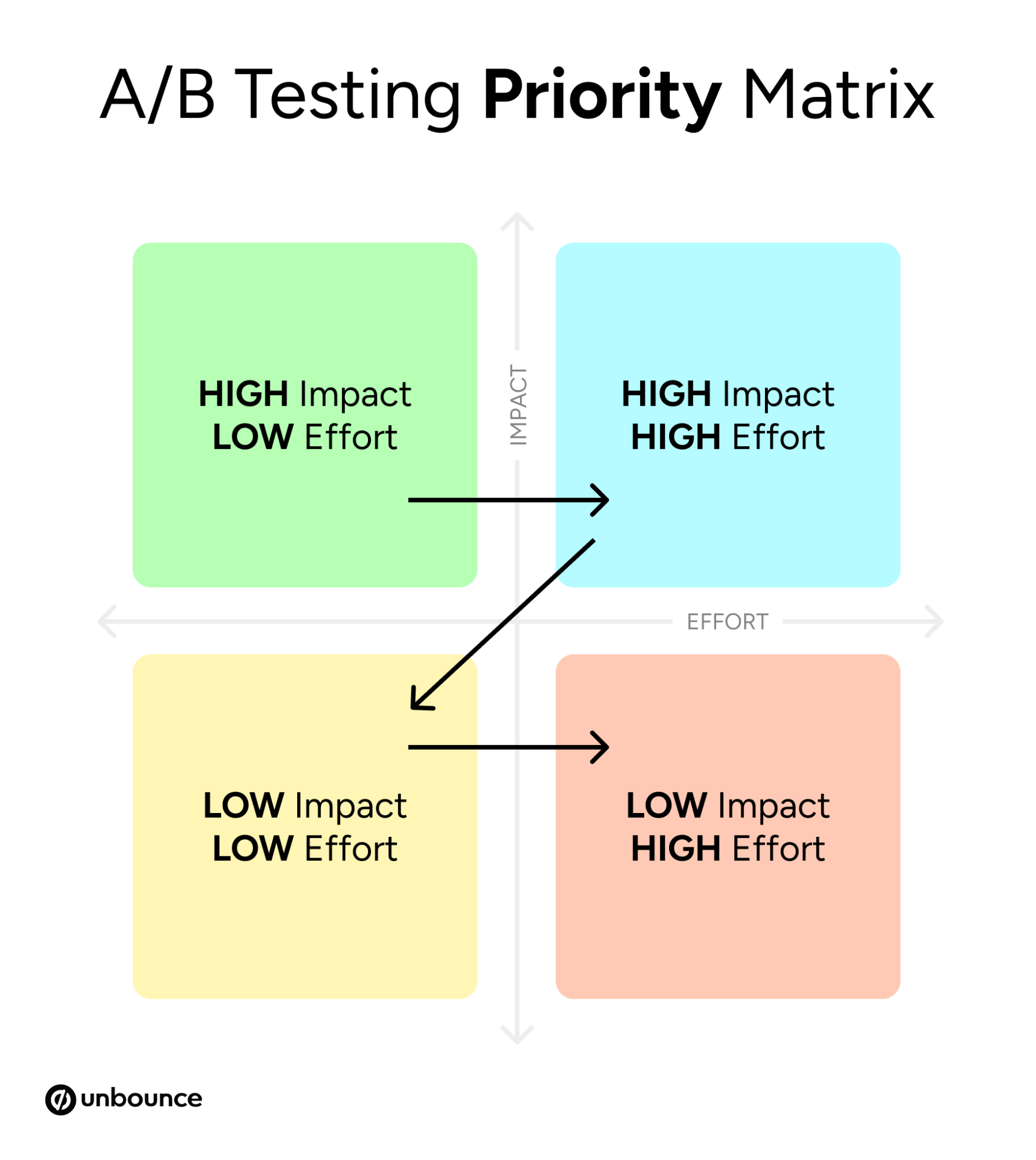
Not all tests are created equal. Smart marketers use a 2×2 matrix to categorize experiments based on their potential impact and the effort required to implement them. This allows teams to secure "quick wins" to build momentum while reserving resources for high-effort, high-impact strategic shifts.
3. Building Minimal, Testable Variations
"Minimal" does not mean "insignificant." An effective variant should be clean and isolated. Whether you are using specialized A/B testing software or built-in optimization tools, the goal is to duplicate your control asset and apply a single, clear change that provides a meaningful alternative for your audience.
4. Launching and Collecting Data
Statistical significance is the difference between a real insight and a happy accident. Marketers must resist the urge to end tests prematurely. Without adequate sample sizes, you are effectively gambling with your budget. Patience is the hallmark of the data-driven professional; let the experiment run until the data provides a clear, reliable signal.
5. Analyzing Results for Actionable Insights
Raw data is useless without interpretation. When a test concludes, the analysis shouldn’t stop at "Variant B won." You must ask why. If a simpler headline outperformed a clever one, the insight is that your audience prioritizes immediate clarity over creativity. This insight should then be applied to future emails, social copy, and ad headers.
6. Iterating, Expanding, and Scaling
Once a winner is identified, you have three clear paths:

- Iterate: Use the new version as the control and test a new variable.
- Expand: Apply the winning tactic to other channels (e.g., if a landing page change works, roll it out to your email sign-up flow).
- Scale: Update your brand guidelines to codify this new best practice.
Supporting Data: Why Small Leaks Sink Big Budgets
The financial implications of ignoring iterative testing are significant. The 2024 Conversion Benchmark Report provides compelling evidence for this methodology, highlighting that pages written at a 5th-7th grade reading level convert at 11.1%—more than double the rate of professional-level copy. Furthermore, the report notes that high word complexity shows a -24.3% negative correlation with conversion rates.
These are not just "nice to know" facts; they are "actionable intelligence." A brand that fails to test its copy complexity is effectively leaking 24% of its potential conversion volume every day.
Additionally, we see a massive discrepancy in user behavior: 83% of landing page visits occur on mobile devices, yet desktop sessions still convert 8% better on average. This data point is a goldmine for iterative testing. It suggests that a one-size-fits-all approach is failing mobile users. By running iterative tests specifically designed to improve the mobile experience, a team can capture that 8% gap, turning a performance liability into a competitive advantage.
Official Perspectives: The Role of Tools and Culture
Industry leaders emphasize that the "right tool" is a force multiplier for the "right mindset." As Josh Gallant, founder of Backstage SEO, notes, the goal of modern marketing is to create a culture of experimentation. When organizations break down silos—allowing support teams to report customer confusion and sales teams to highlight common objections—the quality of testing hypotheses skyrockets.
Support teams, for example, often hold the key to the most effective tests. If customers are constantly asking about pricing after a purchase, there is a clear, evidence-based hypothesis waiting to be tested: "Adding a pricing transparency section to the landing page will reduce bounce rates."
Using tools that support rapid deployment, such as Unbounce’s Smart Traffic, further empowers teams to move faster. By starting to optimize after as few as 50 visits, these tools allow marketers to avoid the "waiting game" that traditionally kills momentum in testing programs.
Implications: Building a Resilient Marketing Strategy
The ultimate implication of adopting an iterative testing model is a fundamental change in how a brand handles failure. In a traditional model, a failed campaign is a waste of money. In an iterative model, a failed test is a piece of data that prevents you from making the same mistake twice.
This builds organizational resilience. As you continue to test, your "baseline" for performance rises. You stop guessing what your audience wants and start responding to what they tell you.
Key Best Practices for Long-term Success:
- Prioritize Speed: Perfection is the enemy of progress. The best test is the one that is currently running, not the one that is being planned in a meeting.
- Keep it Simple: Avoid complex, multi-variant testing that creates noise. If you can’t explain the test in one sentence, it’s likely too complicated.
- Break Down Silos: Your sales and support teams interact with your customers more than your marketing team does. Use their feedback to build your test backlog.
- Focus on Core Metrics: Don’t drown in data. Pick the 3-4 metrics that directly correlate to revenue—conversion rate, cost-per-acquisition, and bounce rate—and ignore the vanity metrics that don’t influence the bottom line.
Conclusion
Iterative testing is the bridge between gut-feeling marketing and scientific precision. By committing to a process of constant, small improvements, marketers can avoid the volatility of the "home run" strategy and replace it with the steady, reliable growth of "base hits."
As the digital landscape becomes more crowded and customer attention spans continue to shrink, the ability to learn faster than your competitors is your most valuable asset. Start with a single, focused hypothesis today. Run the test. Analyze the result. Then, build the next iteration. In the world of high-performance marketing, progress is not a destination—it is a continuous, beautiful cycle.