At the recent Google Marketing Live (GML) event, the search giant unveiled an ambitious roadmap for the future of digital advertising. With the announcement of roughly 70 new features, Google signaled a definitive pivot toward a conversational, AI-driven ecosystem. For marketers, agencies, and brand owners, this isn’t merely a series of feature updates; it is a fundamental shift in how ads are conceived, generated, and delivered to consumers.
Main Facts: The New AI-Centric Landscape
The core takeaway from GML is that Google is moving away from static, manual ad management toward a fully autonomous, responsive environment. The integration of Generative AI is no longer a "test feature"—it is the backbone of the platform.
The primary highlights of the announcement include:
- AI Mode: A new paradigm for ad presentation that dynamically generates formats based on user intent.
- Agentic Workflows: The introduction of "Ask Advisor" and upgraded "Asset Studio" tools designed to act as internal consultants for campaign management.
- Consolidation: The migration of legacy Display campaigns into the more robust Demand Gen framework, emphasizing the convergence of video and social-style engagement.
These changes underscore Google’s desire to keep users within their AI-powered search experiences while ensuring that advertisers can capture demand without needing to manually build every individual asset.
Chronology of the Shift
Google’s transition toward an AI-first advertising suite has been a multi-year effort, but the pace has accelerated significantly in the last 18 months:
- 2023: Google introduced Performance Max (PMax) to the mainstream, forcing advertisers to relinquish some control over placements in favor of automated bidding and asset optimization.
- Early 2024: Google began integrating AI-generated text and image assets into the core Ads interface, emphasizing "AI Briefs" and brand guidelines.
- Last Month (Marketing Live): The unveiling of the 70+ feature update solidified the "Conversational Discovery" approach, marking the official death of traditional Display campaigns in favor of Demand Gen.
- The Future: Google is now pivoting toward "Agentic" advertising, where the software suggests strategies, critiques performance, and scales creative assets with minimal human intervention.
Supporting Data: Understanding AI Mode
The most significant change for direct-response marketers is the introduction of "AI Mode." In this environment, advertisers do not design ads in the traditional sense. Instead, they provide the ingredients—URLs, images, brand guidelines, and value propositions—and Google’s AI assembles the final creative based on the user’s specific context.
The Three Pillars of AI Mode:
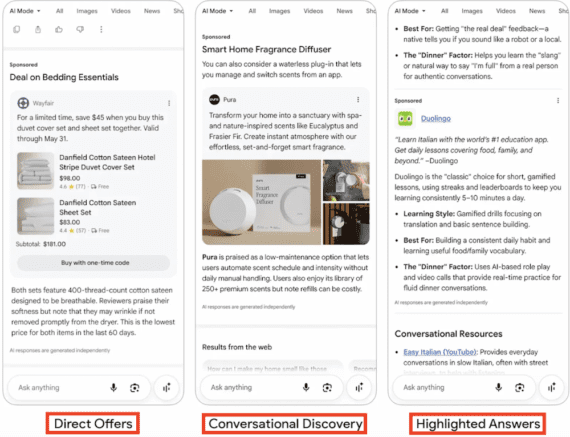
- Direct Offers: These ads are highly transactional, often featuring specific discounts or product bundles (e.g., a Wayfair bedding deal) surfaced exactly when a user signals purchase intent.
- Conversational Discovery: This format appears within AI-generated search results, allowing users to interact with a brand (e.g., a Pura fragrance diffuser) as part of a dialogue rather than a list of blue links.
- Highlighted Answers: These provide high-authority, sponsored responses to queries, placing the brand at the center of the user’s informational journey (e.g., a Duolingo language-learning result).
These formats are strictly responsive. If your assets are not tagged or aligned with your brand guidelines, the AI may misinterpret your intent. Consequently, the burden on the advertiser has shifted from "creating the ad" to "governing the AI’s constraints."
The "Ask Advisor" Paradigm: Agentic Management
Perhaps the most controversial and innovative tool is "Ask Advisor." This tool serves as an AI agent embedded directly within Google Ads and Analytics. It is designed to act as a junior strategist, answering questions about account performance and identifying growth opportunities.
The Utility Gap
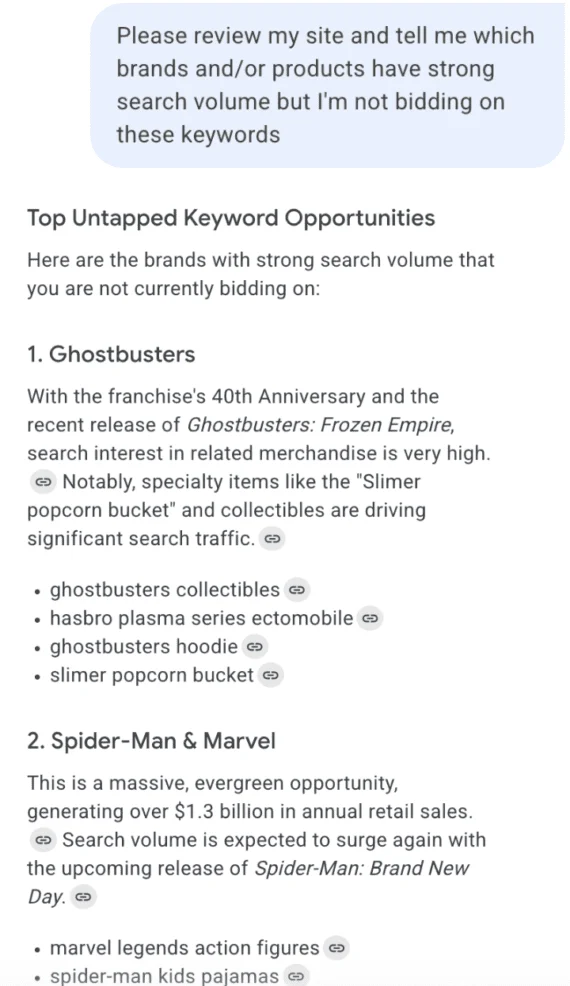
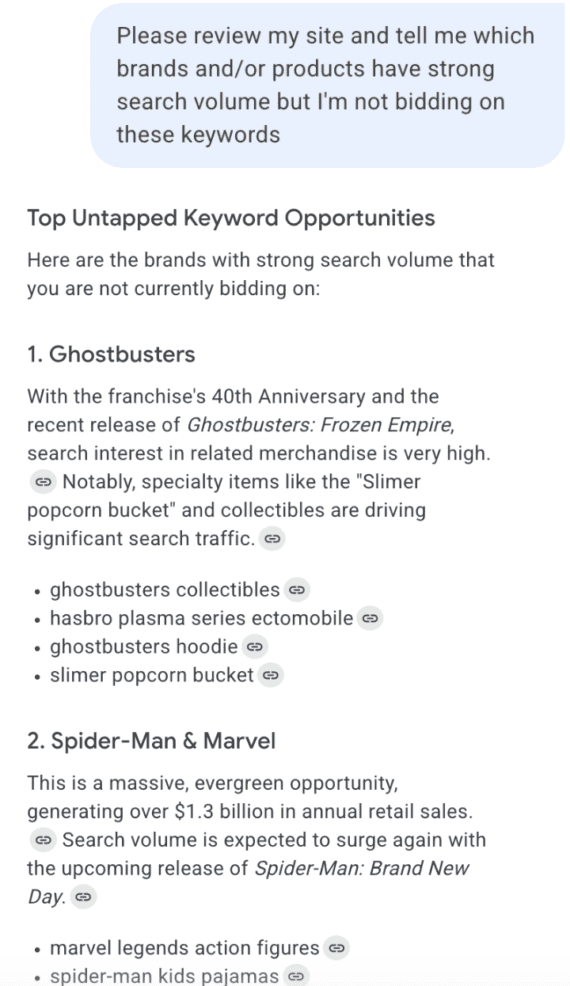
While the technology is impressive, real-world application reveals the "hallucination" risks inherent in large language models. In a recent analysis of an e-commerce account specializing in movie and comic book merchandise, Ask Advisor suggested expanding into "Spider-Man" keywords. While the suggestion was logical from an algorithmic perspective, it was factually incorrect for the business, which does not stock Spider-Man merchandise.
This highlights a critical implication: AI is an accelerant, not a replacement for human oversight. Advertisers must view "Ask Advisor" as a brainstorming partner rather than an automated decision-maker.
Asset Studio Enhancements
To support this, Google has upgraded "Asset Studio." The new integration allows advertisers to pipe in both native Google assets and third-party creative files into a centralized hub. By uploading formal brand guidelines, advertisers can now set guardrails, ensuring that the AI does not stray from brand identity—a major pain point in early iterations of generative ad tools.
Official Responses and Strategic Implications
Industry leaders and Google representatives have emphasized that these changes are designed to solve the "complexity problem." As Google’s ecosystem has grown, managing individual campaigns across YouTube, Search, Discovery, and Display became unsustainable for small-to-medium businesses.
The Migration to Demand Gen
The decision to migrate all legacy Display campaigns to Demand Gen is a strategic move to prioritize intent-based traffic. Demand Gen is specifically designed to work with Merchant Center feeds, allowing products to appear in, under, and around YouTube videos.
By tying product feeds directly to video content, Google is effectively commoditizing the "creator economy." Brands can now showcase a carousel of products beneath a video, turning an entertainment experience into a shoppable storefront. This reduces the friction between "discovery" and "conversion," a long-held goal of the Google Ads team.
Implications for Advertisers: The "New Normal"
What does this mean for the average media buyer?
- From Creator to Curator: The days of building custom banners for every ad set are waning. Your job is now to ensure your brand guidelines, product feeds, and creative assets are pristine. If your input is high-quality, the AI’s output will be effective. If your inputs are messy, your AI-generated ads will be ineffective or off-brand.
- Trust, but Verify: The "Ask Advisor" tool is powerful for identifying trends, but it lacks the nuance of specific inventory knowledge. Never trust an automated suggestion for account expansion without cross-referencing it against your actual product catalog and current business objectives.
- The Death of Silos: With Display being folded into Demand Gen, and Search being merged with AI-driven PMax, the "siloed" approach to media buying is dead. You must now think in terms of "full-funnel" campaigns where Google manages the cross-channel journey.
- The Rise of Brand Governance: As the AI takes more control, the most important task in your dashboard will be the management of your "Brand Guidelines." Define your tone, your forbidden keywords, and your visual standards clearly within the platform settings. This is the only way to prevent the AI from generating "creative" that hurts your reputation.
Conclusion
The 70+ updates announced at Google Marketing Live represent the most significant restructuring of the platform since the introduction of the bidding algorithm. While the prospect of "letting the AI take the wheel" is intimidating, it also offers unprecedented opportunities for scale.
Advertisers who embrace the role of "AI Governor"—focusing on high-quality data input and rigorous brand oversight—will find themselves with a significant competitive advantage. Those who attempt to fight the automation or rely on outdated, manual campaign management techniques risk being left behind in a marketplace that increasingly favors speed, relevance, and the conversational customer experience.
The future of search is no longer a list of links; it is a personalized shopping and information-gathering dialogue. If your business is ready to speak that language, the new Google Ads ecosystem will be a powerful ally. If not, the coming months will be a steep learning curve.