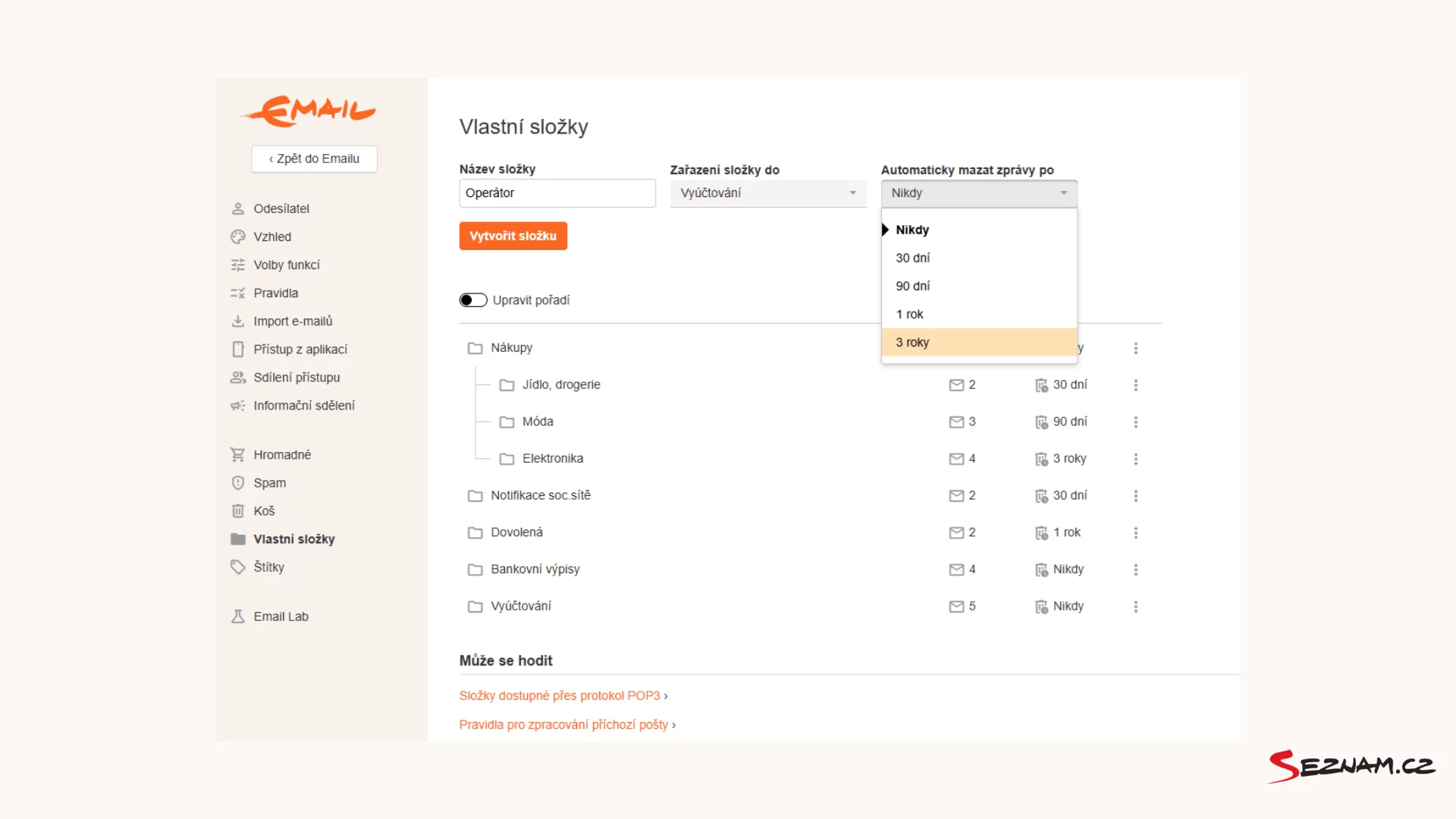
In an era where the average professional receives dozens, if not hundreds, of emails daily, the inbox has evolved from a communication hub into a digital repository of overwhelming proportions. For many, the "inbox zero" dream has been replaced by the reality of thousands of unread notifications, expired promotional codes, and long-forgotten receipts. Addressing this perennial struggle, Czech tech giant Seznam has introduced a sophisticated new feature for its email service: automated, age-based message deletion.
Announced in June 2026, this functionality allows users to define specific retention periods for folders within their Seznam Email accounts. By setting a "time-to-live" for digital correspondence, users can effectively outsource the tedious chore of manual mailbox maintenance to the system itself. While the update may seem like a minor quality-of-life improvement, it represents a significant shift in how email providers view the lifecycle of a message—moving from a model of permanent storage to one of curated digital hygiene.
The Chronology of Clutter: Why Now?
The history of email is one of expanding capacity. In the early 2000s, storage was a premium commodity; users were forced to delete messages simply to make room for new ones. As storage costs plummeted and cloud infrastructure became ubiquitous, providers like Gmail and Outlook pivoted to a "never delete" philosophy. Users were encouraged to keep every communication, under the assumption that search functionality would negate the need for organization.
However, by 2026, the paradigm has shifted once again. The primary pain point is no longer storage capacity, but "cognitive load." Users are suffering from "inbox fatigue," where the sheer volume of accumulated data makes it difficult to locate essential documents.
Seznam’s implementation, launched in mid-2026, follows a period of internal beta testing aimed at understanding user behavior. Data collected during the development phase revealed that the vast majority of emails—specifically newsletters, automated system notifications, and transactional updates—lose 95% of their utility within 30 days of receipt. Recognizing this, Seznam developers engineered a system that allows users to create granular rules: for instance, automatically purging messages in a "Promotions" folder after 90 days, while keeping "Work" or "Personal" folders indefinitely.
The Mechanics of Automated Cleanup
The feature is built on a straightforward, user-centric interface. Within the Seznam Email settings, users can select specific folders and toggle an "Automatic Deletion" switch. Once activated, they choose a retention threshold—ranging from 30 days to one year.
Technically, the system operates as a background task. When an email enters a folder designated for auto-cleanup, the server attaches a metadata timestamp. Once the current date exceeds the timestamp plus the user’s defined retention period, the email is flagged for deletion.
Crucially, Seznam has built in safeguards to prevent accidental data loss. Users receive a notification before mass-deletion events, and deleted items are moved to a "Trash" folder for a recovery period, ensuring that critical documents aren’t lost due to a misconfigured rule. This design choice strikes a balance between automated efficiency and the inherent risk of digital permanence.
Industry Implications: The Death of the "Long-Tail" Engagement
For marketers and email senders, Seznam’s announcement carries significant weight. For decades, the "long-tail" engagement—the clicks and opens that occur weeks after a campaign is sent—has been a metric of success. If a user returns to a newsletter three months later to click a link, it is recorded as a positive interaction.
With the proliferation of automated deletion, that long-tail is at risk of being severed. If a user’s inbox is programmed to clear out messages older than 60 days, any marketing content, receipts, or informative content residing in those folders will disappear.
The Shift in Engagement Metrics
Marketing analysts suggest that this will force a change in how email campaigns are structured. Senders may need to prioritize:
- Immediate Call-to-Action (CTA) Value: Ensuring that the most vital information is accessible within the first week of delivery.
- External Archiving: Encouraging users to save important receipts or reference materials to cloud services like Google Drive, Dropbox, or OneDrive rather than relying on the inbox as a filing cabinet.
- Higher Frequency/Lower Volume: Focusing on high-impact communications rather than flooding the user with content that will ultimately be deleted by an automated script.
The IETF and the "Expires" Header: A Parallel Evolution
While Seznam is taking the lead on the recipient side, a fascinating conversation is simultaneously occurring at the protocol level. The Internet Engineering Task Force (IETF) is currently evaluating a draft that would modernize the "Expires" header for standard SMTP email.
Historically, the "Expires" header was largely ignored or used only for specific calendar events. The proposed IETF standard would allow a sender to suggest a "use-by" date for a message. For instance, a flight confirmation email could carry a header indicating that it is no longer relevant once the flight has departed.
It is vital to note that this is a "signal, not a command." As the draft explicitly states, mailbox providers cannot be forced to delete or block messages based on this header. Instead, it serves as a metadata signal that allows the mailbox provider to display the email more effectively—perhaps by dimming the message, moving it to an "Archived" folder, or grouping it with other expired items.
When combined with Seznam’s new user-controlled cleanup tools, the direction is clear: the industry is moving toward a "disposable" email culture. Senders and receivers are being encouraged to treat email as a transient medium rather than a permanent archive.
Official Responses and User Sentiment
Seznam has maintained a professional stance, emphasizing that the feature is about "empowerment" rather than "interference." In a statement issued alongside the launch, a Seznam spokesperson noted: "Our users have asked for more control over their digital environment. Providing the tools to automatically prune irrelevant data is not about devaluing communication; it is about respecting the user’s time and mental space."
Early feedback from the tech community has been largely positive. Productivity experts have praised the feature as a "digital detox" tool. "We spend an exorbitant amount of time managing files we don’t need," says Dr. Aris Thorne, a digital sociology researcher. "By automating the deletion of clutter, Seznam is effectively helping users reclaim their focus."
However, some privacy advocates have raised questions regarding the long-term implications of automated deletion. If users become accustomed to their email being purged, they may lose the habit of backing up critical documentation. The responsibility now shifts from the service provider to the individual, who must decide which data is "worth" keeping.
Future Outlook: The Intelligent Inbox
Looking ahead, we can expect this trend to accelerate. As Artificial Intelligence becomes more integrated into email clients, these rules will likely become more "intelligent."
Imagine an inbox that doesn’t just delete messages based on age, but based on intent. An AI could identify that a receipt from a restaurant is no longer needed once the expense report is filed, or that an event invitation is obsolete once the calendar date has passed.
Seznam’s latest move is the first step in this transition. It acknowledges that the inbox is a living environment. By giving users the power to set the boundaries of that environment, Seznam is not only improving their specific platform—they are setting a new standard for the email industry at large.
The era of "infinite storage" is giving way to the era of "intelligent retention." As we move further into 2026 and beyond, the most successful email services will be those that help users find what matters, while gracefully discarding what doesn’t. Seznam has planted its flag, and the rest of the industry is likely to follow suit, signaling a fundamental change in our relationship with the digital mail we receive every single day.