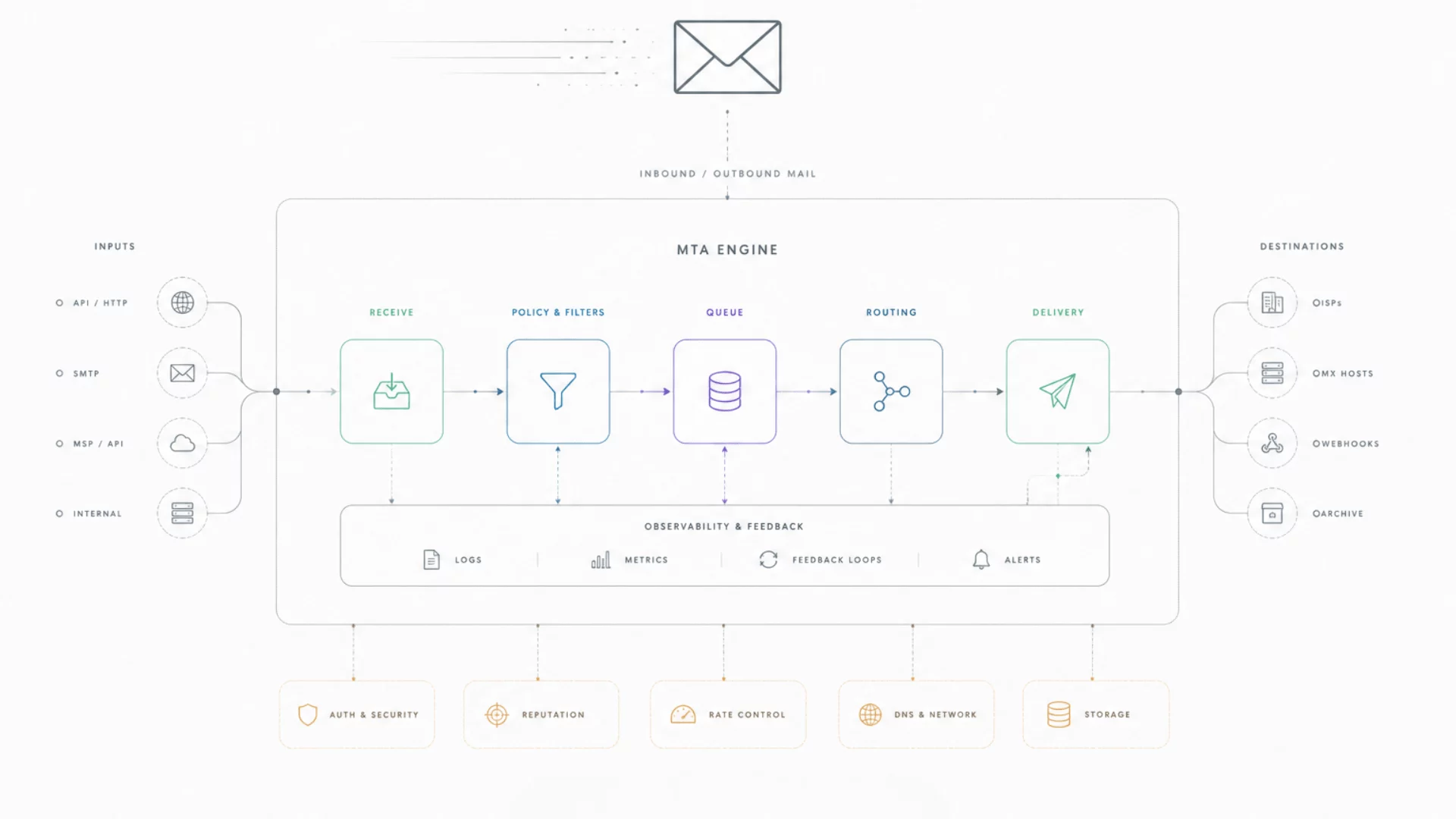
While the tech industry’s collective attention was fixated on the hype cycle of generative AI agents and the frantic debate over large language model verdicts, the underlying architecture of global digital communication—the Mail Transfer Agent (MTA)—quietly underwent a significant evolution. Behind the scenes of every transactional email, password reset, and marketing campaign lies a complex, load-bearing infrastructure that demands reliability over novelty.
Recent updates from the industry’s primary MTA vendors—KumoMTA, Halon, and GreenArrow—reveal a collective shift toward operational maturity, observability, and the pragmatic application of machine learning. Far from the superficial glitter of "AI-everything," these releases represent a concerted effort to solve the most stubborn, long-standing challenges in email deliverability.
The State of the MTA: Why Infrastructure Matters More Than Ever
The modern email ecosystem is increasingly fragile. As mailbox providers tighten authentication requirements and expand the use of behavioral feedback loops, the "boring" layer of the stack—the MTA—has become the frontline of digital business. If the MTA fails, the customer experience fails.
This spring, three major players within our membership ecosystem have demonstrated that the path to resilience lies not in replacing human operators, but in providing them with better tools, deeper insights, and more robust automation. Whether it is KumoMTA’s commitment to open-source transparency, Halon’s integration of ML into delivery queues, or GreenArrow’s focus on modern mobile-first tracking, the theme remains constant: hardening the engine to ensure that when a message is sent, it actually arrives.
KumoMTA: Transparency, Lua Flexibility, and the Price of Autonomy
KumoMTA’s release cycle (culminating in the 2026.05.12 update) serves as a masterclass in how to manage a sophisticated, modular MTA. Unlike many closed-source alternatives, KumoMTA maintains a pace of development that encourages community involvement—a fact underscored by the consistent contributions from community member kayozaki.
Key Technical Advancements
The May release is a maintenance-heavy update, focusing on stability without introducing breaking changes. Key improvements include:
- Counter Series Module: A new in-memory rolling counter system for rate-aware policy logic within Lua, allowing for more granular, real-time control.
- HTTP Injection API Enhancements: ESP builders can now attach per-recipient metadata, a highly anticipated feature that simplifies complex multi-tenant operations.
- TCP Keepalive Fixes: A critical improvement to the proxy listener that ensures unresponsive peers are terminated rather than left hanging, preventing resource leakage.
The "April Change" Warning
A critical point for operators involves a subtle change from the April release. Kumo removed an implicit check that automatically flagged a policy failure when a From: domain did not align with a DKIM signature. While this was technically "baggage" from a legacy dependency, it represents a shift in philosophy: the MTA is no longer doing the guessing for the user. If your organization relies on strict DMARC enforcement, you must now explicitly iterate through verification results and enforce alignment within your Lua policy. Failure to audit these scripts could lead to unexpected delivery failures.
Halon: Moving Beyond "Autonomous" Hype
Halon’s spring releases—Engage 26.1 and Protect 26.1—represent the most significant attempt yet to apply machine learning to the "unglamorous" work of delivery management.
Flow Dynamics: ML for the Delivery Queue
For two decades, deliverability engineers have spent their days writing manual backoff rules for every possible provider response pattern. Halon’s Flow Dynamics attempts to automate this. By utilizing ML-based classification, the system identifies deferral patterns in real-time and adjusts traffic flow accordingly.
Crucially, Halon has avoided the trap of "black-box" automation. The system serves as an intelligent baseline, but deliverability teams retain the authority to override policies. This "human-in-the-loop" design ensures that when an automated system encounters a novel scenario, it doesn’t create a business-critical outage.
Gateway-Enforced Security
On the Protect side, Halon has moved to standardize gateway-enforced encryption. By offering full CMS lifecycle support for S/MIME and PGP at the gateway level, Halon allows organizations to enforce high-security standards without requiring end-users to manage complex encryption keys. For entities in finance, government, or healthcare, this is a significant compliance differentiator.
Diagnostic Visibility
The 6.10 platform update also includes a long-overdue feature: diagnostic transparency for Forward-Confirmed Reverse DNS (FCrDNS) failures. Rather than simply reporting a failed connection, the MTA now explains why the verification failed. This shift toward "explainable infrastructure" is a vital step in reducing the DNS fragility that plagues modern email delivery.
GreenArrow: Mobile-First Maturity and Cloud-Native Rigor
GreenArrow has arguably had the most aggressive development schedule this spring, with a focus on solving the friction points between web-based email tracking and native mobile applications.
Universal Link Tracking
The standout feature in version 4.362.0 is Universal Link Tracking. Traditionally, click tracking has been the enemy of deep linking, forcing users to land on a web page before redirecting to an app. GreenArrow now handles the generation of tracking URLs that comply with Apple’s Universal Links and Android’s App Links, allowing for a seamless transition from email to native app. By hosting the required association files directly, GreenArrow has removed a major technical hurdle for app-centric brands.
The Cloud-Native Trajectory
GreenArrow’s shift toward a cloud-native architecture continues at a rapid clip. With the transition to running as a non-root user (UID/GID 1000) and full support for RHEL/Alma/Rocky 10, the platform is signaling its readiness for modern, containerized enterprise environments.
Lessons from the Seed-Testing Glitch
A notable fix in the May update corrected a bug where SimpleMH seed messages were missing DKIM signatures. This serves as a vital reminder to all operators: if your placement testing results suddenly dip, do not assume it is a reputation issue. Always audit the authentication headers of your test seeds. It is a classic example of why observability into the process of testing is just as important as the results of the test.
Implications for the Industry: Hardening vs. Hype
The common thread linking these three vendors is a transition toward "operator ergonomics." As email becomes more difficult to send, the tools used to send it must become more intuitive and more informative.
The Convergence of Strategy
- Observability over Automation: Vendors are focusing on telling operators why things are happening (e.g., Halon’s FCrDNS diagnostics, GreenArrow’s authentication header sanity checks).
- Configuration as Code: The push toward non-root, container-ready, and environment-variable-friendly configurations indicates that MTAs are finally being treated as first-class citizens in the DevOps lifecycle.
- Pragmatic AI: The industry is signaling that it is uninterested in AI that writes marketing copy. It is, however, very interested in AI that can read provider feedback, classify bounce patterns, and manage traffic pacing.
Recommendations for Operators
- Audit Your Policy Layers: If you are using KumoMTA, review your DKIM alignment scripts immediately to ensure that the removal of legacy implicit checks hasn’t weakened your enforcement.
- Test Your Deep Links: If you are a mobile-first sender, evaluate whether your current click-tracking implementation is hindering your conversion flow. GreenArrow’s approach to Universal Links is the current gold standard.
- Review Your Security Perimeter: For organizations in sensitive industries, the move toward gateway-enforced encryption (as seen in Halon’s latest release) should be prioritized to meet increasing data sovereignty and privacy mandates.
Conclusion
The "boring" work of MTA maintenance is the foundation upon which the digital economy rests. While AI and machine learning will continue to dominate the headlines, the real innovation this spring has happened in the trenches of queue management, DNS diagnostics, and mobile-native integration.
By focusing on hardening their platforms and providing operators with better observability, KumoMTA, Halon, and GreenArrow are ensuring that the engine of the internet remains functional. In an era of increasing noise and volatility, there is no substitute for a well-maintained, transparent, and professionally managed MTA. For the operators of these systems, the message is clear: the era of "set it and forget it" is over. It is time to lean into the diagnostics, embrace the shift toward cloud-native hygiene, and ensure that your infrastructure is as smart as the messages it carries.
Disclaimer: KumoMTA, Halon, and GreenArrow Email are Enterprise Members of Emailexpert. Coverage decisions and editorial analysis are conducted independently of commercial relationships to ensure an objective perspective on the email technology landscape.