In an era where search engines are evolving from mere indexers into sophisticated AI-driven assistants, the way users interact with content is undergoing a seismic shift. Google, the gatekeeper of the global information ecosystem, recently highlighted its "Preferred Sources" feature—a tool that allows users to signal which websites they trust most. While not entirely new in concept, its integration into AI Overviews and AI Mode represents a fundamental transition toward a more personalized, human-curated search experience.
For publishers, brands, and content creators, this feature is more than a UI tweak; it is an invitation to deepen audience loyalty and secure a prominent position in the future of search.
The Core Concept: What Are Preferred Sources?
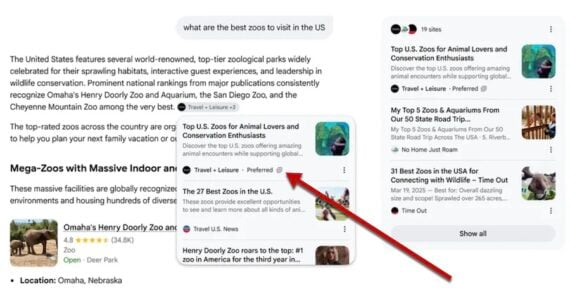
At its simplest, Google’s "Preferred Sources" feature allows individual search users to "tag" specific websites as their go-to destinations for information. Once a user designates a site as a preferred source, that site receives a visual label in AI Overviews and AI Mode. This label serves as a badge of trust, signaling to the search engine that the user values this particular domain above others.
While Google has previously utilized similar mechanisms in its "Top Stories" section—primarily for news organizations to curate high-quality, time-sensitive content—the expansion of this functionality into AI-generated answers is significant. It moves the needle from algorithm-led discovery to user-led curation, effectively allowing the audience to influence the AI’s decision-making process.
A Brief Chronology of Search Personalization
To understand why "Preferred Sources" matters, one must look at the arc of Google’s search philosophy over the last two decades.

- The Early Days (The "One-Size-Fits-All" Era): In its infancy, Google relied almost exclusively on PageRank and objective signals like backlinks. The search results were largely uniform, regardless of who was searching.
- The Rise of Personalization (2005–2015): As Google began tracking search history, location data, and browsing habits, results became tailored to the individual. The goal was to anticipate user intent based on past behavior.
- The Entity and Trust Era (2015–2022): With the introduction of E-E-A-T (Experience, Expertise, Authoritativeness, and Trustworthiness), Google began focusing on the quality of the author and the reputation of the domain.
- The AI Revolution (2023–Present): With the rollout of AI Overviews, Google is synthesizing data into conversational responses. The challenge is ensuring these responses remain trustworthy. "Preferred Sources" is the latest evolution in this journey, granting users the power to audit and influence the AI’s output directly.
How It Works: A Guide for Publishers
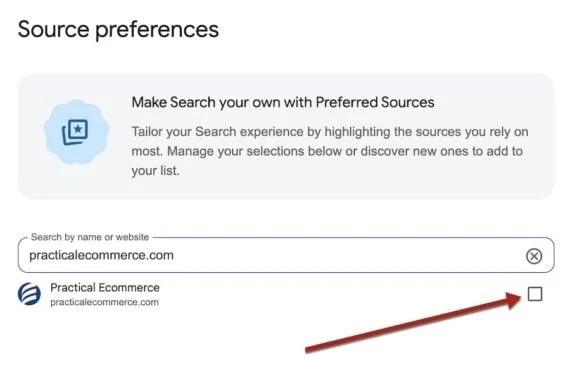
The mechanics of the feature are straightforward, yet they require an active strategy from site owners. Google has provided a specific URL structure that allows developers and marketers to invite their readers to add their domain to their list of preferred sources.
The Implementation Process
- Unique URL Creation: You must create a link using the domain-specific query parameter:
https://google.com/preferences/source?q=example.com. - Domain Constraints: It is critical to note that Google only accepts root domains or subdomains. You cannot direct users to specific subdirectories (e.g.,
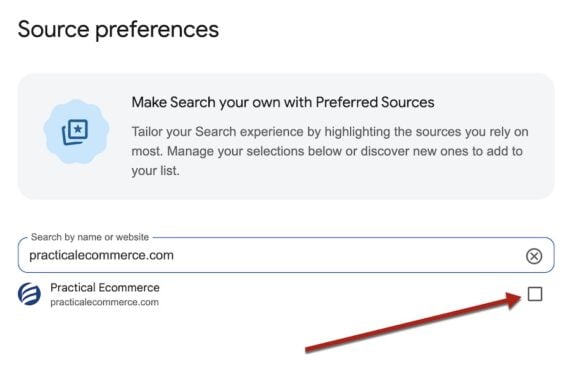
example.com/blog). - The "Unintuitive" Hurdle: Simply clicking the link is not enough. The user must arrive at the Google preference page and manually check the box next to the domain name.
- Strategic Promotion: Because the process requires user action, it is incumbent upon publishers to educate their audience. This can be integrated into newsletters, footer links, or "About Us" pages. A clear call to action, such as "Add us to your Google Preferred Sources to see our latest insights in your AI search summaries," is highly recommended.
Implications for SEO and Content Strategy
The shift toward "Preferred Sources" has profound implications for how businesses should approach digital marketing.
1. From Reach to Relationship
Traditionally, SEO was a game of casting a wide net to capture high-volume, generic keywords. The "Preferred Sources" model shifts the focus toward community building. If you are a niche publisher, your goal is no longer just to rank for a term; it is to convince the user that you are the definitive authority on that term.
2. The AI Visibility Advantage
When a user asks an AI-powered query, the model has to choose from thousands of potential sources. By identifying a site as a "preferred source," the user provides a strong signal to Google’s LLM (Large Language Model) that this content should be prioritized. This could lead to a significant increase in visibility within AI Overviews, where traditional blue-link competition is replaced by synthesized information.
3. Trust as a Competitive Moat
In a world saturated with AI-generated, generic content, human-verified trust becomes the ultimate differentiator. Websites that can cultivate a loyal following will be more resilient to algorithm updates. If your audience explicitly tells Google they trust you, your site becomes a foundational building block for that user’s personalized AI experience.
Addressing the "Black Box" of AI Ranking
One of the most common questions from publishers is: If I am a preferred source for a user, will I appear for every topic they search?
While Google has not released a comprehensive technical manual on how these signals are weighted, historical data suggests that user preference acts as a significant "override" or "booster" in the ranking stack. If a user searches for "World Cup updates," and they have designated a specific sports news outlet as a preferred source, the AI is highly likely to prioritize content from that outlet over a generic, high-ranking aggregator.
This suggests that Google is moving toward a "federated" AI model—one where the AI acts as a curator of trusted nodes rather than a closed-loop source of truth.
Official Responses and Industry Outlook
Google’s messaging around this feature has been consistent with its broader E-E-A-T goals. In their official documentation, Google states: "When you come to Search, you’re looking for information you can trust from the sources, websites, and creators you value most."
Industry analysts view this as a strategic move by Google to mitigate the "hallucination" problems associated with AI. By allowing users to tether the AI to specific, high-quality domains, Google shifts the burden of trust from the algorithm to the user-publisher relationship. It is a win-win: the user gets higher-quality, curated results, and the publisher earns a "sticky" relationship with the search engine.
Best Practices for Maximizing "Preferred" Status
If you are a business owner or content manager, how do you leverage this to your advantage?
- Educate the Audience: Don’t just drop a link. Explain why the user should care. Use language that emphasizes the value of personalized, high-quality information.
- Integrate into User Journeys: Add the link to your "Thank You" pages after a newsletter sign-up or a purchase. These are moments where the user has already demonstrated affinity for your brand.
- Consistency is Key: If a user marks you as a preferred source and then visits your site only to find low-quality content, they will likely remove the designation. The feature is an incentive to maintain high editorial standards.
- Monitor Analytics: Keep an eye on your referral traffic from AI-driven search channels. While attribution is notoriously difficult in the era of Generative Search, a spike in traffic for branded or highly specific queries can be a strong indicator of success.
Conclusion: The Future of Curated Search
The "Preferred Sources" feature is a quiet but monumental shift in the digital landscape. It represents the end of the "impersonal internet" where users were passive recipients of algorithmic decisions. Instead, we are entering a phase of "curated search," where the user is an active participant in defining the quality and relevance of the information they consume.
For publishers, the path forward is clear: double down on brand identity, prioritize original reporting, and foster a deep, transparent relationship with your audience. In the age of AI, your reputation is your most valuable SEO asset. By embracing tools like Preferred Sources, you aren’t just optimizing for a machine; you are optimizing for the human being on the other side of the screen.