In the rapidly evolving landscape of digital advertising, a profound transformation is underway. For decades, the professional standard for "Search Marketing" involved a granular, hands-on approach: marketers spent their days obsessing over match types, bid modifiers, negative keyword lists, and the delicate art of segmenting campaigns by geography, time of day, and audience demographics.
Today, that era is effectively over. In a world where fuel-efficient, long-range motorcycles have replaced horses as the primary mode of transportation, insisting on traditional manual management of ad platforms is akin to refusing to step off the saddle. The modern Google Ads environment is inherently "AIfied," and for professionals still clinging to the "AdWords-era" manual control model, the cost of inaction is not just missed opportunity—it is profit pulverization.
The Death of the Manual Control Mindset
The fundamental shift in the advertising industry is defined by a move away from human intervention toward machine-driven optimization. Platforms like Google and Meta are increasingly architecting their systems to favor automated, AI-driven outcomes over manual adjustments.
"Search marketing" is no longer a binary of brand versus non-brand performance. It is now a high-velocity, intent-driven ecosystem. Yet, a significant portion of the agency world continues to justify its existence by performing manual tweaks multiple times a day. This approach is not only inefficient; it is fundamentally misaligned with how modern algorithms process data.
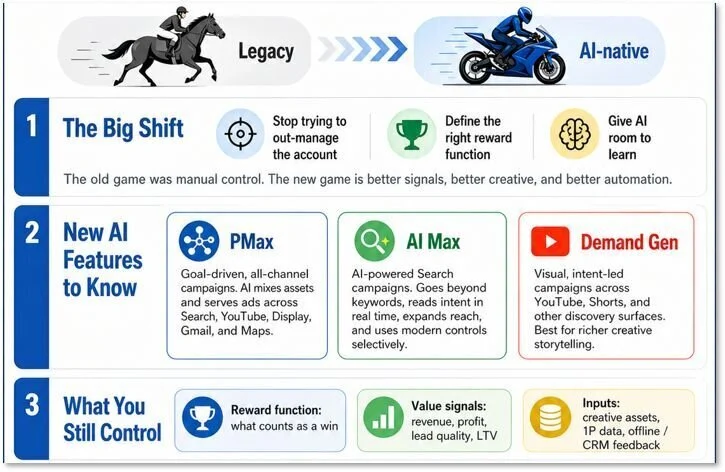
To succeed in the current climate, marketers must shift their perspective from "managing the auction" to "feeding the machine." The goal is to provide the AI with superior data, high-quality creative assets, and clear business objectives, then stepping back to let the system learn and optimize in real time.
Chronology of the AI Evolution in Search
The transition to AI-native advertising has been a steady, deliberate march, though it has accelerated dramatically in the last three years:
- The Era of Manual Control (2000–2015): The "AdWords" epoch, characterized by extreme segmentation, manual bidding, and keyword-based targeting.
- The Rise of Smart Bidding (2016–2020): Google introduced automated bidding based on conversion signals, marking the beginning of the end for manual bid modifiers.
- The Integration of Broad Intent (2021–2023): The launch of Performance Max (PMax) signaled a shift toward cross-channel automation, where assets—not just keywords—became the primary currency of the ad auction.
- The AI-Native Present (2024–Present): With the introduction of AI Max and Demand Gen, the system now analyzes intent across a massive, multi-signal landscape, rendering manual segmenting largely obsolete.
The New Arsenal: PMax, AI Max, and Demand Gen
To navigate this new reality, marketers must understand the primary tools now available within the Google ecosystem:
- Performance Max (PMax): The "all-in-one" solution. By inputting business goals, budgets, and creative assets (text, imagery, video), the AI autonomously distributes ads across the entire Google ecosystem, including Search, YouTube, Gmail, Maps, and Display.
- AI Max: A Search-focused evolution that abandons the traditional keyword-only structure. By analyzing real-time intent signals, AI Max identifies relevant search queries that go far beyond the user’s literal input, expanding reach to high-converting audiences that were previously inaccessible through manual keyword research.
- Demand Gen: The successor to Discovery ads, this visual-first format uses AI to deliver immersive video and short-form content to users who show high purchase intent, optimizing delivery based on deep, non-linear signals.
These tools share two defining characteristics: the human still controls the "reward function" (defining what "winning" looks like, such as revenue, profit, or lead quality), but the AI executes the strategy based on a breadth of data that is humanly impossible to process.
Maturity Assessment: Are You a Tourist in the AI Age?
To help organizations determine whether they are effectively utilizing these tools or merely "touring" the modern landscape, industry experts have developed a Maturity Model. This model evaluates an organization’s capability and the depth of its AI implementation across six core dimensions.
The Two Pillars of Assessment
- Capability Scoring (0–4): Measures how sophisticated the organization’s processes are, ranging from "Legacy" (manual, control-first) to "AI-native" (fully automated, objective-driven).
- Depth Scoring (0–4): Measures how widespread this sophistication is across the account. A common trap is "pilot-itis," where AI is used only on a tiny fraction of spend. A true AI-native organization applies these methodologies to 75%–100% of its operations.
The Six Dimensions of Maturity
- Measurement & Value Architecture (Weight: 30 pts): If your measurement foundation is weak, your automation will fail. This dimension focuses on transitioning from "proxy" metrics like pageviews to "true business value" metrics like CRM-fed, closed-won lead value or predicted LTV.
- Search Operating Model (Weight: 20 pts): This involves migrating from exact-match, manual bid-modifier structures to Smart Bidding and broad-match architectures that allow the system to capture intent at scale.
- 1P Data & Audience Intelligence: Leveraging first-party data to inform the machine about who your best customers actually are.
- Surface Breadth & Campaign Mix: Ensuring that the organization is utilizing the full breadth of Google’s inventory, not just legacy Search.
- Creative & Landing Page Adaptability: Recognizing that in an AI-first world, creative assets are the new keywords.
- Operating Cadence & Governance: The shift from daily manual tweaks to strategic oversight and high-level goal setting.
Strategic Implications: The Business Case for Change
The implications of failing to modernize are severe. Businesses that continue to employ an AdWords-era mindset are effectively choosing to compete with one hand tied behind their back.
Why the "Human-in-the-Loop" Model is Failing
The primary argument for manual management—that humans know the business better than the machine—is becoming increasingly fragile. While human intuition is critical for defining the reward function, the machine is demonstrably better at executing the auction-by-auction decision-making process. Every hour a human spends manually adjusting a bid or pruning a negative keyword list is an hour of "lost cash" that the AI could have spent optimizing for actual revenue.
The Path to High Performance
To reach the upper echelons of the maturity model (a score of 85 or higher), organizations must:
- Prioritize Data Integrity: Ensure that the conversion signals being fed to the machine are tied to real, bottom-line financial outcomes.
- Simplify Account Structures: Stop fragmenting accounts into thousands of tiny, manual, or device-specific segments.
- Empower the Machine: Give the AI the budget and the creative variety it needs to learn. If the system has no room to experiment, it cannot optimize.
Conclusion: Embrace and Extend
The choice to stay in the past is no longer an available business strategy. As the digital landscape continues to consolidate around AI-driven performance, the divide between "Legacy Operators" and "Modern Advertisers" will only widen.
The transition requires a cultural shift: a movement away from the comfort of manual control toward the agility of machine learning. While the initial learning curve may be steep, the payoff is substantial. Organizations that successfully bridge this gap report 3x, 5x, or even 20x increases in revenue and profit. More importantly, it shifts the role of the marketer from a "campaign mechanic" to a "business strategist," making the work not only more profitable but significantly more meaningful.
In the final analysis, the new game is not about who can manage the account better—it is about who can feed the machine the best truth. Carpe diem.