In an era where consumer attention is increasingly fragmented across infinite digital streams, live sports remain the last true "campfire" of the media landscape. Last year, nearly all of the top 50 most-watched telecasts in the United States were sports-related. Even oddities like a "Weather Delay" during an NFL game drew massive viewership, proving that audiences will engage with almost anything if it carries the prestige of athletic competition.
Yet, this dominance has created a dangerous paradox for marketing executives. While streaming giants and global brands are rushing to acquire rights and plaster logos on everything from jerseys to stadium naming rights, a sobering question is finally being asked in the boardroom: Beyond the hospitality suites and the thrill of meeting celebrity athletes, is this multi-million dollar investment actually driving business results?
The Main Facts: The "Last Bastion" of Live TV
Sports telecasts are the only content that demands to be watched in real-time, together. This unique characteristic makes them the ultimate vehicle for brand exposure. However, the sheer volume of sports-related advertising—from team sponsorships to back-panel interviews and stadium naming rights—has created a cluttered environment where a brand’s presence can easily be lost.
The fundamental issue is that many organizations treat sports marketing as a "set it and forget it" vanity project. When a company spends $38 million on a sponsorship, the absence of a rigorous measurement framework transforms that spend into a blind bet. The challenge for the modern marketer is not merely to "be there," but to ensure that the halo effect of the sport translates into tangible commercial outcomes.
Chronology of the Sports Marketing Boom
The trajectory of sports marketing has shifted from traditional broadcast advertising to a complex ecosystem of integrated partnerships.
- The Era of Mass Reach: Initially, sports were simply the best vehicle for reaching the largest possible audience through television commercials.
- The Rise of Integration: As DVRs and streaming allowed audiences to skip ads, brands moved toward "on-jersey" and "on-court" presence, embedding themselves directly into the action.
- The Streaming Shift: Giants like Amazon, Apple, and Netflix have entered the fray, treating sports rights as the primary catalyst for subscriber growth, thereby further inflating the cost and necessity of sports-adjacent advertising.
- The Accountability Pivot: Today, we are in the era of "consequences." With tightening budgets and the rise of advanced marketing analytics, the honeymoon phase of sports sponsorships is ending. CFOs are now demanding the same granular level of performance data from a stadium naming deal that they demand from a Google Search campaign.
Supporting Data: Why "Noise" Isn’t Enough
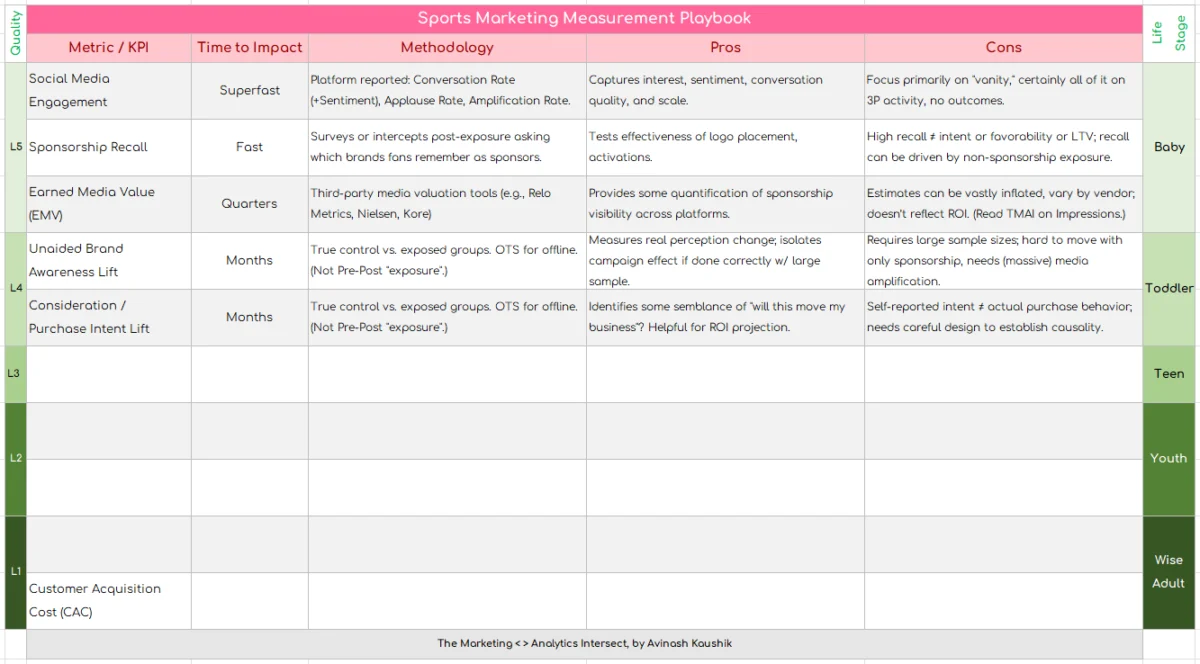
To understand the effectiveness of these investments, we must categorize how companies currently measure impact. Industry experts utilize a hierarchy of sophistication, often referred to as the "Impact Intelligence Score" (IIS), which scales from 1 to 10.
Level 5: The Vanity Trap
Most brands begin—and unfortunately, many end—at Level 5. This level is defined by "Big Numbers." Companies report on "450 million impressions" or "Earned Media Value" (EMV).
- The Flaw: EMV often calculates the cost of an ad by multiplying the duration of a logo appearance by the cost of an expensive television spot. This is widely considered a "con" by marketing analysts because it ignores audience quality, relevance, and whether the consumer actually internalized the brand message.
- The Metric: This level measures noise, not value. It answers the question, "Did people see us?" rather than "Did people care?"
Level 4: The Quest for Brand Impact
Level 4 moves the needle toward human behavior. It focuses on:
- Unaided Brand Awareness (UBA) Lift: Measuring whether the sponsorship actually shifts long-term brand perception.
- Purchase Intent: Determining if exposure to the sports brand correlates with a higher likelihood of the consumer choosing that brand during their next purchase cycle.
- Methodology: This requires test-vs-control group analysis rather than simple pre-post surveys. By using propensity score matching, marketers can isolate the specific lift generated by the sports partnership versus other concurrent marketing activities.
Implications for the Modern CMO
The implication of this data is clear: The laws of marketing apply to sports just as they do to any other channel.
If a creative narrative fails to capture attention on TikTok in 1.2 seconds, it will fail to capture attention on a stadium back panel. In fact, because the viewer’s primary purpose is to watch the game, the threshold for capturing attention is actually higher in a sports context.
The Creative Imperative
Creative is responsible for 60% to 70% of brand marketing success. Smart companies are realizing that it can be highly profitable to hand over the "storytelling" to the sport or the athlete itself. By aligning with the values of a specific team or individual, a brand can inherit those qualities. However, this must be a conscious, strategic decision. If the creative is weak, the sponsorship is merely an expensive logo placement that will be ignored by the audience.
The Frequency Requirement
A common misconception is that "organic" placement in sports replaces the need for paid frequency. This is false. To build a brand, you still need to hit the "sweet spot" of frequency—roughly three times per user per week. Achieving this in sports requires a disciplined combination of paid media and strategic placement, where the sports entity serves as the hook for the creative.
Official Guidance: Moving Toward "Show Me the Money"
For any organization looking to move beyond vanity metrics, the roadmap involves progressing through the remaining levels of sophistication:
- Level 3 (Heart & Mind Influence): Understanding how the partnership builds compounding brand advantage over time.
- Level 2 (The First Digital Trace): Identifying the specific digital footprints left by sports-exposed audiences that lead to financial outcomes.
- Level 1 (The Gold Standard): Proving incrementality. This is the "Show Me The Money" stage, where marketing analytics can definitively prove that the sponsorship directly caused a sale that would not have happened otherwise.
Conclusion: Turning on the Lights
Sports marketing has the power to be transformative—think of the enduring association between Rolex and tennis. But transformation is not a byproduct of simply writing a check. It is the result of rigorous, continuous measurement.
Brands that treat their sports investments as a "black box" are destined to see their budgets slashed when the CFO eventually asks for accountability. Those that treat sports as a measurable, data-driven channel will find that it is one of the most effective ways to secure long-term market share.
Stop sponsoring in the dark. By shifting from vanity metrics to causal, incremental measurement, marketing leaders can ensure that their sports partnerships deliver the one thing that matters most: a measurable, profitable impact on the bottom line.
This analysis serves as a framework for serious marketing and analytics professionals. For those navigating the complex intersection of brand strategy and performance, the path to maturity is clear: turn on the lights, demand better data, and treat the arena as a place of commerce, not just a place of play.