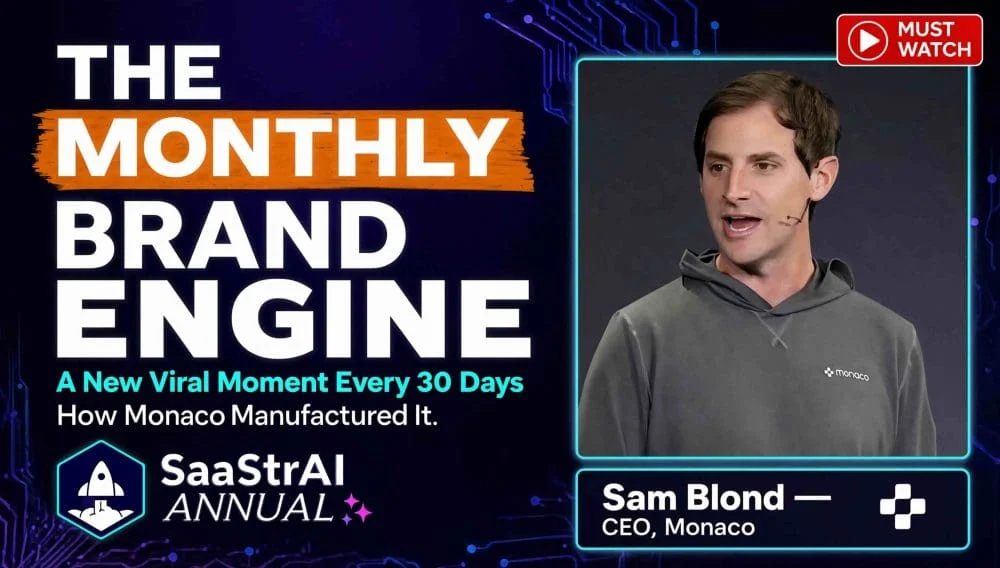
In the modern B2B landscape, the definition of a "marketing engine" is undergoing a radical, AI-driven transformation. For years, the industry standard was defined by incremental growth, steady content production, and predictable lead generation. However, Sam Blond, CEO of Monaco and former CRO of Brex, has introduced a more aggressive framework. During his keynote at SaaStr AI 2026, Blond argued that if your marketing team isn’t producing a major, buzz-worthy "brand moment" every single month, you are likely losing the war for attention.
The central thesis of Blond’s philosophy is that AI has effectively commoditized the "mechanical" 80% of go-to-market (GTM) strategy. By automating TAM (Total Addressable Market) scoring, lead enrichment, signal detection, and multi-channel outbound, AI has cleared the desk for a new type of human-centric, high-impact creativity. The companies that win will not be those that use AI to do less, but those that use the reclaimed time to manufacture constant, compounding momentum.
The Mechanical 80%: Why Automation is No Longer Optional
To understand the necessity of a monthly "brand moment," one must first accept the new baseline of GTM operations. In 2026, the manual labor of prospecting is a relic. AI agents are currently handling:
- Dynamic Prospecting: Real-time identification of target accounts based on trigger events like funding rounds, leadership hires, or technology stack shifts.
- Record Enrichment: Constant cleaning and updating of CRM data, ensuring that sales teams are never operating on stale intelligence.
- Pipeline Hygiene: Predictive modeling that flags stalled deals and suggests specific interventions for account executives.
Blond’s argument is stark: if you are still manually building lists or researching prospect backgrounds, you are effectively operating at a speed that invites obsolescence. A competitor utilizing autonomous agents to monitor the market 24/7 will inevitably out-execute, out-pace, and out-reach any team relying on human legwork. The "mechanical" portion of marketing is now a utility—settled and solved.
The competitive advantage, therefore, has shifted entirely to the remaining 20%: high-level strategy and the creation of visceral, memorable brand experiences that AI cannot replicate.
Chronology of a Monthly Engine: From Product Launch to Poker
The most common failure point for B2B marketing teams is the "dead air" between major milestones. Companies typically wait for a Series C announcement or a massive product release to make noise, leaving months of inactivity in between. Blond rejects this seasonality.
February: The Foundation
For Monaco, the year began with a natural milestone: the confluence of a significant product launch and a Series A funding round. During these months, the goal is not to invent a moment, but to optimize the extraction of value from an existing one. Every channel, from social media to email sequences, was synchronized to amplify these events.
The "Dead Air" Solution: The Monaco Invitational
The true test of a marketing system occurs in the gaps. Between February and May, Monaco lacked a natural milestone. Rather than accepting this as a quiet period, the team manufactured one. They launched the "Monaco Invitational"—a high-stakes poker tournament in San Francisco with $100,000 in prizes.
The brilliance of this stunt lay in its thematic alignment. By leaning into the "Monaco" name—a brand synonymous with luxury, high-stakes gaming, and exclusivity—the event felt organic rather than forced. It generated localized press, social media buzz, and, most importantly, provided a reason for the company to stay in the conversation during a traditionally slow quarter.
The Stacking Effect: Why Sequential Marketing Wins
Blond posits that marketing is not additive—it is multiplicative. A billboard in San Francisco is a passive asset. A poker tournament is an active event. When you run a billboard campaign during a poker tournament, and you announce a Series B while the event is trending, the impact of each initiative is magnified.
"One plus one plus one does not equal three," Blond explained. "It equals four, or five." The cadence creates a halo effect where the audience perceives the company as being "everywhere," fostering a sense of inevitability and market dominance that a single, isolated stunt could never achieve.
Supporting Data: The Economics of Attention
The most common objection to a "monthly moment" strategy is budgetary. However, Blond challenges the assumption that these tactics require enterprise-level advertising budgets. Using the example of the "Monaco Plane"—a banner plane that circled San Francisco for ten days—he broke down the economics of high-impact, non-traditional marketing.
The Cost-Benefit Breakdown
- The Plane: Running a banner plane costs approximately $6,000 per day. This includes flight time, logistical setup, and the aerial permit.
- The Billboard Comparison: A premium, high-traffic billboard on the 101 freeway can cost upwards of $120,000 per month.
- The Efficiency Ratio: For the cost of a single static billboard, a company could fund nearly 20 days of aerial advertising.
Beyond the raw dollars, Blond emphasizes the "Attention Per Dollar" metric. Modern consumers are conditioned to ignore static signage. They are not, however, conditioned to ignore a plane flying over the city center. By breaking the pattern of the environment, Monaco achieved a level of brand recall that no amount of digital display ads could replicate.
Furthermore, the "meta-marketing" effect was significant. When Blond posted the economics of the plane on social media, the thread garnered 3.6 million views. The campaign became a second campaign, proving that if the initial stunt is creative enough, the documentation of its success becomes its own viral asset.
Implications for the B2B Executive
The implications for CMOs and CEOs are clear: the era of the "calendar-based" marketing plan is over. The new era is defined by the "cadence-based" engine.
1. Shift from Content to Moments
Most marketing departments are organized around content calendars (blogs, whitepapers, webinars). Blond suggests shifting toward "moment calendars." If the team spends 80% of their time on content that will be forgotten in 48 hours, they are wasting the capacity AI has provided.
2. Prioritize Novelty over Polish
In a saturated market, "perfect" marketing is often invisible. The Monaco plane worked because it was the first of its kind in downtown San Francisco. It didn’t need to be a polished, high-production commercial; it just needed to be unexpected. Marketing teams must prioritize the "first-mover" advantage in their local or niche ecosystems.
3. The "Human" Moat
As AI models become more sophisticated, the value of the human connection increases. The time saved by AI should be poured into:
- In-person engagement: Creating experiences that cannot be replicated by a chatbot or an automated email.
- Strategic storytelling: Defining the "why" behind the company, which AI can mimic but not truly originate.
Conclusion: The New Competitive Landscape
Sam Blond’s tutorial at SaaStr AI 2026 serves as a wake-up call for the B2B sector. We are entering a phase where the divide between "growth companies" and "stagnant companies" will be defined by their ability to maintain a rhythmic, compounding brand presence.
The founders and marketers who view AI as a tool to shrink their workload are doomed to lose market share to those who use it to amplify their reach. By automating the mundane, companies have the opportunity to build a "brand machine" that never sleeps. When a company consistently shows up—whether through a poker tournament, an aerial banner, or a perfectly timed series of announcements—it creates a sense of momentum that is difficult to disrupt.
The math is clear: the budget isn’t the constraint. The constraint is the lack of a system that treats marketing as a disciplined, monthly sequence of high-impact events. In 2026, if you aren’t the loudest, most creative presence in the room, it is no longer because you lack the money—it is because you lack the cadence.