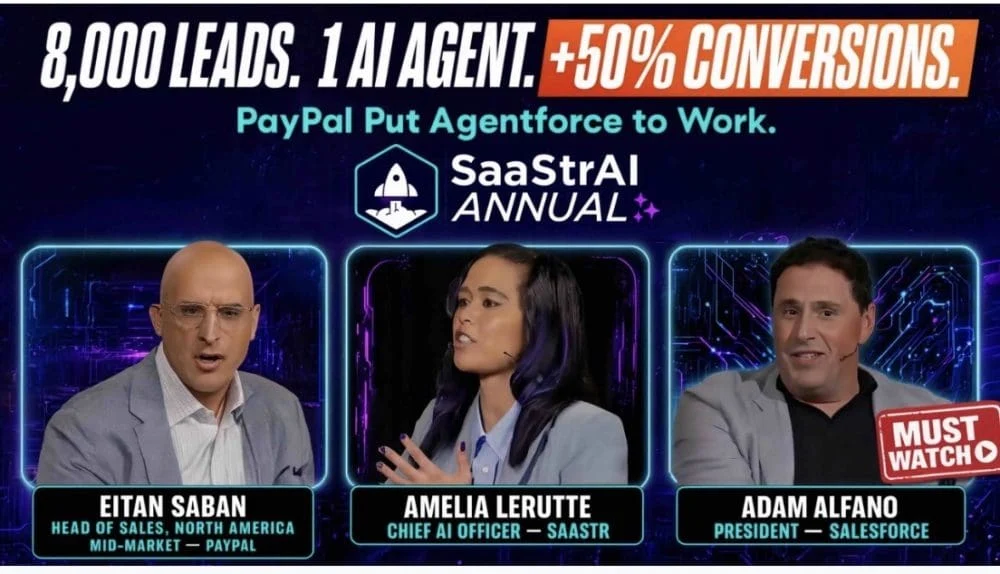
At SaaStr AI 2026, the industry’s most compelling narrative wasn’t a hypothetical vision of a future dominated by artificial intelligence. Instead, it was a practical, high-stakes masterclass in operational reality. Amelia Lerutte, in a standout session, sat down with Adam Alfano, President at Salesforce, and Eitan Saban, Head of Sales for North America Mid Market at PayPal, to deconstruct the implementation of AI sales agents.
The core message was clear: The era of "AI as a science project" is over. We are now in the age of production-grade autonomy, where massive, regulated, global enterprises are putting AI agents on real revenue pipelines and observing tangible shifts in conversion math within a single quarter.
The Evolution of the Sales Stack
The discussion began by addressing the elephant in the room: the fear that AI is a tool for headcount reduction. Both Salesforce and PayPal were adamant that their adoption of Agentforce was not designed to replace the human sales representative. Rather, it was designed to solve a problem of human capacity.
PayPal, for instance, manages an onboarding process for over 100,000 merchants every month. Historically, a significant percentage of these merchants would stall in their journey, creating a backlog of roughly 8,000 leads that required consistent follow-up. No sales organization, regardless of its size, possesses the human bandwidth to manage 8,000 individual "nudge" cycles every month without sacrificing quality. Consequently, these leads were traditionally abandoned.
The introduction of AI agents changed this dynamic. These agents perform a 10-nudge cadence against every single stalled lead. They do not tire, they do not favor high-commission targets, and they do not skip weekends. By the time a human representative engages, the agent has already performed the heavy lifting, ensuring the rep starts the conversation further down the funnel with full context and a qualified lead.
Chronology of an AI Implementation
The transition from a pilot program to a full-scale deployment follows a rigorous, if unconventional, trajectory.
Phase 1: The "Action Bias" Approach
Many organizations are paralyzed by the "dirty data" dilemma. During the session, the panel addressed the common hesitation: "Can we deploy an agent if our CRM data is messy?" The consensus was an emphatic "No, don’t wait."
Adam Alfano noted that Salesforce runs its own SDR agent with high levels of deliverability, largely because the agent leverages a curated data environment. However, he argued that waiting to achieve a perfect data state is a recipe for stagnation. Organizations can deploy web agents that utilize website FAQs and product data while simultaneously cleaning their back-end infrastructure. Crucially, the process of running the agent often reveals exactly what data structure is needed, essentially allowing the implementation to drive the cleanup effort in reverse.
Phase 2: The Headless Unlock
The most profound shift discussed was the transition to "headless" operations. The traditional view of a CRM as a digital rolodex for human input is becoming obsolete. Instead, it is being reimagined as an execution layer for AI agents.
At SaaStr, for example, the organization’s AI VP of Marketing—an agent dubbed "10K"—operates entirely through an API. It pulls pipeline data, revenue metrics, and engagement history without a human ever logging into the CRM. Similarly, Adam Alfano manages a massive team through Slack-based agents, demonstrating that when AI is allowed to execute against structured data programmatically, it gains a level of precision that "probably doing the right thing" cannot match.
Phase 3: Conversational Intelligence as Data
The panel introduced a critical, often overlooked, data vector: conversational transcripts. PayPal feeds its agents every conversation from platforms like Gong, alongside account data from Seismic. This creates a feedback loop where the agent understands exactly why deals are lost and what specific variables drive conversion. By treating every human-to-human, agent-to-human, and agent-to-agent conversation as part of the training set, the AI’s contextual awareness grows exponentially.
Supporting Data and Performance Metrics
The results of this shift are quantifiable. For companies like PayPal, the transition is measured in conversion lift. By the 14-week mark of their deployment, the integration of AI agents into the sales motion had moved the needle on conversion rates significantly.
The maturity curve is equally important to note. An agent working 200 leads in its first week is a primitive version of the same agent working 80,000 leads a month later. This journey requires ongoing management—what the panel referred to as "caring for the agents." Just as a human employee requires onboarding and coaching, these AI teammates require a "virtual mom"—a dedicated support structure to ensure they stay aligned with brand voice, compliance, and strategic goals.
Official Responses and Strategic Perspectives
Eitan Saban of PayPal emphasized that the integration of AI is not merely a technical challenge; it is an organizational one. In a highly regulated environment, an agent cannot simply be "turned on." It requires a cross-functional buy-in from marketing, compliance, and sales leadership.
"An agent without a quota is a science project," Saban noted. "An agent with a quota is a teammate."
By assigning a clear, quantifiable target to their agents, PayPal transformed their AI deployment from a experimental technical feature into a core component of their GTM (Go-To-Market) strategy. This is the crucial distinction between companies that are merely "testing" AI and those that are effectively scaling it.
The Implications for the Modern Workforce
The ultimate takeaway from the session was a challenge to the workforce. As the barriers to building and deploying agents continue to collapse, the question shifts from "Will AI replace me?" to "How can I become the type of professional that AI makes irreplaceable?"
The Maturity Gap
The panelists highlighted a clear divide in the deployment playbook:
- Small Organizations: For leaner teams, the strategy is "vibe coding." With fewer stakeholders, leaders can deploy agents rapidly, iterating in real-time without the overhead of massive institutional buy-in.
- Large Enterprises: The challenge is orchestration. For a firm like PayPal, the success of an agent is tied to how well it is integrated into the broader team structure. The technical deployment is trivial; the human-to-AI orchestration is where the real work lies.
The Death of the "Pilot" Mentality
Perhaps the most urgent advice from the panel was the call to "burn the boats." The era of endless sandboxing is over. Companies that are successfully leveraging AI to gain a competitive edge are those that accept that their data will never be perfect and that their strategy will evolve through the act of doing.
By pushing agents into live production environments, these companies force a rapid cycle of learning. They fix the data gaps, adjust the prompts, and refine the orchestration in response to real-world outcomes.
Conclusion
The session at SaaStr AI 2026 served as a definitive reality check for the industry. AI agents are no longer confined to theoretical discussions or limited pilot programs. They are acting as force multipliers for global sales organizations, handling high-volume tasks with precision, learning from the nuance of conversational data, and, most importantly, driving bottom-line results.
The message to the audience was simple: The tools are ready. The methodology has been battle-tested by some of the most complex, regulated, and high-volume businesses on the planet. The only remaining barrier is the decision to stop waiting for perfect conditions and to start treating AI agents as what they are: the most capable teammates your organization has ever had.