In an era of fragmented digital consumption, sports remains the final frontier of mass-reach, synchronous television. Last year, nearly every one of the top 50 most-watched telecasts in the United States was tied to sports. From the high-stakes drama of the NFL to the global phenomenon of the Olympics, the cultural gravity of live athletics is undeniable. Even anomalies like the 97th Oscars or the 67th Grammys serve only to prove the rule: when people tune in en masse, it is almost always for a live, unscripted event.
This dominance has triggered a gold rush. Streaming giants are aggressively bidding for broadcast rights, while marketers are pouring billions into sponsorships, stadium naming rights, and high-profile athlete endorsements. However, as the initial euphoria of hospitality suites and clubhouse handshakes fades, a recurring question is surfacing in the boardrooms of global enterprises: "For the $38 million we spent, is this actually moving the needle for the business?"
The Paradox of Visibility
The fundamental challenge in sports marketing is that the very thing that makes the medium attractive—the intense, undivided attention focused on the game—also makes it an incredibly hostile environment for traditional brand messaging.
In the digital age, marketing suffers from the "1.2-second attention span" trap. If a brand’s narrative fails to capture interest on a platform like TikTok, it is almost certainly failing to gain traction on a stadium back-panel or a player’s jersey. When the viewer’s primary purpose is the game, the brand logo becomes little more than background noise.
This creates a "spike and silence" problem. Unlike consistent, multi-channel marketing, sports sponsorships often provide a fleeting flash of exposure followed by prolonged periods of irrelevance. To derive actual value, brands must transition from "spike and silence" to "spike and sustain." This requires a level of frequency—ideally three exposures per user per week—that far exceeds the organic reach of a single sponsorship deal. Without a robust paid media strategy to bridge these gaps, a multi-million dollar investment is effectively an expensive exercise in vanity.
Chronology of the Measurement Gap
For decades, sports marketing operated on a "trust-me" model. CMOs accepted the logic that "being there" was enough to build brand equity. The evolution of measurement has been slow, categorized by a shift from pure vanity metrics to more sophisticated causal analysis.
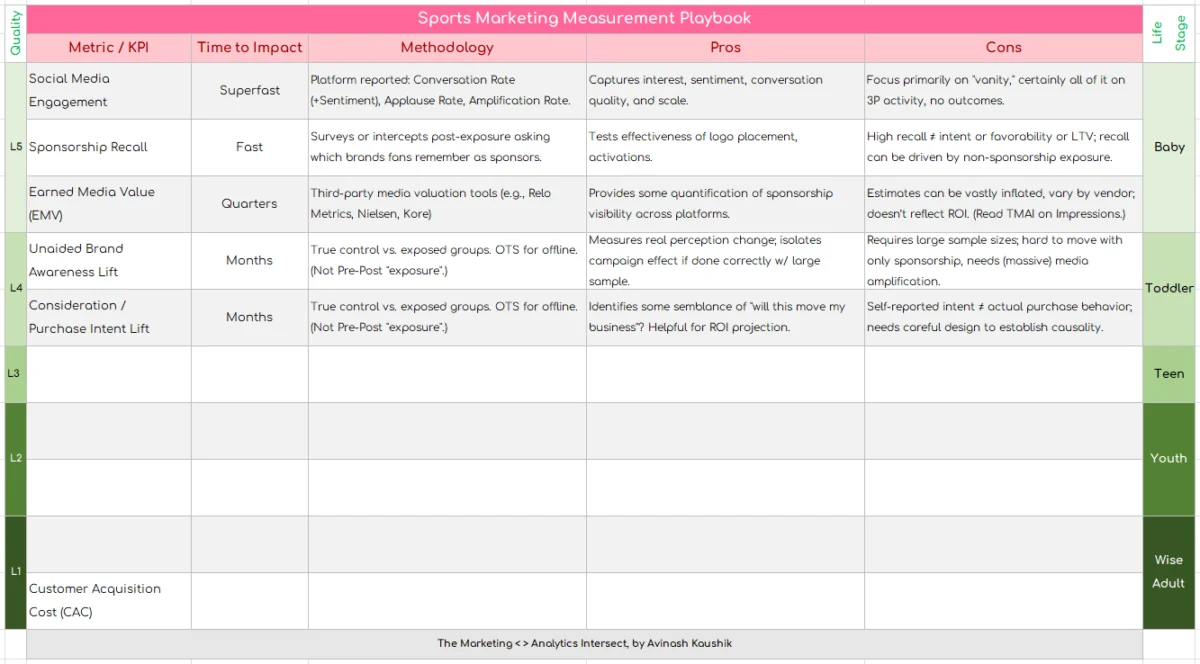
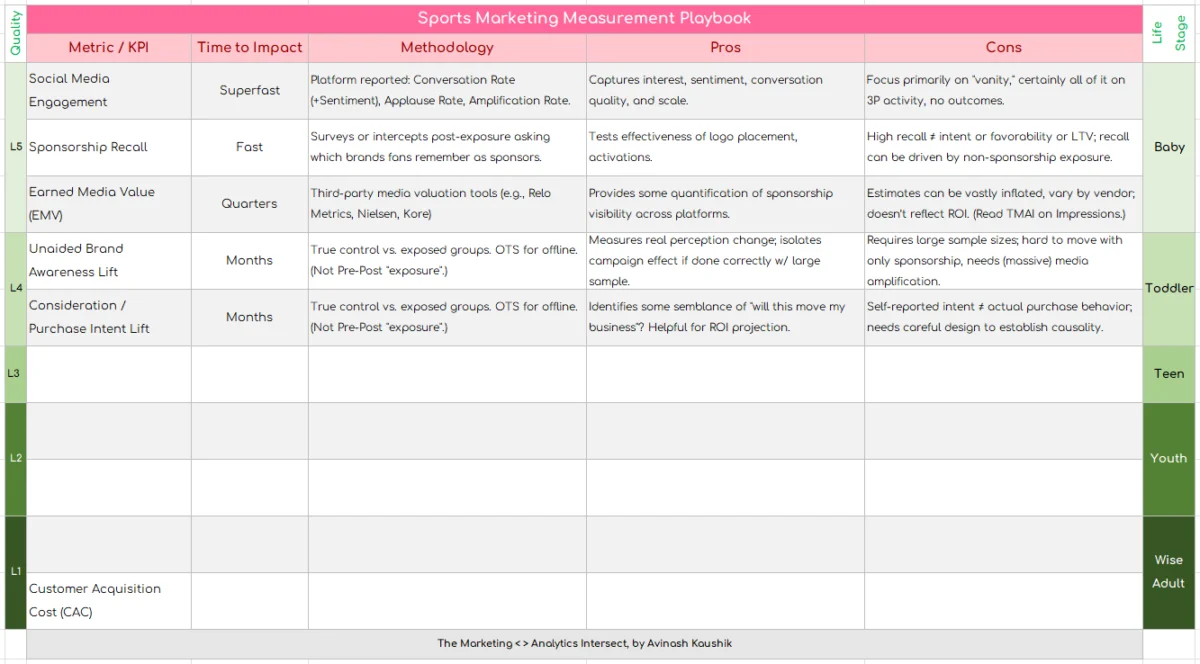
The Era of Vanity (Level 5)
For most brands, the journey begins at Level 5. This is the realm of "Big Numbers"—slide decks boasting of 450 million impressions. While impressive to the untrained eye, these metrics measure activity, not outcomes.
- Social Media Engagement: While useful for gauging immediate reaction, it remains a measure of noise, not business health.
- Ad Recall: Often flawed by "aided" questioning, which tends to over-report awareness.
- Earned Media Value (EMV): Frequently referred to as the industry’s "dirty little secret," EMV attempts to quantify logo exposure as if it were a purchased advertisement. Major marketing associations have largely discredited this methodology, yet it persists because it creates a comforting, albeit imaginary, sense of return on investment.
The Shift Toward Brand Impact (Level 4)
As organizations move toward Level 4, they begin to ask more uncomfortable, meaningful questions. This stage marks the move toward "true test vs. control" methodologies. Here, the goal is to isolate whether a sponsorship has genuinely shifted the "think and feel" metrics of the target audience.
By tracking Unaided Brand Awareness (UBA) and Purchase Intent, companies can finally determine if the sports investment is driving long-term revenue positivity. This is particularly crucial for B2B enterprises, where sales cycles are long and complex. By using propensity score matching, marketers can compare a group exposed to the sponsorship against a control group that was not, finally moving away from the "pre-post" analysis that often masks true causal impact.
Supporting Data: The Anatomy of Success
The data confirms that creative quality remains the single most significant driver of brand success, accounting for 60% to 70% of performance. Brands that succeed in sports marketing do not rely on the sport alone; they treat the sport as a vehicle for their own storytelling.
Consider the "Super Bowl champion" test. Despite decades of massive viewership and sponsorship, many consumers struggle to identify the single corporate logo on a team’s uniform. This lack of recall, even in a high-visibility environment, serves as a stark warning: visibility does not equal memory, and memory does not equal purchase intent.
The Five-Level Impact Intelligence Score (IIS)
To quantify this, experts have developed the Impact Intelligence Score (IIS), a scale of 1 to 10 that ranks a company’s sophistication in measuring business impact.
- Level 5 (Score 1/10): Focuses on impressions and EMV. It is the "Opening Gambit" that provides zero causal evidence.
- Level 4 (Score 4/10): Introduces true test vs. control measurement. It begins to address brand sentiment and consideration.
- Levels 3, 2, and 1: Represent the gold standard, moving from "Heart and Mind Influence" to "The First Digital Trace," and finally to "Incrementality." These levels bridge the gap between brand awareness and the actual movement of currency.
Official Industry Perspectives: The Strategic Pivot
The current industry consensus is shifting toward a "Performance First" approach to sports marketing. Streaming platforms, now major players in sports rights, are pushing for more granular data. They understand that if they cannot prove the value of these rights to advertisers, the current valuation bubble will eventually burst.
Leading marketing analytics experts emphasize that the rules of marketing physics remain constant. If an advertisement fails to perform in a standard digital environment, adding a sports star to the mix will not save it. The sport can, however, provide a "halo effect" that amplifies a high-quality creative. The most successful brands today are those that consciously outsource their brand values to the athlete or the team, provided they have the budget and the data to prove that this transfer is yielding measurable, incremental profit.
Implications for the Future
The implications for CMOs and CFOs are clear: the era of "sponsoring in the dark" must end. The investment in sports is too large to remain a "black box" expense.
- Stop the Short-Termism: Sports marketing requires long-term commitment. One-off campaigns are essentially capital flight. To see movement in brand awareness and purchase intent, brands must commit to multi-year horizons.
- Unify Paid and Owned: Sports sponsorships should not exist in a silo. They must be integrated with paid media campaigns that utilize the sports creative as the foundation.
- Demand Financial Linkage: As organizations mature in their measurement, they must move beyond "brand love" metrics. The ultimate goal of any sports marketing investment is the same as any other: to contribute to the company’s bottom line through demonstrable, incremental sales.
As we look toward the next decade of media consumption, the battle for attention will only intensify. Sports will remain a powerful tool for brands, but only for those that treat it with the same rigor and analytical depth applied to every other aspect of the marketing mix. Those who treat sports as a "vanity project" will likely find themselves shaking hands with celebrities while their competitors quietly capture market share through data-backed, high-impact strategies.
In the final analysis, the goal is not just to be seen, but to be remembered—and ultimately, to be chosen. For the CFO who questions that $38 million spend, the answer is no longer found in the hospitality suite; it is found in the incrementality reports that prove, beyond a doubt, that the investment was worth it.