The WordPress landscape is currently navigating a "seismic" shift. For over a decade, the agency model has relied on a relatively stable set of methodologies: standard operating procedures (SOPs), manual debugging, and traditional client communication. However, as the conversation surrounding Artificial Intelligence (AI) moves past the initial wave of novelty and into the realm of implementation, a new reality is emerging.
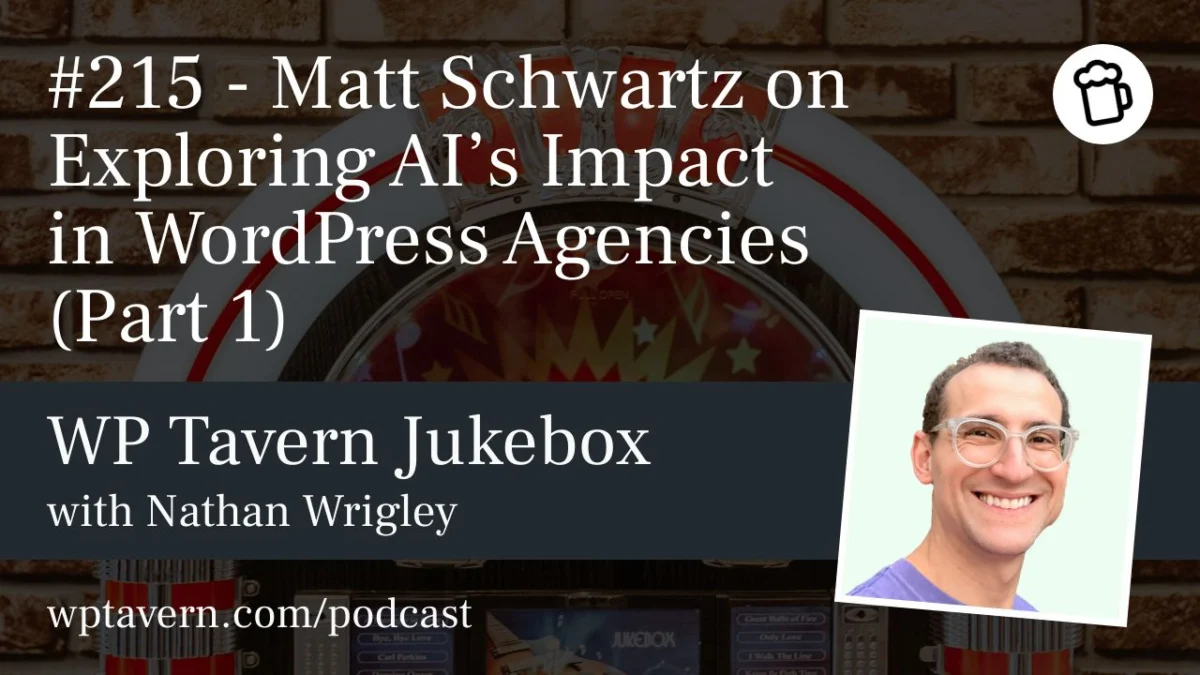
In a recent episode of the WP Tavern Jukebox podcast, Nathan Wrigley sat down with Matt Schwartz, founder of the Atlanta-based agency Inspry, to discuss how WordPress agencies can move beyond the surface-level "AI fatigue" and integrate these tools into the foundational fabric of their businesses. Rather than focusing on AI as a content generator or a website builder, Schwartz argues that the true value of AI lies in optimizing the "behind-the-scenes" operations that define a successful agency.
The Evolution of the Agency Model: From Stumbling to Strategy
The journey of most agency owners in the WordPress space often begins with a "stumble"—a series of ad-hoc projects that slowly evolve into a business. Schwartz, who started Inspry in 2011, reflects on this common origin story. For years, the focus was entirely on execution: building sites, managing tables, and wrestling with early CMS platforms like Drupal before finding a home in WordPress.
As an agency grows, the lack of formal, scalable processes becomes a liability. "I didn’t look at my process for years," Schwartz admits. "It wasn’t until I actually started hiring people that I realized that was even a thing." This realization is central to the current AI transition. Because agency execution is increasingly becoming a commodity, the differentiator is no longer the final visual output of a website, but the clarity, efficiency, and communication flow—the "touchpoints"—that a client experiences throughout the engagement.
Chronology of the Shift: Why Now?
The last three years have marked a departure from the incremental technological improvements that characterized the previous two decades. In the world of SaaS and digital agencies, change is no longer linear; it is exponential.
According to Schwartz, the "floor is rising" for every agency. Clients are no longer impressed by the mere existence of a website; they are aware of the speed at which AI can produce digital assets. This awareness has fundamentally changed the value proposition. If an agency continues to charge traditional rates for tasks that are now achievable in a fraction of the time, they face an existential crisis. The "seesaw" of industry expectations has tipped, and agencies that fail to integrate AI into their operational backbone risk being outperformed by competitors who are leveraging these tools to provide more value, more quickly.
The AI Vision Document: Establishing Guardrails
One of the most actionable insights provided by Schwartz is the concept of the "AI Vision Document." Rather than treating AI as a "yolo" experiment where employees and contractors use random tools with no oversight, agencies should formalize their approach.
What is an AI Vision Document?
This document acts as a strategic roadmap for the agency. It outlines:
- Process Mapping: Identifying which areas of the business are repetitive and ripe for automation (e.g., meeting summaries, initial proposal drafting) versus those that require human judgment (e.g., high-level strategy, sensitive client communication).
- Guardrails: Establishing strict boundaries on when and where AI is permissible. This protects the agency’s reputation and ensures that security and data privacy remain intact.
- Pattern Recognition: Using AI to analyze internal data—such as time-tracking logs from software like Everhour—to identify which tasks consume the most resources and whether those tasks could be handled more efficiently through AI intervention.
By writing down these rules, agencies move from a state of chaotic experimentation to one of deliberate, controlled scaling.
Supporting Data and Operational Efficiency
The practical application of AI within agency operations is where the most significant time-savings are found. Schwartz highlights several key areas where AI currently serves as a force multiplier:
1. The Power of Meeting Summarization
The mundane nature of AI-generated meeting summaries belies their impact. In a professional setting, having an AI bot join a discovery call to capture notes, identify action items, and assign tasks to the correct team members eliminates hours of administrative overhead. This allows the agency to focus on the "human" element of the consultation while ensuring no detail is lost.
2. Streamlining Proposals and SOWs
Creating Statements of Work (SOWs) and project proposals can be a massive drain on resources, especially for leads that may not convert. AI allows agencies to draft nuanced, high-quality proposals by synthesizing previous successful projects and client-specific data. This enables the agency to provide a tailored experience that was previously impossible within a limited discovery budget.
3. Support Workflow Optimization
One of the most sensitive areas of an agency is client support. Schwartz cautions against "chat-bot fatigue," where customers are trapped in infinite loops without reaching a human. However, when used as an internal tool, AI can digest massive amounts of historical ticket data, server error logs, and project management history to suggest resolutions to human support agents. This allows for faster response times without removing the human touch that clients demand during "pain moments."
Official Perspectives: The Role of Human Oversight
A recurring theme throughout the discussion is the "human-in-the-loop" necessity. Schwartz is adamant: regardless of how advanced the model becomes, the risk of "hallucinations" or errors means that final verification must always be performed by a human.
"You hire a developer, they lie to you twice, you’re probably going to fire them," Schwartz notes. "But with AI, we just keep giving them a second chance. Why are we doing that?" The answer, he suggests, is a combination of excitement and a misunderstanding of risk. To truly professionalize the use of AI, agencies must move away from blind trust and toward a framework of rigorous review.
Implications for the Future of WordPress
WordPress, as a platform, is uniquely positioned to handle this shift. The core development team has been working to make the platform "AI-ready," turning the dashboard into a foundation upon which AI agents can interact. We are moving toward a future where the WordPress admin interface might be secondary to a conversational UI where the agency—or even the client—can request changes through natural language.
Expanding the Service Offering
The most significant implication for agencies is the ability to offer new, high-value services that were previously out of reach. By using AI to analyze market data, user demographics, and geographic spending patterns, agencies can now offer sophisticated marketing and strategic consulting alongside their development services. They can build custom, lightweight internal applications for clients at a fraction of the traditional cost, effectively replacing the need for expensive third-party SaaS products.
Conclusion: A Two-Part Journey
The transition to an AI-augmented agency is not about replacing the human element; it is about liberating the human from the drudgery of execution to focus on strategy and value creation. As Nathan Wrigley and Matt Schwartz demonstrate, the "seismic" change in the industry is an opportunity for those willing to be intentional.
By establishing an AI vision, creating clear guardrails, and using these tools to solve deep-seated operational inefficiencies, agency owners can ensure they remain relevant in an increasingly automated world. As this conversation continues into part two, the focus will shift even further into the technical and ethical considerations of these tools, proving that the most successful agencies of the future will be those that manage the intersection of code, common sense, and, most importantly, human intuition.