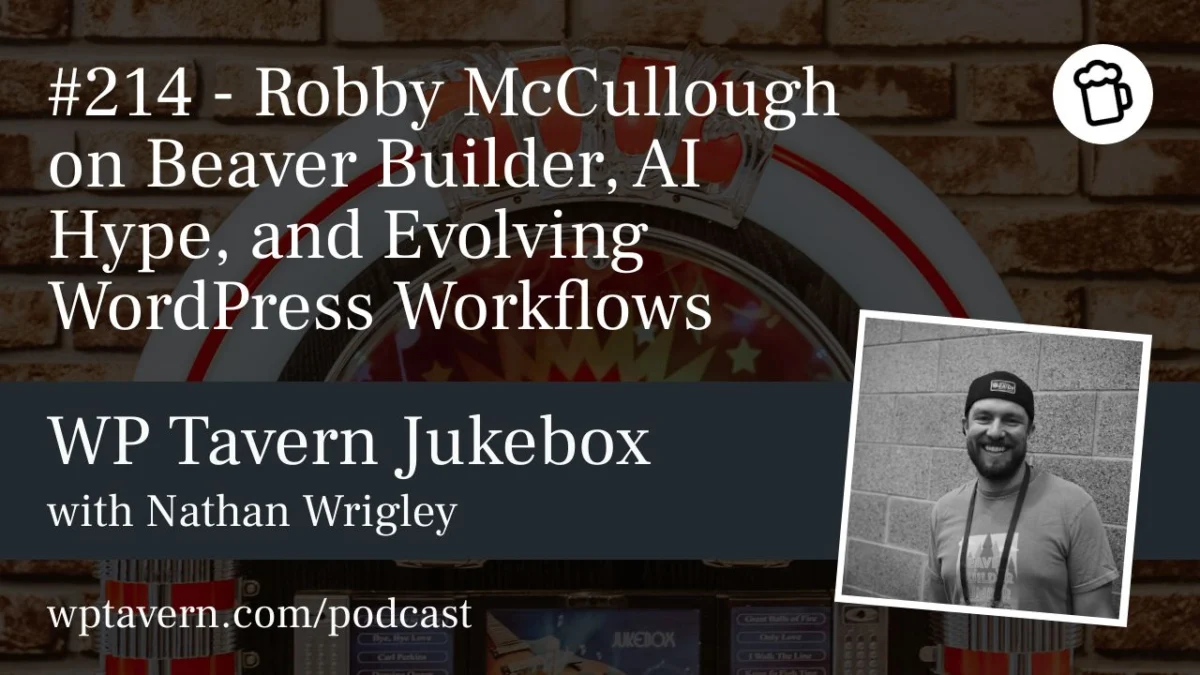
In the ever-evolving landscape of WordPress, few products have managed to maintain the longevity and relevance of Beaver Builder. As the platform approaches its 13th anniversary, its co-founder, Robby McCullough, finds himself at a unique intersection: balancing the legacy of a foundational page builder with the explosive, disruptive reality of generative AI.
In a recent episode of the WP Tavern Jukebox podcast, host Nathan Wrigley sat down with McCullough to discuss the trajectory of web development, the "vibe coding" revolution, and how the role of the site builder is fundamentally changing in an era where websites can be generated with a simple prompt.
The Journey: From Agency Roots to WordPress Staple
Beaver Builder was born out of necessity. Twelve years ago, McCullough and his team were operating a web design agency. They faced a recurring problem: they needed a way to build websites that were powerful enough for developers but intuitive enough for clients to maintain on their own, without requiring constant developer intervention for minor changes.
"We were a web design agency," McCullough explained. "We wanted to use a page builder to build a site so that we could hand that site off to a client and they could make changes to the site themselves, instead of having to email us to update an image or the copyright footer."
This philosophy—bridging the gap between technical complexity and user accessibility—became the cornerstone of Beaver Builder. While the early days of WordPress were marked by debates over "the WordPress way" versus visual builders, Beaver Builder eventually secured its place as an essential tool. It enabled a massive influx of users to build professional-grade sites, contributing significantly to WordPress’s growth from a niche blogging platform to a dominant force powering over 40% of the web.
Chronology of a Paradigm Shift
The history of web development has been a series of increasing abstractions.
- The Hand-Coding Era: In the early 2000s, web design was synonymous with manual HTML/CSS coding and understanding the intricate WordPress template hierarchy.
- The Page Builder Revolution: Tools like Beaver Builder (circa 2012–2014) democratized web design by introducing drag-and-drop interfaces, effectively hiding the complexity of the backend code while allowing for visual customization.
- The AI "Vibe Coding" Era: Today, we are witnessing a new inflection point. "Vibe coding"—the ability to generate functional, high-quality websites through natural language prompts—has arrived.
McCullough notes that this transition feels different from previous shifts. Unlike the slow adoption of visual builders, the pace of AI advancement is breathtaking. "What wasn’t possible five years ago is now possible," he remarked. "But it’s that the pace of change seems to be so rapid now that what wasn’t possible six weeks ago is now possible."
Supporting Data: Why AI Hype Was Initially Resisted
When the AI boom began roughly 18 months ago, many software companies scrambled to integrate GPT-wrappers into their products. It was common to see "AI-powered" features that were little more than basic text generators for blog titles or meta descriptions.
McCullough and his team at Beaver Builder took a deliberate, skeptical approach. They chose not to join the "bandwagon" early on. "It felt like every piece of software I used… had to have AI to appease your corporate C-levels and your shareholders," McCullough said.
This patience proved strategic. By avoiding the initial wave of superficial AI integration, the team avoided "announcing themselves into a corner." Instead, they spent time evaluating how AI could genuinely enhance the user experience rather than just serving as a marketing buzzword. Now that AI has moved beyond simple text generation to "agentic" tools—capable of writing code, debugging, and assisting in complex architectural tasks—Beaver Builder is actively exploring how to integrate these capabilities into their ecosystem.
Official Stance: The Roadmap for Agentic Integration
Beaver Builder’s approach to AI is twofold, focusing on both creation and maintenance:
- The "Import" Approach: McCullough discussed prototypes that allow users to "vibe code" a landing page elsewhere (using tools like Claude or Codex) and then import that code directly into the Beaver Builder interface. This bridges the gap between external AI generation and the professional-grade editing environment of the plugin.
- The "Chat Agent" Approach: The company is working on an in-product chat agent. The goal is to allow users to focus on specific components of a site—such as a pricing table or a hero section—and use natural language to iterate on the design, copy, or layout within the existing Beaver Builder workflow.
Crucially, McCullough emphasizes that Beaver Builder does not intend to become a "black box" where users pay monthly tokens for closed-source designs. They want to maintain the "bring your own key" model, ensuring that the developer still has access to the underlying code, markup, and CSS.
Implications: The Future of Web Design and Craftsmanship
The rise of AI brings forth profound existential questions for the web development community. If an AI can generate a perfect landing page in four seconds, what becomes of the artisan?
The Loss of "Plumbing" Knowledge
One of the primary concerns raised during the discussion is the potential loss of fundamental knowledge. When a user creates a site via prompt, they lose the "plumbing" interaction—understanding how WordPress handles drafts, metadata, and site architecture. McCullough admits to a sense of melancholy regarding this. He recalls the days of hand-building layouts in Figma or Photoshop, noting that while the new way is undeniably more productive, it removes the "craftsmanship" aspect of the work.
The Maintenance Tooling Reality
A critical insight from the podcast is that while AI is becoming the primary creation tool, page builders may evolve into the primary maintenance tools. "I still think you need a thing that you can invoke as the editor," Wrigley noted. Even if an AI creates the site, the site owner will inevitably need to make modifications—changing a logo, updating copy for the holidays, or tweaking a layout. Beaver Builder is positioned to remain the essential interface for these ongoing, business-critical edits.
Human Connection vs. Synthetic Productivity
Perhaps the most sobering implication of the AI era is the risk to human collaboration. McCullough questioned whether "faux human" interactions with AI agents will begin to take precedence over genuine human collaboration. As developers and designers work alone, interacting primarily with bots, the need for community—the "pub," the local meetups, and WordPress events—becomes even more vital.
McCullough remains an optimist. He believes the pendulum will swing back. Just as the physical "canoeing and mountaineering clubs" are seeing a resurgence in the UK, he hopes for a revitalization of WordPress events. "I would love to see [the community] come back a little bit," he said.
Conclusion: The Path Ahead
The web is not going to stop changing. Whether we eventually interact with our websites via voice commands, neuro-links, or advanced LLM-based interfaces, the role of the "editor" will remain. Beaver Builder, by embracing AI as a tool for efficiency while retaining its core function as a visual editor, is preparing for a future where "vibe coding" and professional site management coexist.
For now, the lesson for the WordPress community is clear: don’t abandon the tools of the trade, but learn to use the new "agentic" capabilities to augment the creative process. The artisan may be evolving, but as long as businesses need to maintain their digital presence, the need for a stable, reliable, and human-accessible editing interface will remain the bedrock of the web.