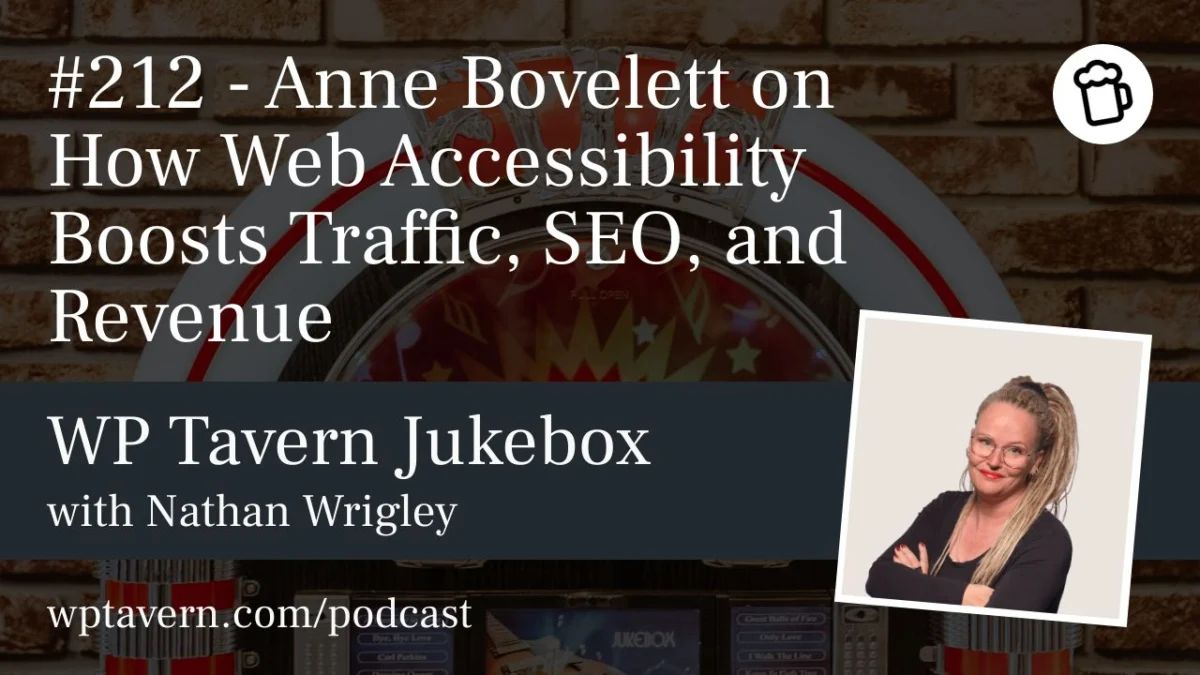
For decades, web accessibility was framed almost exclusively as a moral imperative—a "nice-to-have" feature that developers and designers should consider to accommodate users with disabilities. While this humanitarian argument remains vital, it has historically failed to penetrate the boardrooms of major corporations. Today, a new narrative is taking hold, led by accessibility strategists like Anne Bovelett. This perspective shifts the focus from compliance to capital, framing accessible web design as a core driver of organic traffic, higher search engine rankings, and significant revenue growth.
In a recent episode of the Jukebox podcast from WP Tavern, host Nathan Wrigley sat down with Bovelett to discuss why businesses are effectively "leaving money on the table" by neglecting the fundamental accessibility of their digital properties.
The Evolution of the Web and the "Accessibility Gap"
To understand why the internet is currently riddled with inaccessible barriers, one must look at the history of web development. In the early days of the web, developers relied heavily on semantic HTML. Because these sites were built with clear, structural tags, they were naturally—albeit unintentionally—quite accessible to screen readers and other assistive technologies.
However, as the industry matured, the desire for aesthetic innovation and rapid development cycles led to a phenomenon Bovelett refers to as verschlimmbesserung—a German term describing an attempt to improve something that results in making it worse.
"We started over-engineering," Bovelett explains. "Semantic HTML was pushed aside in favor of div and span elements, which are essentially ‘useless chameleons’ without massive layers of JavaScript. We moved away from the building blocks of the web to frameworks that prioritize speed for the developer, often at the direct expense of the user."
This shift created a disconnect. While physical world architecture evolved to include ramps, elevators, and wide doorways, the digital world moved toward complex, JavaScript-heavy interfaces that effectively barred millions of users from participating in the digital economy.
The Data: Making the Economic Case
The primary obstacle to widespread accessibility adoption has been a lack of tangible, data-driven proof that it impacts the bottom line. However, recent research—most notably a study conducted by Semrush in partnership with AccessibilityChecker.org—has begun to change the conversation by analyzing 10,000 websites to determine the relationship between compliance and performance.
Key Research Findings
- Organic Traffic: Websites with higher accessibility compliance scores saw an average 23% increase in organic traffic.
- Keyword Rankings: Compliant sites ranked for 27% more organic keywords compared to their less accessible counterparts.
- Authority: There was a 90% boost in authority scores for sites that achieved higher levels of accessibility compliance.
These statistics offer a compelling "win-win" scenario. By making a site accessible, businesses aren’t just doing a good deed; they are effectively optimizing their infrastructure for search engine crawlers. As Bovelett notes, "If assistive technology can’t read your site, the search engines probably can’t either." By embracing accessibility, companies are essentially "humanizing" their content, which aligns perfectly with the goals of modern search algorithms that prioritize user experience above all else.
The "Billion-Pound" Opportunity: E-commerce and Revenue
The financial consequences of inaccessible e-commerce are staggering. Bovelett points to the "Click Away Pound" report, which quantified the lost revenue when disabled users encounter barriers in online shops.
In 2016, the estimated lost revenue was £11.75 billion. By 2019, that figure had climbed to £17 billion. Bovelett argues that in the current, more complex digital landscape, these numbers have likely increased further.
"The economic case is simple: you are stealing from your own wallet," says Bovelett. "Data suggests that 75% of disabled customers have willingly paid more for a product from an accessible website rather than struggle with a cheaper, inaccessible one."
This behavior reveals a critical truth: users prioritize the ability to complete a transaction independently. When a website is frustrating to navigate—requiring assistance, failing to work with screen readers, or relying on inaccessible video players—users will abandon their carts. For a large retailer, even a 0.5% or 1% gain in conversion, when scaled across millions of users, can result in hundreds of millions of dollars in additional revenue.
The Hidden Costs: Support and User Retention
Beyond direct sales, accessibility has a massive impact on operational overhead. Many companies spend millions on customer support teams to help users navigate websites that are fundamentally broken.
When a site is designed with universal design principles in mind, the need for "hand-holding" decreases significantly. Bovelett cites a Dutch tax office that underwent a full accessibility redesign, resulting in a 30% reduction in support requests. By empowering users to solve their own problems, organizations can reduce the load on their support staff while simultaneously increasing customer satisfaction.
"There is a culture of ‘ignoring’ the user," Bovelett notes. "When you force a user to call support to explain that they have dyslexia or a hearing impairment because your website is unusable, you are forcing them into a position of vulnerability. If they can’t solve it themselves, they will simply walk away."
Breaking Down Silos: A New Strategic Role
The challenge for modern organizations is structural. In large companies, development teams are often siloed from design teams, and neither group feels ownership over accessibility. Compliance is often relegated to a single, overworked "accessibility officer" who is expected to police thousands of pages of code.
Bovelett advocates for a new type of leadership role: the Accessibility Strategist. This role would not necessarily be a master coder, but rather a bridge-builder who understands the intersection of design, content, and development.
"You need someone who can speak to the C-suite in the language of revenue and risk, but also sit with developers to explain how a design choice might create an accessibility barrier," she explains. "We need to foster a culture where a developer feels empowered to go to a designer and say, ‘I noticed this feature might be hard for some users—how can we rethink this?’"
Implications: Moving Forward
The transition to an accessible web is not just a technological challenge; it is a cultural and organizational shift. As the European Accessibility Act and other global regulations loom, the legal pressure is increasing, but the real motivation should be the undeniable economic advantage.
For web owners and digital leaders, the path forward is clear:
- Stop viewing accessibility as a "project": It should be a fundamental component of the product development lifecycle from day one.
- Leverage the data: Use the correlation between accessibility, SEO, and revenue to secure buy-in from stakeholders.
- Prioritize User Autonomy: Every time a user has to ask for help to navigate your site, you have failed. Design for self-service.
- Audit and Iterate: Use tools to identify barriers, but remember that automated tools only catch a fraction of the problem. Human-centric testing remains the gold standard.
Ultimately, as Anne Bovelett concludes, the businesses that win in the coming years will be those that realize that accessibility is not a tax on innovation, but a competitive advantage. By removing the barriers that prevent users from interacting with their products, companies aren’t just doing the right thing—they are ensuring their own long-term growth and relevance in an increasingly digital world.
For those interested in exploring these concepts further, Bovelett encourages professionals to look beyond the "code-only" view of accessibility and start treating it as a cornerstone of modern, high-performance business strategy.