Most marketing professionals are familiar with the "swing-for-the-fences" approach. They design a landing page, launch a campaign, and hold their breath, hoping for a home run. When the results arrive—whether they represent a celebration or a period of mourning—the team moves on to the next project, often leaving the previous asset exactly as it was.
But in an increasingly competitive digital landscape, this one-off testing mentality is becoming a liability. The future of high-performance marketing lies in iterative testing—a methodology that treats every campaign as an ongoing cycle of small, evidence-based improvements rather than a singular event. By shifting from massive, risky overhauls to incremental, data-driven refinements, marketers can reduce wasted ad spend, adapt to shifting consumer behaviors, and compound their gains over time.
The Core Philosophy: Why Iteration Beats Overhaul
At its essence, iterative testing is the systematic process of repeating experiments, measuring the output, and refining assets based on real-world data. While product development teams have utilized this agile methodology for decades to build robust software, marketers are now applying these same principles to messaging, design, and user experience.
The primary reason to adopt this model is simple: marketing failures are rarely sudden, catastrophic crashes. Instead, they are usually "slow leaks"—subtle friction points in a user journey that drain your budget day after day. Iterative testing acts as a sealant, identifying and plugging these leaks through continuous optimization.
Data-Backed Motivation
The necessity of this approach is underscored by industry research. For instance, Unbounce’s 2024 Conversion Benchmark Report revealed that landing pages written at a 5th-to-7th-grade reading level convert at a rate of 11.1%—more than double that of professional-level, complex copy. This finding is a perfect candidate for an iterative test: instead of rewriting your entire site based on an assumption, you can test simplified copy on a single landing page to see if your specific audience responds with higher conversion rates.

Chronology of an Iterative Campaign
Implementing an iterative testing program does not require a complete change in strategy, but it does require a shift in operational tempo. The following represents the lifecycle of a modern, iterative marketing experiment:
- Observation & Hypothesis (Days 1–2): The team identifies a bottleneck in the current asset, such as a high bounce rate on a specific CTA. They form a hypothesis: "Simplifying the button copy will increase click-through rates."
- Implementation (Day 3): A minimal variation is created. The change is isolated to ensure the data remains clean.
- Active Testing (Days 4–10): The campaign runs. With modern tools, the test begins gathering data immediately, often reaching statistical significance faster than traditional long-form testing.
- Analysis (Day 11): The data is reviewed not just for a "winner," but for a "why." The team determines if the result confirms the hypothesis or points to a new, unforeseen trend.
- Scaling (Day 12+): The successful element is promoted to the primary asset, and the next cycle begins immediately.
Supporting Data: The Power of Incremental Gains
Why does this approach yield better ROI than traditional methods? The answer lies in the compounding nature of small wins.
Faster Feedback Loops
Traditional testing cycles often span months, causing marketers to miss market windows. By contrast, iterative testing shrinks these cycles from quarters to days. Tools like Unbounce’s "Smart Traffic" can begin optimizing performance with as few as 50 visits. This allows even small-scale campaigns to benefit from real-time data, ensuring that you discover what resonates with your audience long before your competitors do.
The Cost of Complexity
Evidence shows that high word complexity is negatively correlated with conversions. Data suggests a -24.3% correlation between complex, industry-jargon-heavy text and conversion rates. However, a "blanket" change across all assets can be dangerous. Iterative testing allows you to test this on a small segment. If your audience is highly technical, they might prefer the complexity; if not, you have saved yourself from a site-wide conversion drop.
The Mobile-Desktop Disparity
The 2024 Conversion Benchmark Report highlighted that while 83% of traffic is mobile, desktop still converts 8% higher on average. This statistic serves as a crucial starting point for iterative tests. Instead of assuming one device is "better," iterative testing empowers teams to create device-specific messaging cycles, learning whether mobile users require a shorter path to purchase or different incentives entirely.

Official Best Practices for Execution
For teams looking to transition to this model, industry leaders suggest a rigorous adherence to the following best practices:
1. Define a Focused Hypothesis
The most common point of failure is "testing everything." If you change the headline, image, CTA, and form fields simultaneously, you will never know which variable drove the change. A focused hypothesis targets one element at a time, ensuring that the resulting data is actionable.
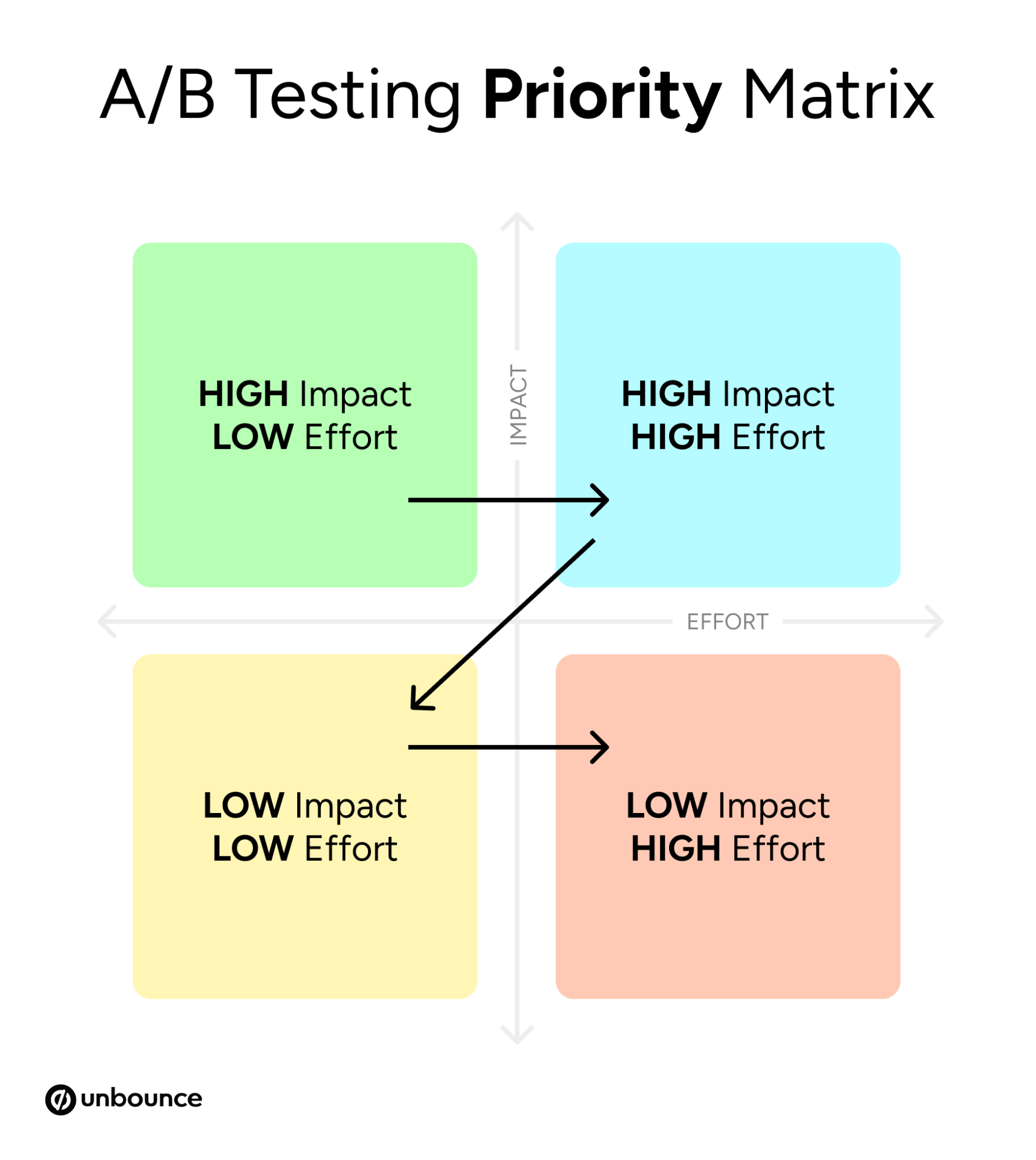
2. The Prioritization Matrix
Not all tests are created equal. Marketers should use a 2×2 matrix that evaluates Impact vs. Effort.
- High Impact, Low Effort: These are your "quick wins" and should always be prioritized.
- Low Impact, High Effort: These should be avoided until you have more resources.
3. Maintain Statistical Integrity
A common pitfall is stopping a test because a result "looks" like a winner after only a few hours. Statistical significance is the gatekeeper of truth. Ensure your test reaches a sufficient sample size before declaring a winner to avoid basing decisions on random noise.
4. Foster Cross-Departmental Collaboration
Marketing should not operate in a vacuum. By inviting input from customer support and sales teams—who interact with the audience daily—marketers can build a backlog of test ideas that address genuine customer pain points. When the support team identifies that customers are confused by a specific pricing structure, that should immediately move to the top of the testing priority list.
Implications for Modern Marketing Teams
The shift to iterative testing represents a broader cultural evolution within the marketing department. It moves the team away from "guessing" and toward "learning."
The Cultural Shift
When a test "fails" to produce the desired uplift, it is often viewed as a disappointment. However, in an iterative framework, a failed hypothesis is still a win—it provides data on what does not resonate with the audience, which is just as valuable as knowing what does. This culture of experimentation reduces the "fear of failure" that often stifles creativity in large organizations.
The Role of Technology
To move at the speed required for iterative testing, teams must leverage technology. Platforms that allow for rapid duplication, easy variant creation, and automated reporting are no longer luxuries; they are essential infrastructure. The ability to deploy a test in minutes rather than days is the difference between a static marketing program and one that grows in intelligence every single week.
Final Thoughts on Sustainability
Iterative testing is not a short-term hack; it is a long-term competitive advantage. By committing to this cycle, organizations ensure that their messaging, design, and user journey are in a constant state of refinement. As your audience’s needs evolve, your campaigns will evolve with them, ensuring that you are not just keeping pace with the market, but leading it.
In the final analysis, the goal of marketing is not to find the "perfect" landing page once and retire it. It is to foster a culture of progress. Whether it is a 5% bump in click-through rates or a 50% increase in form completions, every iterative test is a step toward a more efficient, high-converting future. Start small, test often, and let the data guide the way.