The landscape of performance marketing is bracing for a significant shift. On August 17, Google Ads will implement a fundamental change to its automated bidding infrastructure, altering how the platform processes Target Return on Ad Spend (tROAS) and Target Cost per Acquisition (tCPA) strategies. While Google frames this update as a move toward "predictable performance," seasoned digital marketers are raising alarms, suggesting that the adjustment could lead to significant, and potentially volatile, fluctuations in campaign outcomes.
For advertisers who have grown accustomed to "over-performing" against their set targets, this update represents a move toward strict adherence to guardrails. Understanding the nuances of this transition is no longer optional—it is a critical requirement for maintaining revenue stability in the third and fourth quarters.
The Core Change: Prioritizing Targets Over Performance
Historically, Google’s automated bidding algorithms—specifically Smart Bidding—have operated with a degree of flexibility. If an advertiser set a tROAS target of 300%, but the campaign was naturally performing at 500% due to favorable market conditions or high-intent traffic, Google would often allow the campaign to continue generating that 500% return. The algorithm essentially prioritized "more volume at high efficiency" over "strict adherence to a specific goal."
Starting August 17, that philosophy is shifting. Google is reconfiguring its bidding logic to prioritize the target above all else. Under the new regime, if a campaign is currently hitting a 500% ROAS, but the target is set at 300%, the algorithm will actively throttle performance to bring the return closer to that 300% mark.
Google’s stated rationale is that this will provide "predictable performance." For the search giant, this means removing the "surprise" of over-performance to ensure that budget delivery is consistent and aligns exactly with what the advertiser has defined in the settings. However, for e-commerce businesses and performance-driven brands, this effectively turns a "target" into a "ceiling."
Chronology of the Update
- Pre-Announcement Phase: Throughout early 2026, advertisers noted increased variance in how Smart Bidding handled over-performing campaigns, leading to speculation about underlying algorithmic adjustments.
- Official Communication (Late July): Google published support documentation detailing the shift in logic for target-based bidding strategies, confirming that the system would begin aggressively aligning actual results with user-defined targets.
- The Transition Period (August 1–16): Google released the "bid target adjustment tool" to help advertisers audit their current campaigns and visualize the delta between their historical performance and their set goals.
- The Implementation (August 17): The new bidding logic goes live globally. Any campaign currently exceeding its target will be subject to an immediate downward optimization trend as the system attempts to normalize performance to the goal.
Supporting Data and the "Adjustment Tool"
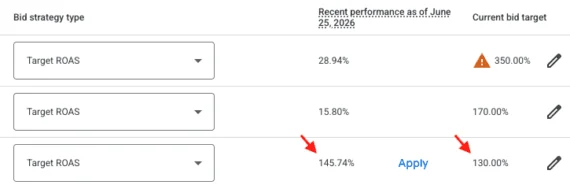
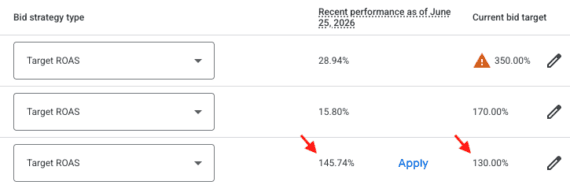
To help advertisers navigate this shift, Google has introduced a new diagnostic interface within the Ads dashboard. This tool compares the "Current Target" against "Recent Performance."
For example, if an advertiser has a campaign with a tROAS target of 130% but recent data shows a 145.74% return, the tool flags this discrepancy. Previously, an advertiser might have viewed this as a "win." Under the new paradigm, this is viewed as a "misalignment."
The data suggests that for high-performing accounts, the risk is not in under-delivering, but in over-delivering. Advertisers who fail to adjust their targets upward to reflect their actual performance will likely see their campaigns "optimize downward," resulting in lower total revenue and a loss of market share as the algorithm reduces bids to pull performance back to the (lower) target.
Implications for Advertisers: The Strategic Pivot
The impending change forces a decision on every account manager. You can no longer set a "safe" (low) target and hope the algorithm delivers outsized results. You must now define exactly what you want the algorithm to achieve.
1. The "Keep as Is" Strategy
If your current performance is consistently exceeding your goal, and you are comfortable with the system reducing that performance to meet the target, no action is required. However, be prepared for a drop in overall conversion volume and revenue, as the algorithm will stop bidding on high-value auctions that fall outside the "target" window.
2. Maintaining Recent Performance
For those who want to keep their current level of revenue, you must raise your targets. However, caution is advised. A sudden, massive jump in target ROAS can trigger a "learning phase" or cause the campaign to collapse if the budget is too constrained.
- The 20% Rule: Increase your targets incrementally. If your recent ROAS is 200% and your target is 130%, increase the target to 156% first. Observe the performance for two weeks before making further adjustments. This "stair-stepping" approach allows the algorithm to adjust its bidding auctions without forcing a hard reset.
3. Adjusting Custom Targets
If your current target is fundamentally out of touch with reality—for instance, targeting a 300% ROAS when the account has been sustaining 400% for six months—you should perform a one-time adjustment to a more realistic target. This is not a gradual change; it is a recalibration of the account’s expectations.
4. Switching to "Maximize" Strategies
If your priority is pure growth, volume, or market share, the target-based bidding system may no longer be the correct choice. Advertisers can pivot to "Maximize Conversions" or "Maximize Conversion Value." These strategies do not rely on a fixed ROAS percentage. Instead, they seek to spend the entire daily budget by finding the most conversions possible. While efficiency may drop, revenue volume is likely to increase.
Official Responses and Industry Sentiment
Google maintains that this change is a response to advertiser feedback requesting more stability in spend and pacing. By adhering to the target, the algorithm ensures that the budget is spent in a way that minimizes the risk of runaway spend while hitting the efficiency KPIs set by the user.
However, industry experts are divided. Critics argue that Google is essentially penalizing success. By "fixing" over-performance, the system limits the ability of machine learning to find high-margin conversions that happen to exceed the target. Many search marketers view this as a potential "revenue haircut" for businesses that have spent years training their algorithms to exceed goals.
"The shift essentially changes the definition of a Target ROAS," says one veteran agency head. "It is no longer a ‘goal to aim for’; it is a ‘restriction to live within.’ Advertisers who treat it as a goal will be disappointed when the system treats it as a cap."
Preparing for the Aftermath: A Checklist
As August 17 approaches, every digital marketing team should perform the following audit:
- Identify "Over-Performers": Sort your campaigns by ROAS and compare them against their targets. Any campaign with a significant delta is at risk of a performance dip.
- Audit Budget-Limited Campaigns: Google notes that budget-limited campaigns are at the highest risk. Ensure that your budgets are sufficient to support your targets. If a campaign is budget-limited, raising the ROAS target may actually cause the campaign to spend less money.
- Review Account-Level Goals: A single campaign’s performance impacts the account-wide average. If you have one "star" campaign performing at 500% against a 300% target, it is likely propping up your entire account ROAS. If that campaign is forced down to 300%, your overall account health may deteriorate.
- Prepare for a "Learning Period": Regardless of the strategy chosen, any adjustment made to targets will likely trigger a brief period of instability. Avoid making reactionary changes for at least 7–14 days following any target adjustment.
- Data Documentation: Log your current targets and performance metrics now. You will need a baseline to measure how the algorithm responds to the August 17 update.
Conclusion
The Google Ads update represents a fundamental shift in the relationship between the advertiser and the algorithm. By removing the flexibility that previously allowed for "pleasant surprises" in ROAS and CPA, Google is demanding greater precision from marketers. While the platform promises predictability, the onus is now on the advertiser to provide the correct inputs. Those who fail to monitor their campaigns in the weeks following August 17 risk a sudden decline in efficiency and revenue. In the world of automated bidding, the era of "set it and forget it" has officially come to an end.