In the high-stakes world of SaaS (Software as a Service), growth is often measured in churn rates, customer acquisition costs (CAC), and annual recurring revenue (ARR). Yet, there is a silent, pervasive phenomenon that frequently goes undetected by even the most sophisticated sales organizations: the "Pricing Gap." This structural disconnect between self-serve entry points and enterprise-grade tiers acts as a graveyard for potential revenue, turning interested prospects into lost opportunities without the vendor ever realizing they were in the running.
The Anatomy of a Missed Opportunity: A Case Study
To understand the Pricing Gap, one must look at the user experience through the lens of a prospective buyer. Recently, a common B2B procurement scenario played out that serves as a masterclass in this friction.
The buyer, already entrenched in a stable workflow using Zoom, sought to upgrade their podcasting infrastructure to Riverside, widely considered the "gold standard" for high-fidelity remote recording. The motivation was clear: increase quality. However, the financial barrier was significant because the firm was already paying for Zoom; switching to Riverside represented an incremental cost rather than a replacement cost.
The Chronology of the Disconnect
The buyer’s journey began with logical, incremental steps:
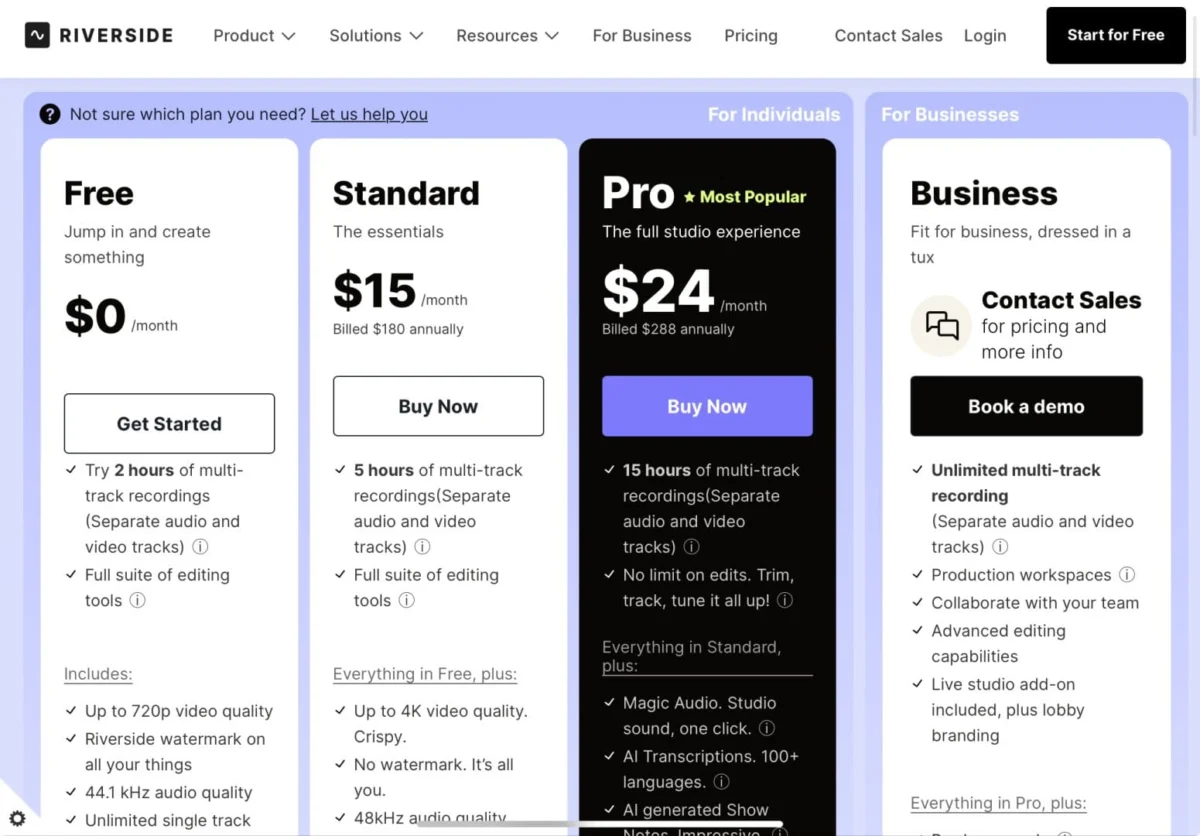
- Initial Adoption: The team signed up for a single-seat paid plan at $15/month.
- Validation: Satisfied with the performance, they upgraded to the Pro tier at $24/month.
- The Pivot Point: The requirement evolved. The team needed two linked accounts to streamline their collaborative workflow.
- The Wall: Upon attempting to scale from one seat to two, the user discovered that the logical progression—a mid-tier business plan—did not exist. Instead, the jump was to an "Enterprise" style business plan costing $500 per month, requiring a $6,000 prepaid annual commitment.
The buyer was effectively forced to choose between purchasing two disjointed $24 individual licenses—which lacked the necessary administrative integration—or committing to a massive, unnecessary financial leap. The result? The buyer abandoned the expansion entirely. While they eventually found a workaround, the initial intent to buy was thwarted, and the vendor was left in the dark about why the conversion stalled.
The “Contact Sales” Trap
The root cause of the Pricing Gap is rarely a lack of product features; it is almost always a byproduct of organizational alignment—specifically, the "Contact Sales" wall.
Sales teams are incentivized to pursue high-value contracts. In many B2B organizations, a $5,000 annual contract is the baseline for engagement. Consequently, sales departments often pressure product teams to steer mid-market customers toward enterprise tiers because those are the only accounts that justify the cost of a human sales representative’s time.
When a company forces a customer into a "Contact Sales" flow, they aren’t just adding friction; they are inadvertently creating a pricing vacuum. Customers who are willing to pay $100 or $200 a month—an amount that represents a significant uplift from a $24 individual plan—are suddenly faced with a $500+ monthly requirement. They aren’t "enterprise" customers, but they are "pro-sumers" who are being pushed out of the ecosystem because the vendor’s internal sales math doesn’t prioritize their size.

The Developer-Focused Precedent
This phenomenon is particularly prevalent in developer-focused products, such as APIs and infrastructure tools. These companies often employ a "freemium" or "low-cost entry" strategy to drive adoption. The basic usage is often priced at near-zero or pennies on the dollar.
However, as usage scales, the pricing structure often undergoes a violent shift. A developer might move from a hobby project to a production application, causing API call costs to aggregate into a bracket that triggers an enterprise contract.
I recall my time as the first U.S. investor in Algolia, the search-as-a-service giant now operating at over $200 million in ARR. In its early stages, the company dealt with a massive gap between the basic usage tiers and the enterprise tiers. By identifying this gap and introducing an intermediate edition, the company saw an immediate revenue boost of approximately 15%. This wasn’t a result of new product innovation, but rather a structural alignment of pricing to the customer’s willingness to pay.
Strategic Implications for SaaS Leaders
Why does this happen, and why is it so hard to fix? The answer lies in the institutional blindness of the sales organization. If a sales rep is tasked with closing large, high-value deals, they are unlikely to track the dozens of customers who drop off at the "Contact Sales" gate. These losses are rarely logged as "lost due to pricing gaps." Instead, they are logged as "not a fit for enterprise" or simply ignored as noise.
The Cost of Ignoring the Gap
- Lost Lifetime Value (LTV): By ignoring the mid-market, you lose the opportunity to grow with your customers. A customer who starts at $50/month and scales to $500/month over two years is a foundational asset.
- Market Share Erosion: Every time a user abandons a "Contact Sales" wall, they return to their previous tool or move to a competitor with a more transparent, tiered pricing structure.
- Inaccurate Sales Data: When the sales team dictates the pricing architecture, the feedback loop from the market is distorted. The company begins to believe that there is no market for mid-tier pricing, simply because they haven’t made it available.
How to Close the Gap
To mitigate this, organizations must perform a thorough audit of their pricing architecture.
- Audit the “No” Responses: Analyze the traffic at your "Contact Sales" pages. How many users visit these pages and then fail to initiate contact? That delta represents your potential revenue leakage.
- Create the “Mid-Market” Bridge: If your self-serve plan is $30 and your enterprise plan is $500, you need a $150 plan. It doesn’t need to be high-touch; it just needs to be automated.
- Empower Product-Led Growth (PLG): Ensure that your pricing tiers are determined by usage metrics or specific feature gates that are self-serve, rather than by a mandate to speak to a salesperson.
- Test the Middle: Run A/B tests on your pricing page. Introduce a "Pro-Team" tier that sits between the individual and the enterprise plans. Even a modest 5% revenue increase, when extrapolated across an entire customer base, can result in millions of dollars of additional valuation.
Conclusion: The Financial Upside of Transparency
The "Pricing Gap" is not merely an inconvenience; it is a structural failure that limits the ceiling of a company’s growth. In a market where customer loyalty is increasingly fragile, forcing users to "Contact Sales" for mid-level needs is a dangerous gamble.
Companies that successfully close this gap—by bridging the divide between low-friction self-serve and high-touch enterprise sales—unlock a latent segment of their user base that is ready and willing to pay. As the software landscape becomes more competitive, the ability to capture this "in-between" revenue will separate the leaders from the laggards. It is time for SaaS leadership to stop viewing pricing as a static necessity and start viewing it as a dynamic engine for growth. The data is clear: if you give your customers a way to pay you, they will—provided you don’t make them jump through hoops to do it.