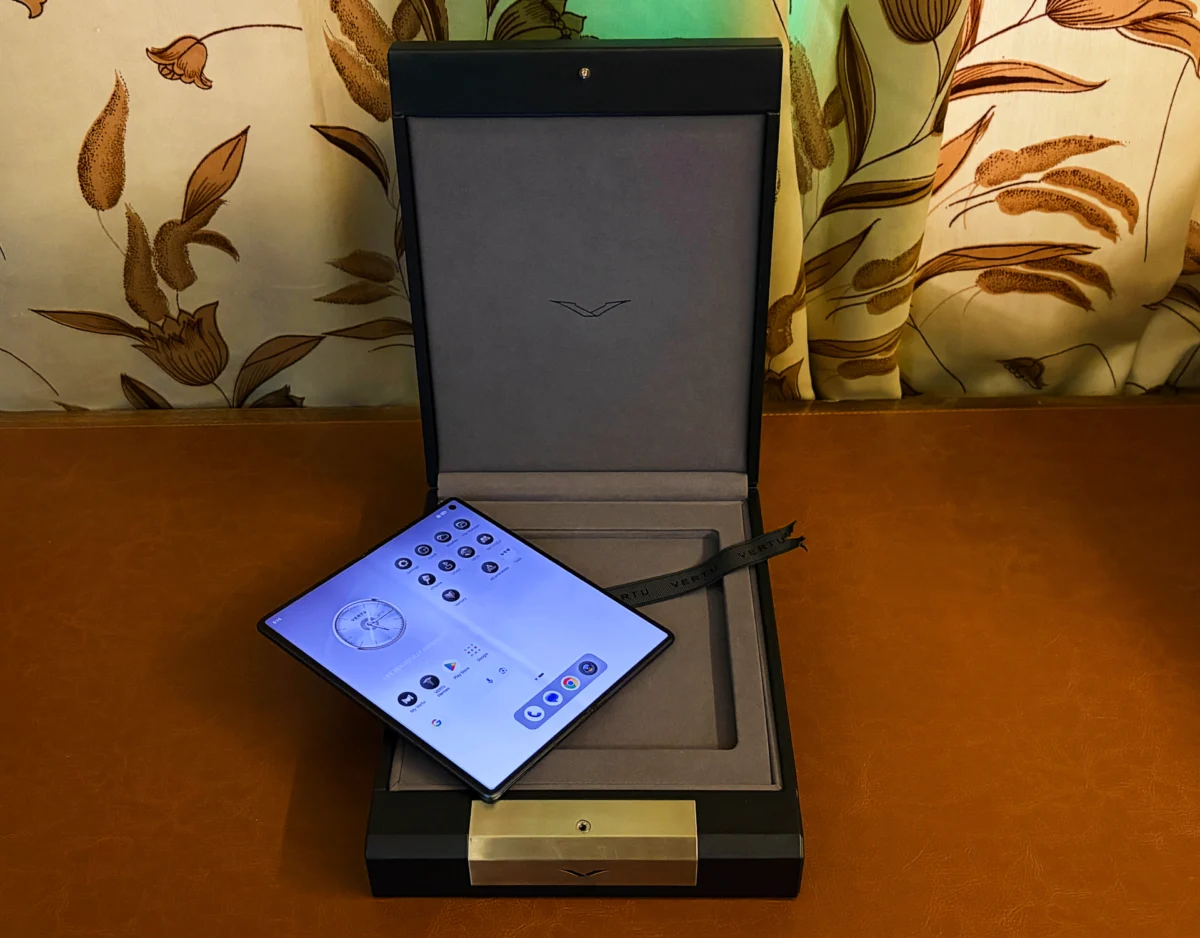
In an era where the global smartphone market has become a monotonous sea of glass-and-silicon slabs, Vertu has long stood as an outlier. Once a subsidiary of Nokia, the brand carved out a niche by selling hyper-luxury, hand-finished handsets to the world’s wealthiest individuals. Today, however, the landscape has shifted. Artificial intelligence is the new currency of the mobile industry, and Vertu is attempting to pivot from a purveyor of ornamental status symbols to a provider of high-end, AI-driven executive infrastructure.
At the center of this ambition is the Alphafold, a foldable smartphone with a starting price tag of $6,880. But unlike the mainstream foldables from Samsung or Google, the Alphafold does not aim to win the race for the highest benchmark scores or the most vibrant display panels. Instead, Vertu is selling a promise: that the device, powered by its proprietary "Hermes Agent," can act as a tireless digital concierge for the C-suite executive.
The Evolution of the Luxury Handset
For years, Vertu’s business model was straightforward: take decent mid-range internals, wrap them in calfskin leather, titanium, or sapphire crystal, and charge a premium for the aesthetic and the brand’s signature 24/7 human concierge button. The Alphafold, however, is a departure from this "vanity-first" philosophy.

While the device certainly looks the part—featuring exquisite leather craftsmanship and a robust titanium frame—the hardware feels secondary to the software. Vertu is no longer just selling a phone; they are selling a workflow. The company is betting that high-net-worth individuals, who are often time-poor and information-overloaded, will pay a massive markup for a device that autonomously manages their professional lives.
Chronology of the Testing Phase
To determine whether the Alphafold is a legitimate professional tool or simply an expensive conversation piece, I spent several days using it as my primary device. I eschewed standard reviewer metrics like camera zoom tests or gaming frame rates. Instead, I lived as a hypothetical CEO. I tasked the "Hermes Agent"—the AI engine built on top of the open-source Hermes project—with complex, multi-step workflows.
Phase 1: Integration and Initial Friction
In the initial 48 hours, the Alphafold proved that it was an "early-access" product in the most literal sense. Early software builds struggled with basic file retrieval and image analysis. However, Vertu demonstrated responsiveness, deploying server-side updates that resolved these connectivity issues. This rapid iteration highlights a critical reality: the Alphafold is a living platform, not a static piece of consumer electronics.

Phase 2: The Stress Test of Autonomy
During the middle of the week, I tasked Hermes with a series of high-stakes executive scenarios:
- The Airport Shuffle: I asked the phone to alert a contact about a delay, set "Do Not Disturb," and provide navigation. The agent succeeded in the first two, but failed to initiate the navigation automatically and botched the reminder timing.
- Trip Planning: I asked for a business trip itinerary between Mumbai and Pune. The AI correctly identified that no direct morning flights were available but failed to book the trip or set the correct calendar dates, ultimately suggesting I escalate the task to the human concierge.
- Document Analysis: I provided a complex financial spreadsheet. Initially, Hermes performed admirably, summarizing Q2 figures. However, when returning to the same chat 48 hours later, it suffered from "amnesia," claiming it could not access local files it had analyzed just days prior.
Supporting Data and Comparative Analysis
To contextualize the performance of the Alphafold, I used the Samsung Galaxy Z Fold 7 as a control variable. The comparison was stark. While the Alphafold’s Hermes Agent is more "opinionated" and autonomous, it is prone to hallucination and workflow errors.
In contrast, the Galaxy Z Fold 7’s integration with Google Gemini is more conservative. It asks for clarification—such as whether to use Google Tasks or Samsung Reminder—before proceeding. While this makes the process feel slower, it resulted in a 100% success rate in my tests, whereas the Alphafold frequently left tasks half-finished or erroneously filed.

Furthermore, the hardware itself raises questions. My analysis revealed that the Alphafold shares the same DNA as the $1,100 ZTE Nubia Fold. From the hinge mechanics to the speaker placement and the internal software identifiers, the lineage is clear. Vertu confirmed this, stating that the Alphafold was developed through a "specialist supply-chain partnership" with ZTE/Nubia. Vertu claims responsibility for the "luxury materials, software experience, quality control, and after-sales service."
Official Responses and Strategic Positioning
When challenged on the hardware origins and the performance of the AI, Vertu’s response has been consistent: the device is an ecosystem, not a gadget.
"We are providing a bespoke professional environment," a company spokesperson suggested, emphasizing the security features. The Alphafold includes a dedicated "A5" security chip intended to handle encrypted communications and sensitive data—a non-negotiable feature for the target demographic of CEOs and high-level administrators.

Furthermore, Vertu points to its "specialist agents" for legal and investment insights. The company is very careful, however, to include disclaimers that these agents should not be treated as authoritative legal or financial advisors, reinforcing that the "Human Concierge" remains the ultimate safety net.
The Implications for the Luxury Tech Market
The Alphafold represents a fascinating, if flawed, evolution of the luxury tech market. For the past decade, luxury phones were defined by their scarcity and their exterior materials. The Alphafold suggests that the next generation of luxury will be defined by utility and time-saving capability.
However, the implications of this strategy are double-edged:

- The "Tax" of Exclusivity: Buyers are essentially paying a ~$5,000 premium for a bespoke software layer and a leather back. Whether this provides enough ROI for a busy executive remains the core question.
- AI Reliability: As demonstrated by the "amnesia" issue, AI agents are currently in a fragile state. For a CEO, an AI that forgets a contract file or sets a reminder for the wrong time is not just a nuisance; it is a liability.
- Security vs. Convenience: While the A5 security chip is a strong selling point, the reliance on external partners for hardware means that Vertu is essentially a "software-and-branding" company operating in a hardware-centric world.
Final Verdict: Is It Worth the Price?
The Vertu Alphafold is a bold experiment in "AI-first" luxury. It succeeds in creating an aesthetic that feels at home in a boardroom, and its attempts at agentic, autonomous AI are genuinely ambitious. Yet, it fails to justify its $6,880 price tag when compared to the raw capability and reliability of standard flagship foldables.
For the user who demands the best performance, the Samsung Galaxy Z Fold 7 (and the impending Z Fold 8) remains the superior tool. For the user who wants the "status" of an AI-driven, leather-clad assistant, the Alphafold is a unique, albeit unpolished, option.
Ultimately, the Alphafold is a product for those who have more money than time, and who prefer the idea of an "exclusive" digital assistant to the reality of a highly functional, standard-issue one. Until Vertu can move the Hermes Agent from "ambitious beta" to "reliable professional," the Alphafold will likely remain a niche curiosity in the pockets of the ultra-wealthy, rather than the indispensable executive tool the company envisions.

The industry is watching closely. If Vertu succeeds in refining this AI ecosystem, they may well invent a new category of "productivity luxury." But for now, the Alphafold serves as a reminder that in the world of high-tech, even the most expensive leather cannot hide the growing pains of artificial intelligence.