Main Facts
For nearly three years, marketing teams globally have embarked on an ambitious journey, experimenting with the transformative potential of generative Artificial Intelligence. The promise was alluring: unprecedented efficiency gains, accelerated content creation, and a radical reshaping of workflow dynamics. While a select vanguard of organizations has indeed realized tangible benefits, a far larger contingent finds itself mired in a different reality. This reality is characterized by an escalating accumulation of tool subscriptions, often layered atop one another, and a growing tide of frustration among teams struggling to bridge the chasm between AI’s touted capabilities and its practical, measurable value. The elusive "AI best practices" often fail to translate into demonstrable outcomes, creating a sense of disillusionment at a time when traditional marketing metrics, such as clicks and organic traffic, are experiencing a precipitous decline.
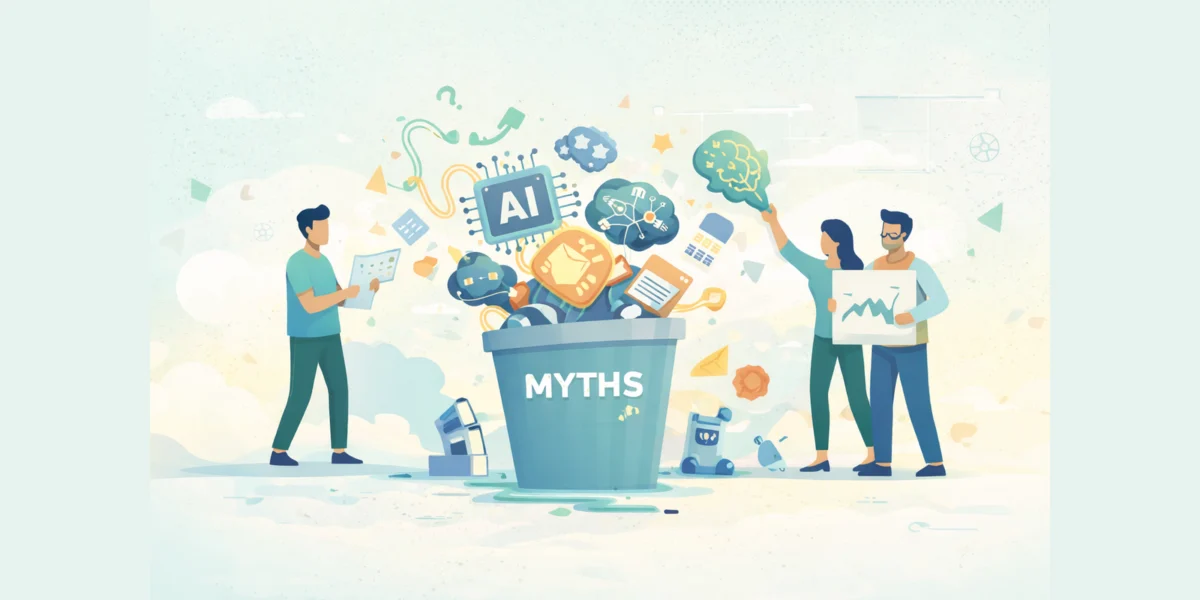
Leading content strategy firms, like Contently, steadfastly champion the inherent value of AI as a potent force multiplier for high-performing teams. When integrated thoughtfully and strategically, AI can dramatically streamline laborious research processes, tighten intricate workflows, and empower content creators to deliver higher-quality output at an accelerated pace. However, this optimism is tempered by a clear-eyed recognition of persistent "marketing myths" surrounding AI’s true capabilities and effective application within content programs. These myths proliferate in an environment where AI marketing advice swings wildly between two extremes: the "hype merchants" who promise effortless transformation, and the "skeptics" who dismiss all AI advancements as fleeting fads. Neither extreme offers practical guidance for the marketing director grappling with real-world implementation challenges on a Monday morning. As the industry progresses into 2025, a critical need for clarity has emerged, demanding a disciplined approach to separate fact from fiction.
Chronology: The Evolution of AI in Marketing
The journey of generative AI in marketing can be broadly traced over the past three years, marking distinct phases of adoption and understanding. Initially, around 2022, the landscape was dominated by fervent anticipation and bold predictions. Early generative AI models captured the imagination, promising to automate content creation entirely, personalize customer experiences at scale, and unlock unprecedented levels of productivity. This period saw a rush of early adopters, eager to gain a competitive edge, often driven by a fear of missing out (FOMO).
The subsequent phase, spanning much of 2023 and 2024, was characterized by widespread experimentation. Marketing departments invested heavily in various AI tools, from content generators and image creators to advanced analytics platforms. Teams explored how AI could assist with brainstorming, drafting social media posts, optimizing ad copy, and even generating video scripts. However, this period also revealed the initial cracks in the "effortless transformation" narrative. Many teams discovered that simply acquiring tools did not equate to efficiency. Instead, they often grappled with integration complexities, inconsistent output quality, and the sheer volume of new processes required to effectively manage AI-generated content.
As we transition into 2025, the industry is entering a more mature, yet also more challenging, phase. The initial hype has begun to recede, replaced by a demand for tangible ROI and practical, scalable solutions. This period is marked by a clear divergence: some organizations, through careful planning and strategic integration, have begun to realize genuine efficiency gains. Others, however, are experiencing mounting frustration, having accumulated a disjointed array of subscriptions without achieving significant operational improvements. Simultaneously, the broader digital landscape has shifted dramatically with the advent of AI-powered search overviews, profoundly impacting traditional SEO strategies and organic traffic patterns. The focus has thus shifted from mere experimentation to disciplined application, demanding a more nuanced understanding of AI’s capabilities and limitations.
Supporting Data and Industry Observations
The claims of efficiency gains often stand in stark contrast to the reality faced by many marketing teams. Industry reports and internal surveys frequently highlight a disconnect. For instance, while some studies project potential productivity boosts of 20-30% for content creation when AI is effectively integrated, a significant portion of teams report only marginal improvements, if any. The primary culprit often cited is "tool sprawl" – the unchecked proliferation of disparate AI solutions that fail to integrate seamlessly into existing workflows. This leads to data silos, increased administrative overhead, and a fragmented user experience, effectively negating any potential efficiency.
The concern regarding the decline in organic traffic and clicks is not anecdotal. Data from reputable analytics firms corroborates this trend. Ahrefs’ seminal 2025 research, for example, paints a stark picture, indicating that AI Overviews—generative answers presented directly within search engine results—have led to a substantial 34.5% reduction in clicks to top-ranking pages. This dramatic shift signals a fundamental change in how users interact with search results and consume information, directly impacting content strategies reliant on traditional click-through rates. This data underscores the urgency for marketers to adapt their strategies beyond mere rankings, focusing instead on visibility within AI-generated responses.
Furthermore, observations from within the industry suggest that the "gap between promise and practical value" often stems from a superficial understanding of AI. Many teams treat AI as a magic bullet rather than a sophisticated tool requiring skilled operation, clear guidelines, and continuous human oversight. This results in generic, uninspired content that fails to resonate with target audiences, leading to wasted resources and a reinforcement of the perception that AI is not living up to its hype. The challenge, therefore, is not merely technological, but also organizational and strategic.
Official Responses and Expert Commentary (Contently’s Perspective)
Contently, a prominent voice in the content marketing sphere, offers a pragmatic and informed perspective on these evolving dynamics. Their official stance, articulated through recent publications and industry dialogues, firmly advocates for AI as a "force multiplier" – a tool that amplifies human talent rather than replacing it. They emphasize that the core issue isn’t AI itself, but rather its misapplication and the propagation of "marketing myths" that obscure its true utility.
According to Contently’s experts, the path to successful AI integration lies in a clear departure from unbridled experimentation towards disciplined, outcome-focused implementation. "This is the year to get that clarity," states a recent Contently article, urging marketers to move beyond theoretical promises and anchor their AI initiatives in measurable business goals. Their recommendations often highlight the need for strategic planning before technology adoption, rigorous training for teams, and a collaborative approach where human expertise remains central to the content creation process. They consistently underscore that while AI can streamline research, optimize outlines, and accelerate first drafts, the critical elements of brand voice, unique perspective, factual accuracy, and persuasive narrative must always be infused by human intelligence.
Contently also directly addresses the evolving SEO landscape, recognizing that the rise of AI Search necessitates a dual strategy. While traditional SEO foundations (technical optimization, backlinks, topical authority) remain crucial, marketers must now also prioritize practices designed for AI visibility. This includes structured data markup, clear entity definitions, and content formats that directly answer user questions, ensuring that content is not only discoverable by search engine algorithms but also digestible and citable by generative AI models. Their overarching message is one of strategic adaptation: embrace AI’s power, but do so with intelligence, intentionality, and an unwavering focus on delivering genuine value to the audience and the business.
Implications for the Future of Marketing
The current state of AI adoption carries profound implications for the future trajectory of marketing departments, content strategy, and digital visibility. The prevailing narrative demands a fundamental shift in mindset, moving away from reactive tool acquisition towards proactive, strategic integration.
For Marketing Teams: The immediate implication is the urgent need for a strategic overhaul of AI adoption. Teams must resist the allure of FOMO-driven decisions and instead focus on identifying specific, high-impact use cases where AI can genuinely remove friction or cost. This requires a rigorous internal audit of existing workflows, pinpointing bottlenecks that AI can realistically address, and then carefully selecting tools that integrate seamlessly. Investment in robust training programs for effective prompting, ethical AI use, and critical evaluation of AI output will become paramount. Furthermore, establishing clear guardrails and governance policies for AI-generated content is crucial to maintain brand consistency, ensure legal compliance, and mitigate data privacy risks. The future marketing team will be a hybrid entity, where human creativity and strategic thinking are augmented, not replaced, by AI’s processing power.
For Content Strategy: The era of content volume for its own sake is rapidly drawing to a close. With AI capable of generating vast quantities of generic text, true performance will increasingly hinge on the uniqueness, expertise, and perspective embedded within content. Marketers must pivot their strategies to prioritize "human-in-the-loop" content creation, where AI handles the foundational work (research, outlines, first drafts) and human editors infuse the distinct brand voice, inject lived experiences, clarify complex arguments, and perform rigorous fact-checking. The emphasis will shift from "publishing more" to "publishing better" – content that resonates deeply, builds trust, and stands out in an increasingly crowded, AI-generated landscape. This also means a renewed focus on niche expertise and authentic storytelling.
For SEO and Digital Visibility: The traditional SEO playbook, while still foundational, is no longer sufficient. The rise of AI Search Overviews fundamentally alters the dynamics of visibility, reducing direct clicks even for top-ranking pages. This implies a critical need for marketers to understand and adapt to how generative AI models discover, synthesize, and present information. Beyond standard keyword optimization and technical SEO, content must be structured for machine readability, rich with clear entity definitions, supported by robust schema markup, and designed to directly answer user questions. The goal is no longer just to rank high, but to be the authoritative source that AI assistants cite in their generated responses. This requires a deeper understanding of semantic SEO and intent-based content creation.
For Technology Vendors: The market will increasingly favor integrated, intelligent platforms over standalone point solutions. Vendors that can offer AI capabilities embedded within existing content management systems, project management tools, and editorial calendars will gain a significant advantage. The focus will shift from simply offering more features to providing seamless workflows and measurable ROI.
For the Future of Marketing Leadership: Leaders must foster a culture of disciplined innovation. This means embracing experimentation but always grounding it in clear objectives, iterative testing, and continuous learning. The ability to discern genuine value from hype, to invest wisely, and to empower teams with the right tools and training will define successful marketing leadership in the years to come. The future of marketing is not about AI or human, but rather AI with human, in a synergistic partnership that elevates both creativity and efficiency.
In essence, the next chapter of AI in marketing is less about boundless experimentation and more about strategic discipline. It’s about leveraging AI where it demonstrably helps, judiciously bypassing it where it doesn’t, and steadfastly anchoring all efforts to tangible outcomes rather than speculative promises. The aspiration for 2026 is a landscape characterized by fewer breathless predictions and an abundance of concrete proof that the work, powered by intelligent human-AI collaboration, is genuinely working.
Ready to build AI workflows that actually help your team accomplish real work? Contently’s AI-assisted content platform combines generative AI efficiency with editorial oversight – so your team accelerates without sacrificing quality or brand safety.
Frequently Asked Questions (FAQs):
How do I know if my team is ready for AI adoption?
Assessing your team’s readiness for AI adoption begins with a thorough evaluation of your current content operations. If your team has well-documented workflows, clear brand guidelines, and consistent publishing processes in place, you are likely in a strong position to pilot AI tools effectively. These foundational elements provide the necessary structure for AI integration. Conversely, if your basic operational processes still feel chaotic, it is advisable to strengthen those foundations before introducing the additional complexity that AI tools can bring. A stable operational environment maximizes the potential for successful AI implementation and minimizes frustration.
What’s the minimum investment needed to see results from AI?
For most marketing teams, the initial investment to see results from AI does not necessarily require significant capital expenditure on new software. Many existing content platforms and marketing suites now include integrated AI features, often at no additional cost or as part of an existing subscription. The most critical investment, however, is time. Expect to dedicate a focused period, typically two to four weeks, to thoroughly train your team on effective prompting techniques, understanding AI outputs, and integrating AI-assisted editing workflows. Budgeting for these initial learning curves is essential, as consistent productivity gains will follow this period of skill development and adaptation.
How should I balance traditional SEO with AI Search optimization?
The most effective approach to navigating the evolving search landscape is to treat traditional SEO and AI Search optimization as complementary strategies. Continue to prioritize fundamental SEO practices: building topical authority, improving technical site performance, optimizing for relevant keywords, and earning high-quality backlinks. These foundational elements remain crucial for overall web presence and credibility. On top of these, layer AI-specific practices: implement structured data markup (such as Schema.org) to provide clear context to AI models, define entities clearly within your content, and develop content formats that directly answer user questions. This dual strategy ensures your content is discoverable and ranks well in traditional search, while also being digestible, citable, and visible within AI-generated responses.