For decades, the B2B media buying industry has operated on a foundation of "trust me" economics. A company signs a contract, wires a substantial sum, and waits for a campaign to "run." Sixty days later, they receive a static PDF—a report containing high-level impression counts and vague engagement metrics—with no granular way to verify the data. Was the ad actually seen by a decision-maker? Or was it lost in a sea of programmatic noise, served to bots and low-level interns?
At SaaStr AI, that era of opaque reporting is officially over. By integrating AI-driven, real-time analytics into the core of their advertising platform, the organization is shifting the power dynamic from the media owner to the sponsor. The result is a transparent, data-backed ecosystem where performance isn’t guessed; it is measured, reconciled, and audited in real-time.
The Chronology of a Shift: From PDFs to AI-Powered Dashboards
The transition began with a realization that the traditional B2B marketing funnel was broken. Advertisers were tired of waiting for end-of-quarter reports that arrived too late to allow for optimization.
SaaStr AI introduced "10K," an AI-powered VP of Marketing, to bridge the gap between ad deployment and actionable insight. Unlike legacy systems that rely on human-generated monthly reports, 10K monitors campaigns in real-time. It tracks every send, every click, and every conversion, providing sponsors with a live, interactive dashboard.
The chronology of this shift represents a departure from batch processing to continuous, real-time accountability. When a sponsor partners with SaaStr AI today, they no longer look at a static image of their progress; they look at a live stream of their campaign’s impact. This allows for mid-campaign pivots, iterative improvements, and an immediate understanding of what resonates with the audience—a luxury previously unavailable in high-end B2B media buys.
Supporting Data: Proof in the Numbers
The efficiency of this model was recently demonstrated through a case study involving a repeat sponsor. Over the course of 67 distinct newsletter editions, the campaign was subjected to rigorous, AI-led monitoring.
The raw data is compelling: 5.4 million impressions were delivered. However, in the context of B2B, raw impressions are often dismissed as "vanity metrics." The true value lies in the downstream effect. The campaign successfully funneled 11,749 qualified B2B buyers directly to the sponsor’s signup form.
This is not a story of high-volume, low-intent traffic. It is a story of high-intent conversion. When 11,749 decision-makers—not passive browsers—actively engage with a sign-up form, the value of the impression changes. It becomes a lead, and eventually, a closed deal. This level of attribution is the hallmark of the new SaaStr AI model, proving that when you align the audience with the content, the metrics stop being just "numbers" and start being business outcomes.
Official Insight: Who is Actually Behind the Screen?
A major criticism of modern media is the "who" behind the "clicks." SaaStr AI addresses this by leveraging its unique position in the B2B ecosystem. Because SaaStr also hosts the massive SaaStr Annual event, the organization possesses a verified, human-confirmed database of its audience.
The people reading the newsletter are the same individuals walking the floors of their events. By cross-referencing digital engagement data with physical event registration, SaaStr AI provides a clear, undeniable profile of their readers:
- Seniority: The audience is dominated by Founders, CROs, CMOs, and VPs of Sales. These are not entry-level employees; these are the individuals who possess budget authority.
- The Peer-to-Peer Dynamic: Every conversation facilitated by the platform is essentially peer-to-peer. It is high-level operators speaking to high-level operators.
- The Shift to AI: The functional breakdown of the audience shows a sector in the midst of a massive, AI-driven transformation, with builders and buyers increasingly merging into a single, cohesive demographic.
The data reveals that the person opening the email is, more often than not, the person who holds the power to sign the contract. This alignment is what separates a generic media buy from a high-performance, conversion-driven investment.
The Distribution Engine: A Multi-Channel Approach
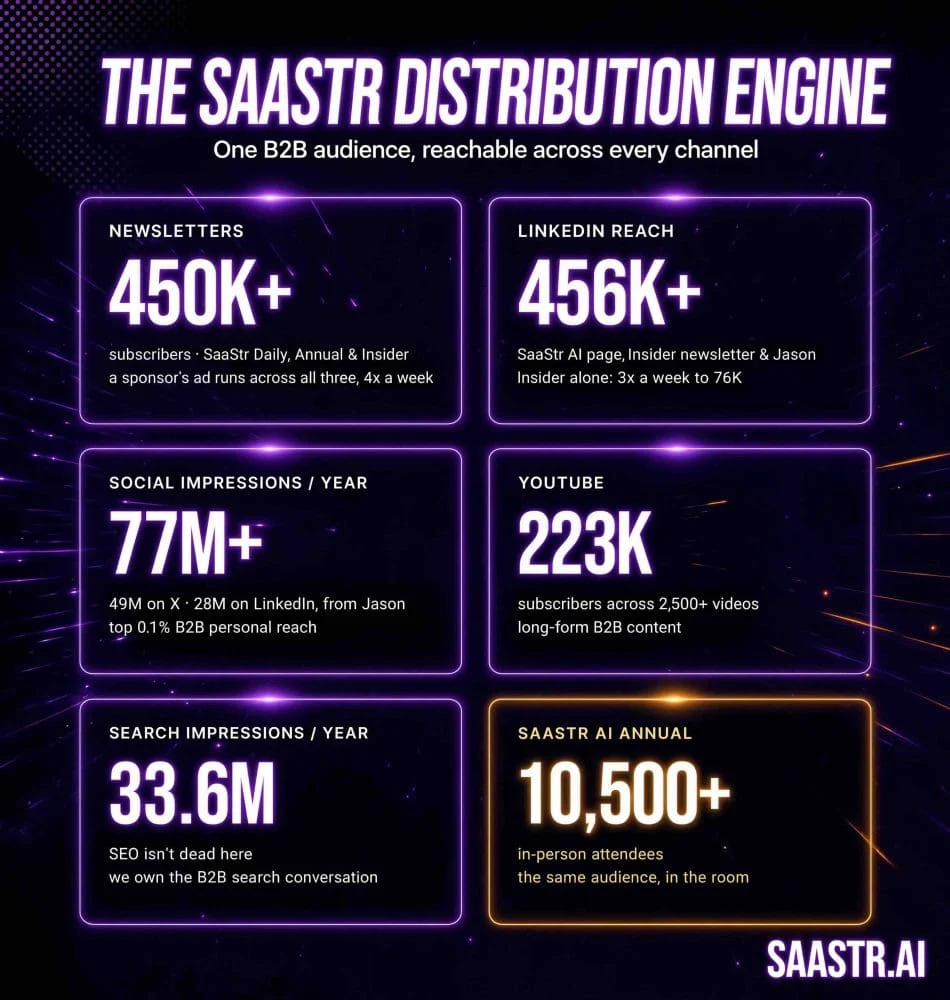
The effectiveness of this model is built upon a multi-channel distribution engine designed to meet the B2B operator where they live. The SaaStr ecosystem is not a singular point of contact; it is a synchronized network:
- Newsletters: Delivering consistent, high-value insights to the inbox of the decision-maker.
- LinkedIn: Maintaining a constant presence in the daily social feed.
- YouTube: Providing deep-dive, long-form content for technical and strategic education.
- SaaStr Annual: The physical manifestation of the community, where digital relationships are solidified into human ones.
The implication here is profound: a single ad seen once is easily forgotten. A brand that shows up across all these channels—all quarter long—builds memory, trust, and eventually, preference. The engine ensures that by the time a prospect hits a sign-up form, they have already been primed by weeks of relevant, high-quality exposure.
Implications for the Future of B2B Marketing
The move toward total transparency has significant implications for the wider B2B marketing industry.
1. The Death of the "Trust Me" Report
For years, media companies have protected their numbers because they often failed to survive scrutiny. By offering reconciled data and per-send attribution, SaaStr AI is setting a new standard. Transparency is no longer a perk; it is becoming the product itself.
2. The Rise of the AI-First Marketer
With tools like "10K" tracking performance, the role of the marketer is shifting from manual data entry and reporting to strategy and optimization. When both the buyer and the seller are looking at the same live, AI-verified dashboard, the relationship changes from a vendor-client transaction to a partnership. If a campaign is underperforming, both parties see it immediately and can act to correct it. If it is succeeding, the data provides the justification for scaling.
3. Tangible ROI vs. Theoretical Impressions
The success of sponsors like Artisan—which closed over $250K on-site and over $1M in the months following—and Monaco—which sourced deals in under three weeks—provides the ultimate proof. These are not theoretical successes; they are measurable, repeatable revenue events. The fact that these companies have renewed their sponsorships multiple times is the single most honest metric in the industry: you cannot fake a renewal.
Conclusion: A New Standard of Partnership
Transparency is the ultimate competitive advantage. By removing the "black box" of media buying, SaaStr AI is forcing the industry to be better. They are proving that when you treat your advertisers as partners and provide them with the tools to verify their ROI, they don’t just buy once—they stay for the long term.
For any company currently wasting budget on opaque, low-conversion media buys, the message is clear: the era of the static, unverified report is over. The future of B2B marketing is real-time, AI-monitored, and fully transparent. If you are looking to get your product in front of the people who actually sign the checks, the path forward is through a platform that has nothing to hide.