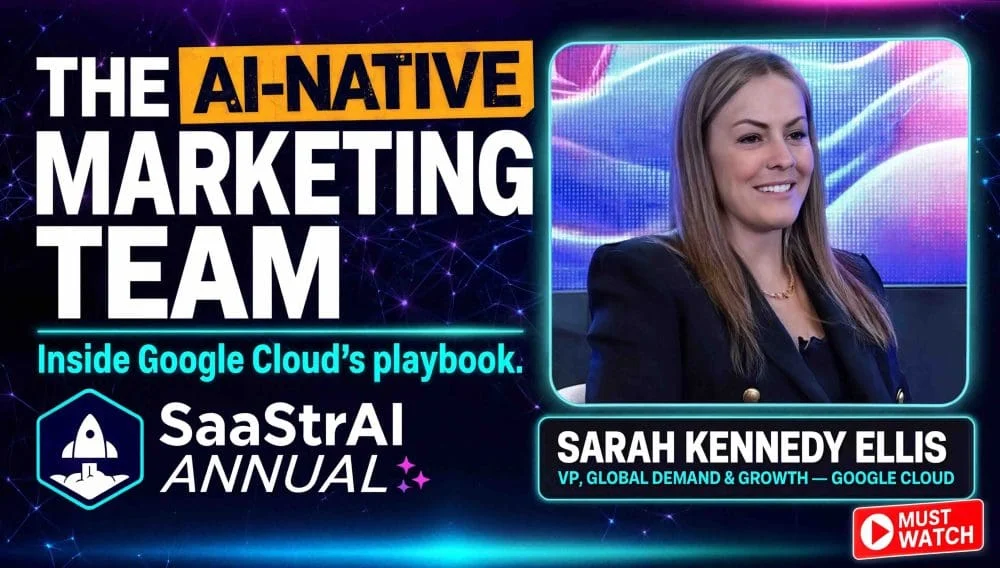
At SaaStr AI 2026, Sarah Kennedy Ellis, VP of Global Demand & Growth at Google Cloud, took the stage to pull back the curtain on a transformation occurring within the heart of one of the world’s most influential tech giants. With a pedigree that includes leadership roles at Marketo and Adobe, Ellis has navigated numerous platform shifts. However, her current mandate at Google is distinct: transforming the marketing organization into "Customer Zero" for AI.
Rather than relying on polished, superficial demos, Google is stress-testing its own AI agents in the trenches of day-to-day operations. By feeding system failures back into product development, Google Cloud is not just building AI—it is pioneering a blueprint for how global enterprises should operate in an agent-led future.
Main Facts: The "Customer Zero" Strategy
The core thesis of Ellis’s presentation is that the era of "AI as a toy" is over. For Google Cloud, AI is a foundational operational layer. The company’s goal is to become the primary testing ground for every AI application in marketing.
The strategy is rooted in a fundamental shift: moving away from task-based automation toward end-to-end agentic workflows. By treating agents as digital employees—requiring onboarding, context, and iterative training—Google has moved from theoretical efficiency to tangible, scalable growth. Whether a team consists of five marketers or five thousand, the principles of this transition remain the same.
Chronology: From Experimentation to Execution
To understand how Google Cloud reached its current state of agentic maturity, one must look at the timeline of its internal deployment:
- Phase 1: The "Thousand Flowers" Period (Months 0–18): Google encouraged unrestricted experimentation. Marketing teams were empowered to build agents for any task, resulting in a proliferation of tools. This phase was critical for uncovering diverse use cases and building internal cultural buy-in.
- Phase 2: The Governance Pivot: As the number of agents ballooned, the focus shifted toward curation. Instead of stifling creativity, Google implemented shared infrastructure, allowing an agent built by the Chrome team to be repurposed by the Cloud team.
- Phase 3: The "Impossible" Projects (The Present): The most recent benchmark is the opening video for Google Cloud Next. Three weeks before the event, the team scrapped their original plan and rebuilt it using internal agents. This project, which would have been impossible a year ago due to technical limitations (such as resolution upscaling), was completed internally without external agency support, showcasing the speed of current AI maturation.
Supporting Data: Efficiency and Quality at Scale
The most compelling evidence for this transformation lies in the metrics. During the launch of Gemini in Chrome, Google Cloud achieved a 70% reduction in production time for thousands of creative assets.
Crucially, this speed did not come at the expense of quality. In fact, conversion rates increased. This contradicts the traditional "fast, cheap, good—pick two" paradigm. By utilizing AI to achieve hyper-personalization at scale, the team was able to provide content that was more relevant to the individual user than anything previously possible.
The lesson here is simple: When humans provide the judgment and AI provides the scale, output quality improves alongside volume.
Official Insights: The 8 Pillars of Adoption
Ellis outlined eight key takeaways for leaders looking to implement AI effectively:
1. Friction, Not Intelligence, is the Blocker
The primary inhibitor to AI adoption is not the quality of the model; it is the friction in existing workflows. Teams that prioritize change management and training see immediate productivity gains, while teams waiting for "smarter" models remain stagnant.
2. The Learning Correlation
There is a direct link between training and productivity. The top 20% of AI adopters within Google Cloud are also those who have invested the most time in deliberate skill-building. Adoption cannot be "bought" via licenses; it must be "earned" through education.
3. The Five-Minute Training Rule
Time is the scarcest resource. Google’s "AI Boost Bites"—short, 2–7 minute videos—acknowledge the reality of a busy marketer’s schedule. If training cannot fit into the gaps of a work week, it will not happen.
4. High-Volume, Low-Judgment Tasks
AI agents perform best in areas where high-volume output is required but the necessity for human subjective judgment is limited. This is where agents truly "earn their keep."
5. The "Impossible" Becomes Routine
The technical walls that seemed insurmountable 12 months ago—such as upscaling 4K content to 12K for massive event screens—are now being breached. Organizations must be prepared to revisit "impossible" projects every quarter.
6. Hiring for Curiosity and Creation
Ellis’s hiring philosophy has shifted. She now asks candidates: "Tell me what you built." She looks for individuals who have personally constructed agents, as this signals a deep-seated curiosity and the ability to operate in an agent-first environment.
7. The Blurring of Sales and Marketing
Agents naturally align with "outcomes" rather than "functional boundaries." By adopting agentic workflows, the historic divide between sales and marketing is collapsing, forcing a unified focus on revenue-generating activities.
8. Onboarding Agents Like Humans
The most significant mindset shift is the treatment of an agent as an employee. They require context, clear objectives, and onboarding. The value of a marketer is shifting from creating the output to designing the input and context that enables the agent to succeed.
Implications: The Future of the Enterprise
The broader implication of Google Cloud’s experience is a fundamental change in organizational structure.
Governance Without Stifling
The "thousand flowers" approach is necessary for innovation, but it eventually creates a "governance problem." The solution is not to clamp down on usage but to invest in shared infrastructure. When agents are built on a centralized platform (like Gemini Enterprise), the organization benefits from a compounding library of reusable assets.
The New Competitive Advantage
The ultimate takeaway is that the "next generation" of marketing is not about choosing between AI or human labor—it is about the orchestration of both. The organizations that win in 2026 and beyond will be those that view their resume not as a list of jobs held, but as a collection of agents built and deployed.
As Ellis concluded, the premium skill for the modern marketer is no longer just the ability to write copy or design a campaign; it is the ability to architect the workflows that allow agents to operate independently.
For founders and leaders, the message is clear: if you are wondering why your team isn’t using AI, stop blaming the tools. Start examining your workflow friction, shorten your training cycles, and begin hiring for builders. The era of the agent-led organization is no longer on the horizon—it is here, and it is moving at the speed of code.